

It was late in the evening on December 11 in Sofia. The air was crisp, the kind that makes people stand closer together, breathe heavier, and feel more intensely. As I moved toward the Triangle—the symbolic heart of Bulgaria’s political power—the roar of the crowd was already unmistakable. It was the sound of frustration built up over decades of failed policies, broken promises, and shattered expectations. But it was also the sound of hope. The sound of a people mustering the courage to say: Enough is enough.
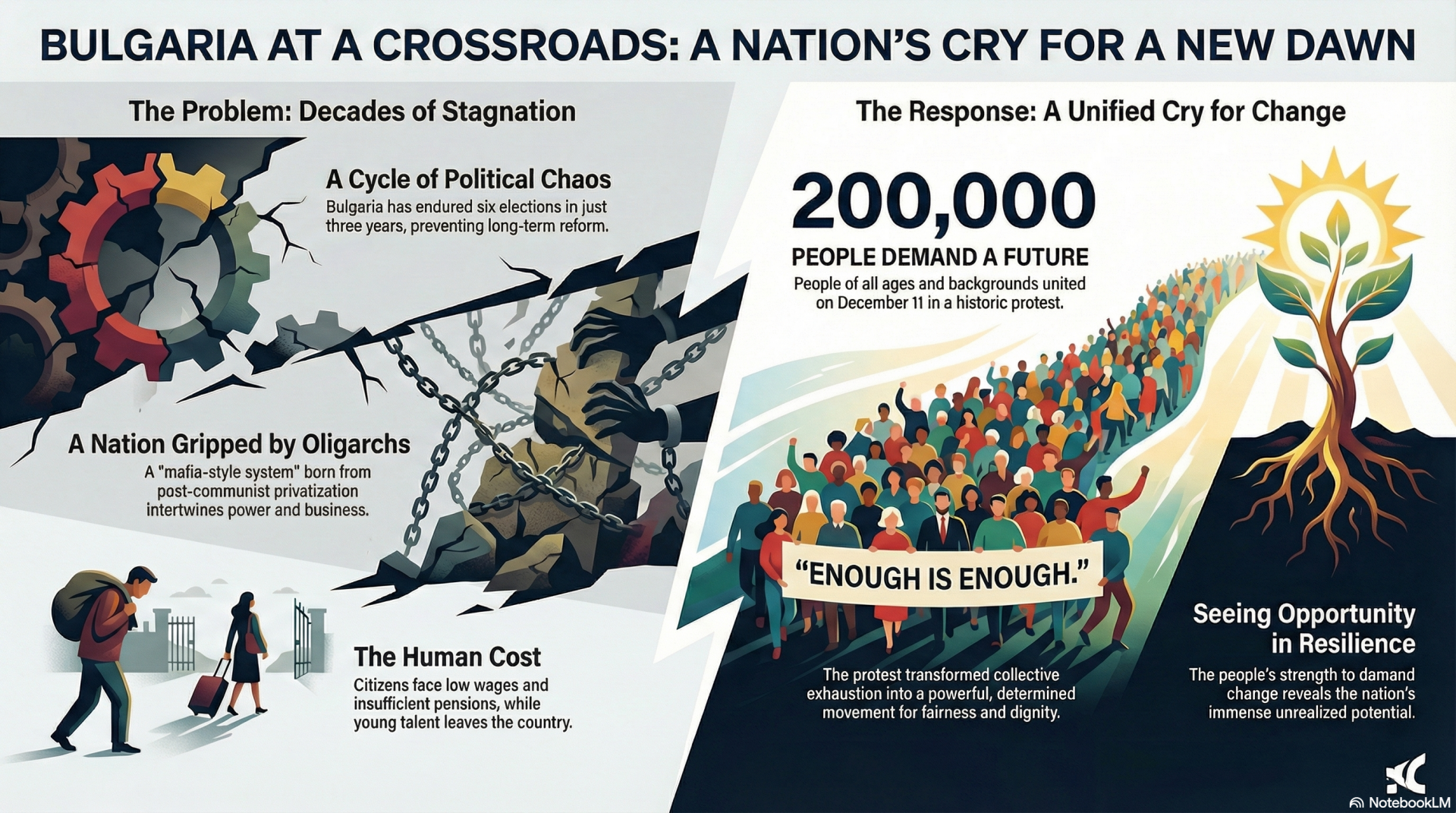
According to Bulgarian media, up to 200,000 people filled the streets to protest. People of all ages—young and old, workers and academics, parents and pensioners—stood united against long-standing corruption, political chaos, repeated elections, a contested national budget, and what many openly describe as a mafia-style system of governance.
Earlier that same day, before I found myself in the middle of this historic moment, I was interviewed by one of the country’s largest media outlets. They asked me a simple but profound question: “What do you see in Bulgaria?”
My answer came without hesitation: “I see opportunities.”
I didn’t say it as a compliment or an empty phrase. I said it because it is true. Beneath the surface of political turmoil lies a nation with immense unrealized potential—driven by a people who refuse to give up.
And on December 11, that energy was impossible to ignore.

A Nation Tired of Starting Over—Election After Election
Bulgaria has gone through six elections in three years. No democracy can thrive under such instability. Constant resets prevent long-term reforms, discourage investment, and drain public trust.
During the protests, several people told me the same thing: “We are tired of standing in the same crossroads.”
Every election cycle promises progress, yet the outcome often feels like circling back to the beginning.
The political system has long balanced between democratic aspiration and oligarchic influence. Governments rise and fall, coalitions form and collapse, but everyday life remains a struggle. Wages stay low, pensions insufficient, and young talent continues to leave the country in search of a future elsewhere. Yet on December 11, everything felt different. A collective exhaustion had transformed into determination. It was as if an entire nation rose to say: We are taking back our country.
The Oligarchs Who Gripped the Nation
The protests cannot be understood without the backdrop of the post-communist transition. The chaotic privatization of the 1990s created a small circle of oligarchs who seized vast assets, concentrated wealth, manipulated political actors, and built empires on corruption and silence.
For decades, Bulgarians have lived in a system where power and business are intertwined. In that sense, when people say “the mafia runs the country”, it is not a metaphor—it reflects a lived reality.
The demonstrations on December 11 were not simply reactions to one government or one budget. They were the eruption of accumulated frustration from a population that has endured too much for too long.
The Triangle – A Stage for Power, Protest, and Change
The Triangle in central Sofia is more than a public square—it is a symbol. A crossroads of history, power, and hope.
On this December evening, the square came alive. Mobile screens lit the air, chants echoed against the stone buildings, and homemade signs waved above the crowd. There was electricity in the atmosphere, the kind that emerges when tens of thousands share the same purpose.
What struck me most was the unity. Despite differences in age, background, or profession, people stood shoulder to shoulder. It was a reminder that Bulgaria’s strength does not lie in its institutions, which have too often failed its people, but in its citizens.
A nation that has survived empires, dictatorships, economic collapse, and systemic corruption carries within it a deep and unshakeable resilience.
A New Dawn? Or Just Another Battle?
The question now is what comes next.
With protests continuing and pressure mounting, Bulgaria faces two possible paths. The first is yet another election, more instability, and more lost time. The second is the beginning of a genuine transformation—where public demands force political renewal, where corruption is not tolerated, and where leadership emerges from responsibility rather than entitlement.
Standing among the crowd, the sense of possibility was real. Not naive optimism, but grounded conviction. People were not asking for miracles; they were demanding fairness, dignity, and accountability.
And that aligns perfectly with what I said earlier in my interview:
Bulgaria is full of opportunities—not because things are easy here, but because people have the strength to change them.
A Foreign Perspective—And Deep Respect
As a Swede, many expect me to see Bulgaria through old stereotypes: a poorer Eastern European country, underdeveloped and struggling. But after living here, witnessing the energy of Sofia’s streets, and meeting the people who shape this country daily, I see something entirely different.
I see creativity.
I see innovation.
I see courage.
I see opportunity—in every conversation, every initiative, every act of resistance.
And Bulgarians are often equally surprised when I describe the decline in Sweden: the erosion of stability, the shrinking welfare system, the uncertainty that now defines everyday life. Both countries mirror each other more than people think.
What I saw in Sofia that night was a population refusing to be defined by the past.
The People Deserve Better—And They Know It
As the night deepened and the streetlights reflected in the wet pavement, the crowd remained. They stayed not because they expected immediate results, but because they understood the importance of standing together.
Bulgarians deserve better than oligarchic rule.
They deserve better than political chaos.
They deserve a future where work pays off, institutions function, and justice is real and accessible.
That is why my answer to the journalist was so simple—and so true:
“I see opportunities.”
Opportunities for change, for renewal, for growth.
The End of an Era – The Beginning of Another?
Walking away from the Triangle that night, I felt as though I had witnessed the close of an old chapter and the beginning of a new one. A chapter written not by politicians or oligarchs but by ordinary citizens who refuse to accept less than they deserve.
Bulgaria now stands at one of the most critical crossroads in its modern history. And if December 11 proved anything, it is that the people are ready.
Ready to push back.
Ready to rebuild.
Ready to seize the opportunities that lie ahead.
Perhaps this night was not only a protest.
Perhaps it was the dawn of the Bulgaria its people have been waiting for.

By Chris...
Sofia - Bulgaria 11 dec 2025
Add comment
Comments