

The story of the amplifier every guitarist wanted
There are moments in music history when everything changes. Not slowly, not gradually—but like an explosion. One such moment did not come from a guitar. Not from a singer. But from an amplifier.
Marshall.
A name that became more than a brand—it became a symbol. A promise. A sound.
And perhaps most importantly—a revolution.
A Drummer Who Changed the Guitar World
It doesn’t begin with a guitarist.
It begins with a drummer.
Jim Marshall was not even a guitar player. He was a drummer, a teacher, and an entrepreneur in West London. In the early 1960s, he ran a music shop where young, hungry guitarists gathered—not just to buy, but to dream.
They had a problem.
The American amplifiers, mainly from Fender, were good. But they were expensive. And more importantly—they weren’t aggressive enough. Not loud enough. Not… dangerous enough.
Guitarists wanted something else.
They wanted more.
And they turned to Jim Marshall.
A Sound Is Born in a Shed
What happened next has almost become mythology.
At a time when innovation today often happens in billion-dollar companies, the Marshall sound was born in something as simple as a small workshop behind a shop. A tiny team began experimenting with components, circuits, and speakers.
The result was the first amplifier:
JTM45.
It was inspired by existing designs—but it was altered. Tweaked. Pushed in just the right way.
It had something new.
A bite.
A midrange punch that cut through everything.
It was the beginning of what we now call:
The Marshall Sound.
The Guitarists Who Shaped the Machine
This is what makes the story unique.
Marshall didn’t create the product alone.
The guitarists were co-creators.
Pete Townshend of The Who was one of the first to push development. He wanted something bigger. Louder. Something that could fill arenas.
And Marshall listened.
Soon, others followed:
Jimi Hendrix.
Eric Clapton.
Jimmy Page.
They used Marshall—but they also pushed it.
They turned the volume up until the amp began to break up. Distortion, once considered a flaw, suddenly became expression.
A language.
From Combo to Stack – A Visual Revolution
Marshall didn’t just change the sound.
They changed the stage.
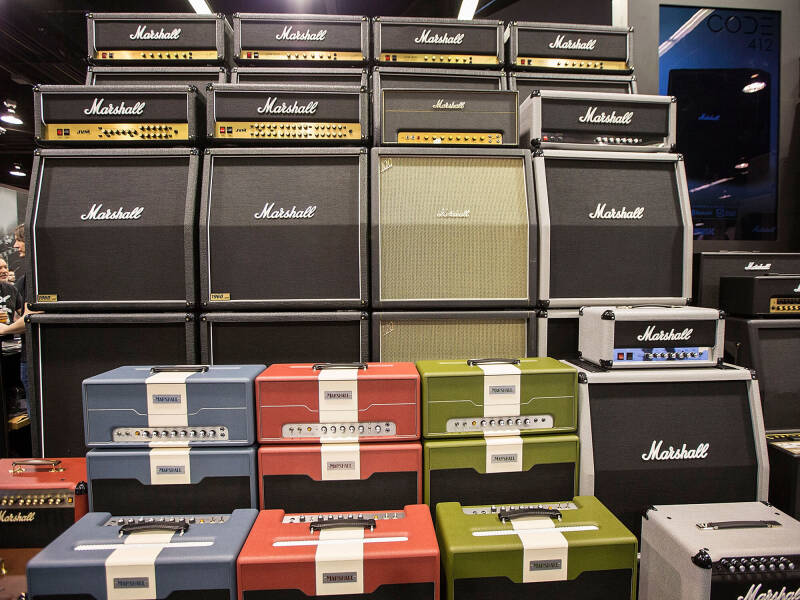
The classic Marshall stack—a head sitting on top of multiple speaker cabinets—became more than equipment.
It became a monument.
A wall of sound.
A visual symbol of power.
Rock music suddenly had physical presence. Weight. Identity.
And the audience felt it.
Not just in their ears—but in their bodies.
The Plexi Era – When Volume Became Religion
By the mid-1960s, the legendary 100-watt amplifiers arrived.
They were loud. Brutal. Unforgiving.
And perfect.
These were not just amplifiers.
They were weapons.
This was when rock moved from clubs to arenas.
From music to experience.
Bluesbreaker – The Tone That Changed Everything
When Eric Clapton plugged his Les Paul into a Marshall Bluesbreaker, something extraordinary happened.
A warm, creamy overdriven tone that would define British blues-rock.
It wasn’t just sound.
It was emotion.
Marshall and the DNA of Rock
There is a reason almost every iconic rock image includes a Marshall amp.
Because Marshall wasn’t just a tool.
It was identity.
From the revolution of the 1960s to the explosion of the 1970s:
Hendrix at Monterey.
Led Zeppelin on tour.
Deep Purple at full volume.
Marshall was there.
Always.
The 1980s – Gain, Metal, and the JCM800
As music evolved, so did Marshall.
In the early 1980s came the JCM800.
More gain.
More attack.
More control.
Bands like Guns N’ Roses, Metallica, and Megadeth built their sound on it.
Marshall was no longer just rock.
It became power.
Aggression.
Precision.
Why Every Guitarist Wanted a Marshall
It wasn’t just about sound.
It was about feeling.
Marshall gave the guitarist:
A voice that could be heard.
A presence that could be felt.
An identity on stage.
It cut through the mix.
It responded to every touch.
It made the guitar alive.
And that’s why guitarists didn’t just want a Marshall.
They needed one.
The Technology Behind the Magic
What made Marshall unique wasn’t just design.
It was the choices.
Tube amplification.
Celestion speakers.
A mid-focused EQ.
A simple yet powerful construction.
The result was a sound that was:
Aggressive.
Dynamic.
Organic.
And above all:
Honest.
From Stage Gear to Cultural Icon
Marshall quickly became more than a company.
It became culture.
A Marshall on stage meant something.
It signaled:
Rock.
Authenticity.
Attitude.
It wasn’t just what the audience heard.
It was what they saw.
A Legacy That Still Lives
Despite digital amps, plugins, and modeling technology, Marshall remains.
Why?
Because there is something in analog.
Something in tubes.
Something in vibration.
That cannot be fully replicated.
Marshall didn’t just build amplifiers.
They built a feeling.
From London to the World
From a small shop in London to the biggest stages in the world.
Marshall changed music.
And more importantly:
They changed how we experience it.
Not just as something we hear.
But as something we feel.
An Ending That Never Really Came
There’s an interesting paradox.
Marshall was never meant to become iconic.
It was a solution to a problem.
But sometimes, it is exactly there—in the need, in the frustration, in the search for “just a little more”—that the greatest innovations are born.
And Marshall was exactly that.
A little more.
A little louder.
A little more dangerous.
Epilogue – The Sound That Never Stops
Think about it.
Every time a guitar roars through a Marshall.
Every time a stage vibrates.
Every time the audience feels the sound in their chest.
You’re not just hearing music.
You’re hearing history.
A drummer in London.
A small workshop.
The beginning of something that never really ended.

By Chris...
The History of Jim Marshall | Father Of Loud Day | Marshall
Lets take a look back at the history of the Father of Loud and the music legacy that lives on today.