

About the wall I built in Bulgaria – and why every project requires patience, persistence and the courage to rethink
When a wall becomes more than a wall
I am Swedish, and I built a wall in Bulgaria. It sounds simple when you say it like that, almost like a practical point on a list: build wall, install door frame, hang door, done. But anyone who has ever built something themselves knows that it is never that simple. What looks on paper like a few straight lines, a few measurements and a few screws becomes something completely different in reality. It becomes dust, thoughts, small mistakes, adjustments and moments when you stand quietly staring at what you have done and think: no, I need to rethink this. And perhaps that is where the real story begins. Not when the wall was finished, but when I understood that I had to let it take the time it needed.
The vision is simple – execution reveals us
I had decided to build a wall and install a door. A room would get a new shape. A place would change. It would not only be a practical solution, but also a way of creating order, feeling and function. I could see in front of me how it would look when everything was finished, how the door would sit there, how the room would feel different and how the world, in some strange way, would look a little newer when I stood inside afterwards. But the vision is always simple in the beginning. It is the execution that reveals us.
The door does not lie
A door is merciless. It does not care that you have good intentions, that you have thought things through, or that you are stubborn. It asks only one question: am I sitting right? If the answer is no, you notice it immediately. It scrapes, it leaves gaps, it does not close the way it should. It reminds you every time you use it that something went wrong. And that is exactly why this door became more than just a door to me. It became a teacher.
I stood here in Bulgaria, with my Swedish habits and my Nordic desire to make things straight, clean and well thought out. But I was not in Sweden. I was in another country, with other materials, other rhythms and other ways of solving things. Here, sometimes, you have to understand by trying, asking, looking and feeling your way forward. That does not make it worse, but it makes it different. And when you build in another country, you are not only building with wood, screws and plasterboard. You are also building with adaptation.
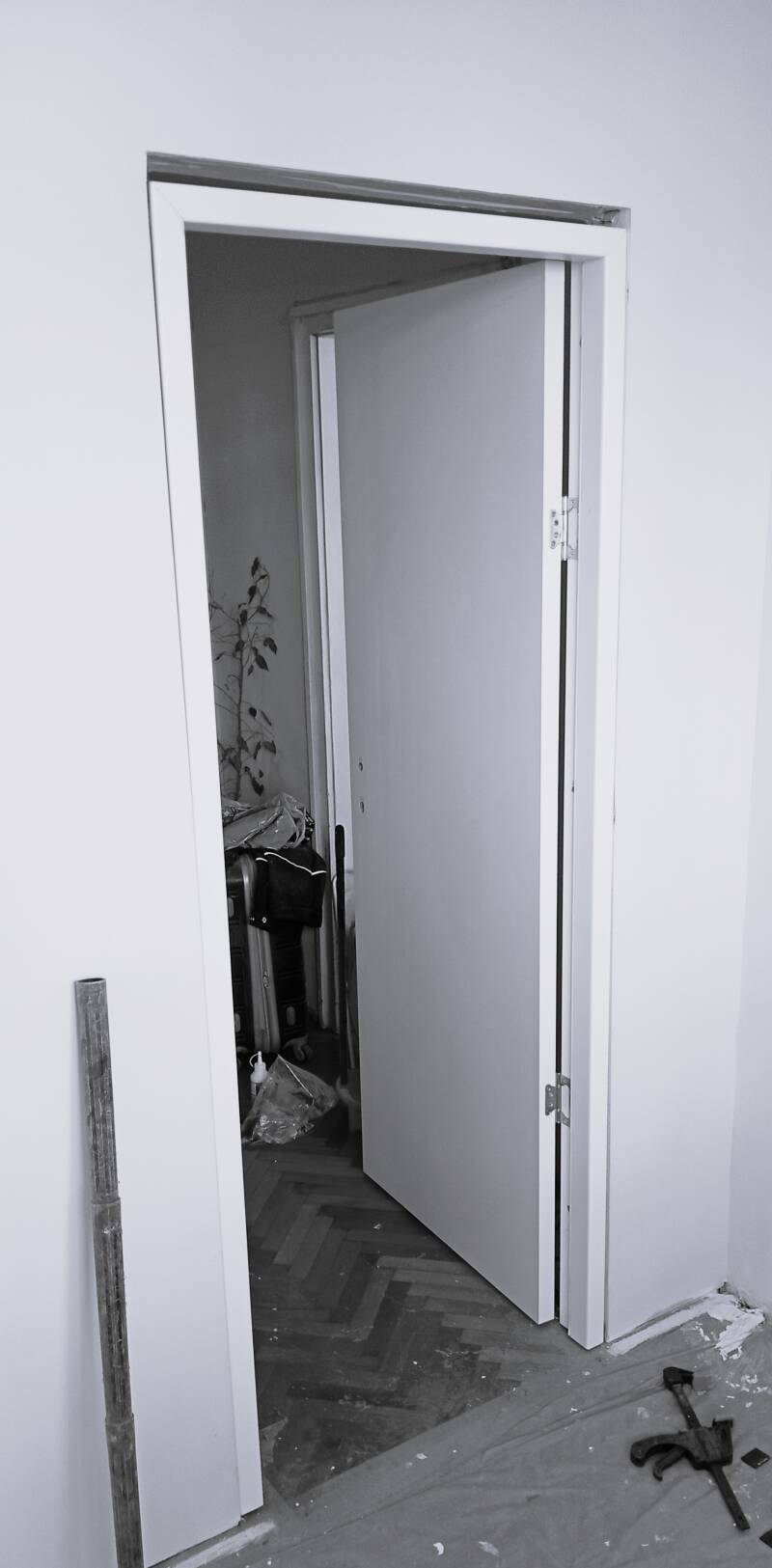
The slow work of getting it right
It was tough to do it myself. Not because I did not believe I could manage it, but because every project that is worth something requires more than confidence. It requires endurance. It requires being able to stand alone in the process without losing direction. It requires daring to continue even when you do not get that quick confirmation from someone else. No one stands beside you applauding when you measure for the third time. No one hands you a diploma when you adjust a door frame by a few millimetres. No one sees those small moments when you swallow your frustration and choose to do it right instead of just getting it done. But you know. And perhaps that is the most important confirmation of all.
I let the wall and the door take the time they needed. Not because I had unlimited time, but because I know that what is meant to last cannot always be rushed. There is a difference between being slow and being careful. There is a difference between hesitating and thinking. There is a difference between postponing and allowing a process to mature into the right decision. That is a difference many people forget in entrepreneurship.
We live in a world where everything is supposed to move fast. Ideas are supposed to become projects, projects are supposed to become companies, companies are supposed to grow, people are supposed to deliver, results are supposed to be displayed, communicated, packaged, launched and preferably measured before anyone has even had time to feel whether the construction actually holds. But a door does not work like that. A door immediately reveals whether you have only tried to look successful. And eventually, a business does the same thing. It may look good from the outside, with a nice façade, a good name, a professional presentation and beautiful words. But sooner or later someone has to open the door. Someone has to use what you have built. Someone has to feel whether it works in reality. That is when the truth arrives.
I have learned through life that the best projects are not always the ones that move the fastest. The best projects are the ones that meet the right kind of resistance. The ones that force you to stop, look, rethink, take a step back and redo. Not because the project has failed, but because you are beginning to understand it better. It is a strange thing: sometimes you have to move backwards in order to move forward properly. When I built the wall, it happened several times. I had to stop and just look. Not do anything. Not continue just for the sake of being productive. Just stand there and let my eyes read the room. Is this right? Does this line feel right? Will the door work? Have I thought about how the room will actually be used?
That pause is important. In many projects, it is precisely the pause that saves the result. But pauses do not look productive. To someone watching from the outside, it may seem as if nothing is happening. But inside your head, everything is happening. You sort, weigh, look again and begin to understand the difference between what you wanted to do and what the project actually needs. That is where experience comes in. A younger version of me might have pushed on, wanted to finish, wanted to see results and wanted that feeling of something being completed. But I have lived long enough to know that “almost finished” can be a dangerous place. That is often where you cut corners, where you think it is good enough, where you leave small faults that later become big irritations.
Entrepreneurship, dust and decisions
So I took the time. I measured, adjusted, thought, redid things and tried to listen to the room rather than to my own impatience. And slowly the wall began to become a wall. The door frame came into place. The door began to find its position. What had first only existed in my head began to stand there in front of me. It is always a special moment when an idea becomes physical. When something you have thought about, imagined and carried inside you suddenly exists outside your body. Then your relationship to the project changes. It is no longer just a plan. It is reality. It requires responsibility.
That is also how entrepreneurship works. An idea is free as long as it only exists inside your head. There it can be perfect, simple and without resistance. But as soon as you start building it, it meets the world: people, money, timing, technology, communication, material, rules and emotions. That is when you find out whether you truly want it. Not whether you like the idea, but whether you are prepared to do the work. I think that is where many people fall. They love the vision but cannot handle the construction. They want the door, but not the work of fitting the frame. They want the room, but not the dust. They want the result, but not all the small decisions the result requires.
But success lives precisely in those small decisions. Not in the grand gesture, not in the dramatic moment, but in the choice to unscrew something and fit it again, in the choice to wait for a moment, in the choice not to cheat with something no one else might even notice, but that you yourself would know. That is where pride is born. Not the loud pride that needs to be displayed, but the quiet pride that comes when you stand in a room and know: I did this properly.
When the wall finally stood there and the door worked, the feeling was hard to describe. It was not only relief and not only joy. It was something deeper, a kind of quiet victory. I stood in the beautiful room and looked out over what had become. And the world felt new. Perhaps because the room really was new. But perhaps also because I had become a little new through the process.
Every project that demands something from us changes us. We enter it with an image of what we are going to do, but we come out with an image of who we are when things become difficult. That is why practical projects can become so powerful. They are honest. They do not allow us to hide behind words. The wall asked me: are you careful? The door asked me: do you have patience? The room asked me: are you willing to redo it until it works? And I did not answer with a theory. I answered by continuing.
That may be the simplest definition of entrepreneurship I know: to answer by continuing. Not blindly, not recklessly and not without reflection, but with a combination of persistence and sensitivity. To hold on to the goal while being prepared to change the way you get there. To understand that a no from reality does not always mean stop. Sometimes it means: try in a better way.
The next room is waiting
I think about all the walls we meet in life. The financial walls, the social walls, the cultural walls, the age walls, the language walls and the invisible walls that other people or systems place in front of us and that say: this far, but no further. But a wall does not always have to be the end. Sometimes it is simply the place where a door has not yet been built.
I like that thought. Because it does not make the resistance less real, but it makes the human being less powerless. It does not say that everything is easy, that everything moves quickly or that the world bends for the person who wants something badly enough. But it says that sometimes it is possible to create an opening with patience, knowledge, persistence, hands in the work and the courage to step back and start again.
And perhaps that is exactly why the door means even more now. Because it is not the end of anything. It is the beginning of the next step. Soon it will be time to take on the kitchen. The floor will get tiles. New kitchen cabinets will be put in place. A new room will be built up, bit by bit, decision by decision, mistake by mistake and victory by victory. If the wall and the door were a first test of patience, precision and persistence, the kitchen will be the next chapter.
A kitchen is something different from a wall. It is the workplace of the home. It is where everyday life happens. Where coffee is made, where dinners grow, where conversations begin and where family life often gathers without anyone really planning it. Renovating a kitchen is therefore not only about tiles, cabinets, cupboards and measurements. It is about creating a place where life is supposed to work. Where movements should feel natural. Where every door, every drawer, every worktop and every centimetre will eventually matter.
And I already know that it will not be simple. A tiled floor does not forgive carelessness. Kitchen cabinets require accuracy. Walls and corners in old buildings are rarely as straight as one hopes. Nothing will be exactly as on a drawing. Something will need to be adjusted. Something will need to be rethought. Something will certainly take longer than I first believed. But that is also where I recognise myself.
Because after the door, I know something I may have needed to be reminded of: I can handle the process. I do not need to have all the answers from the beginning. I do not need to rush. I do not need to prove anything to anyone by finishing quickly. I only need to continue in the same way the wall taught me. Begin. Look. Measure. Think. Redo. Take a step back. And then move forward again.
Where others only see walls
The kitchen will become another project, but also another mirror. It will show whether I can carry the lesson from the door into something bigger. Whether I can use the same patience, the same persistence and the same respect for the details when the project grows. Because that is often how life works. You manage one thing, and then the next thing is standing there waiting. Not as a threat, but as an invitation.
I built a wall in Bulgaria. I installed a door. Now it stands there. It works. It opens and closes as it should. It is part of the room now, almost as if it had always been there. But I know what it required. I know how many thoughts are in it. I know that it is not only built from materials. It is built from decisions, revisions, quiet persistence and my unwillingness to settle for almost.
And every time I see it, it reminds me of something I want to carry with me into the next project, the next idea, the next challenge: begin, look carefully, rethink when needed, take a step back, redo without pride getting in the way, let time be part of the work and continue until the door works. Because when it does, when it finally opens softly into the room you have created yourself, you understand that the project was never only about the wall. It was about proving to yourself once again that you can build a way forward, even in a new country, even alone, even when it takes time and even when it is difficult.
The door stands there now. And behind it is a room that feels new. But perhaps the room is not the most important thing. Perhaps it is the feeling that I can still create openings where others only see walls. And perhaps that is exactly the feeling I take with me into the kitchen, into the next room, into the next project and further into life: that every finished door is only the beginning of the next possibility.

By Chris...


Add comment
Comments