


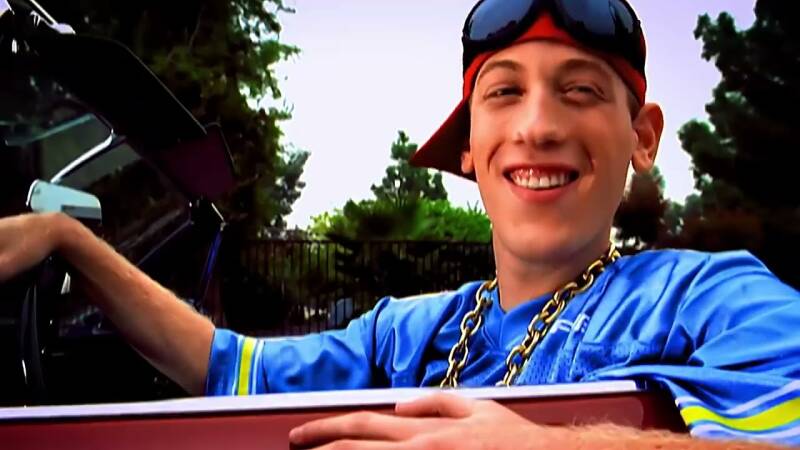
There are songs that seem silly at first. They bounce through the speakers with a chorus that sticks like chewing gum under your shoe, a drumbeat that almost laughs at itself, and lyrics that sound as if they were written to mock someone in a school parking lot. The Offspring’s Pretty Fly (for a White Guy) is one of those songs. On the surface, it is a joke song. An ironic punk-pop hit from the late 1990s about a white guy trying to be something he is not. But beneath that glossy, almost stupid surface, there is something much sharper. There is a diagnosis of a human mechanism that has become even stronger today.
In 1998, the song was about someone borrowing the expressions of hip-hop without understanding the culture, history, or reality behind it. He took the clothes, the language, the attitude, the body language, and the posing. But he had not lived it. He wore the costume, but lacked the experience. He wanted to be cool, but became only a caricature.
In 2026, that figure is everywhere.
He is no longer just a white suburban guy with the wrong cap, the wrong slang, and the wrong self-image. He is an entire contemporary archetype. He is the AI expert who has never built anything. He is the LinkedIn rebel who writes exactly like every other rebel. He is the digital nomad who poses as free but is really only moving his emptiness between coworking spaces. He is the influencer who talks about authenticity with a filter over his face. He is the entrepreneur who has borrowed Silicon Valley language but has never carried real responsibility. He is the culture person who wears other people’s experiences like stage clothes.
He is the person who has all the signals but no substance.
That is where the song still burns.
A World Built on Signals
We live in a time where almost everything has become signals. Clothes signal lifestyle. Language signals competence. Places signal freedom. Books in the background signal depth. The coffee cup beside the laptop signals creativity. A photo from an airport signals movement. A post about burnout signals humanity. A quote from a philosopher signals thinking. An AI-generated image signals vision.
But the signal is not the same as the reality.
That is the great difference between being something and looking like something. And that is exactly the difference Pretty Fly captures so effectively. It shows a person who believes that if he only gathers enough external signs of an identity, the identity will become true.
But that is not how it works.
A person does not become an artist because they wear black and talk about creativity. A person does not become an entrepreneur because they use words like disruption, scalability, and ecosystem. A person does not become an AI strategist because they have created three prompts and written a post about the future. A person does not become free because they sit with a laptop in the sun in another country.
All of this can be real. But only if there is experience behind it.
Otherwise, it is only decoration.
The AI Expert Who Was Born Last Tuesday
The clearest Pretty Fly figure of 2026 may be the AI person who suddenly knows everything. In just a few months, he or she has changed title, language, and self-image. Yesterday the person was a consultant, coach, marketer, or project manager. Today the same person is an AI evangelist, futurist, keynote speaker, transformation advisor, and thought leader.
The words are there. The presentation looks good. The logo is clean. The profile picture is professional. The posts sound as if they come from someone standing on the technological front line of humanity.
But when the questions become practical, something happens.
How do you build real workflows?
How does this affect the organization?
How does responsibility shift?
How do you train people who are afraid?
How do you avoid technology becoming yet another system no one understands?
How do you create value and not just presentations?
Then it often becomes quieter.
Because there is a difference between understanding a tool and understanding the world where the tool is supposed to be used. There is a difference between impressing people in a feed and helping an organization out of a locked position. There is a difference between talking about the future and having stood in real projects where people, money, technology, prestige, and fear collide.
The AI poser of 2026 is not dangerous because he uses AI. On the contrary. AI is a fantastic tool. The problem is that he uses AI as an identity. He borrows the aura of technology to make himself appear larger.
It is the same mechanism as in the song. Just a new costume.
Back then, it was baggy jeans and borrowed hip-hop attitude.
Now, it is prompts, panel discussions, and “the future of work.”
LinkedIn and Mass-Produced Authenticity
Another modern Pretty Fly lives on LinkedIn. There, authenticity has become a formula. You start with a personal confession, turn it into a lesson, end with an insight, and preferably insert a line break after every sentence.
“I failed.”
“It became my greatest strength.”
“Here are three things it taught me.”
It looks personal, but often feels manufactured. It sounds vulnerable, but smells like strategy. It is not necessarily false, but it is packaged in a way that turns even the human into a product.
This is where our time becomes almost comical. Everyone wants to be unique in the same way. Everyone wants to be brave with the same kind of language. Everyone wants to be vulnerable according to the same template. Everyone wants to break the rules by following whatever the algorithm rewards.
That is Pretty Fly in its purest form.
The person wants to be original, but copies the surface of originality. They want to appear free, but obey the invisible rules of the platform. They want to be authentic, but have first studied how authenticity should best be formulated for maximum reach.
It is not just ridiculous. It is sad.
Because somewhere inside, there is often a real human being. Someone who has actually felt something. Someone who has actually failed. Someone who actually has something to say. But on the way out through the digital machinery, the experience is transformed into content, and the content into positioning.
In the end, the person does not become a voice.
They become a format.
The Digital Nomad as Scenery
Then we have the digital nomad. Here too, one must be careful, because many people who live mobile lives do so for real. They have left old structures, searched for freedom, built new lives, and dared to take the leap. There is something beautiful in that. Something brave.
But there is also a posing version.
That version loves the image of freedom more than freedom itself. It loves the laptop on the café table, the sunglasses, the beach, the “work from anywhere” phrase, and the feeling of being a person who has not been captured by the system. But sometimes it is only a new kind of captivity. Instead of the open-plan office in Stockholm, the person sits in a coworking space in Lisbon, Bansko, or Bali, chasing the same validation, the same status, and the same empty performance.
Only the background has changed.
The posing nomad has not necessarily landed in the world. He has only moved his image. He does not know the place, does not listen to the people, does not understand the history, and never becomes part of anything local. He consumes environments the way others consume clothes.
This too is Pretty Fly.
It is wearing freedom as an accessory.
The Influencer Who Became More Brand Than Human
In 2026, perhaps the most extreme version of Pretty Fly is the influencer. Not because all influencers are superficial, but because the system around them rewards surface. You have to be readable. You have to be consistent. You have to have a clear aesthetic. You have to be recognizable in one second. You almost have to simplify yourself so that the audience understands what you are selling.
Eventually, the person behind it can disappear.
The body becomes a channel. The home becomes a studio. Friends become content. Love becomes a story. Children become props. Illness becomes engagement. Happiness becomes a campaign. Grief becomes dramaturgy. Everything can be used.
And when AI personas and synthetic influencers begin to take up space, the question becomes even stranger: does there even need to be a human being behind it anymore?
Then the prophecy is complete.
In 1998, The Offspring mocked a person trying to become an image.
In 2026, the image can exist without the person.
That is unsettling.
Because if the audience is only looking for the signals — the face, the body, the lifestyle, the opinion, the dream — does it matter whether the experience is real? If the answer becomes no, then we have not only created a new kind of entertainment. We have created a culture where authenticity can be fully simulated.
At that point, Pretty Fly is no longer just satire.
It becomes almost a warning.
Why We Pose
But it would be too easy only to mock these people. Many did the same with the song. They laughed at that guy. He was embarrassing. He did not understand. He tried too hard.
But why does someone try too hard?
Often because there is a hole inside. A fear of being ordinary. A fear of not being enough. A fear of not being seen. A fear of standing without a story in a world where everyone else seems to have one.
That matters.
The Pretty Fly figure is not only stupid. He is insecure. He wants to belong. He wants to be chosen. He wants to be someone. He has understood that identity gives status, but he has not understood that real identity costs something.
It costs time.
It costs failure.
It costs work.
It costs loneliness.
It costs responsibility.
It costs years of doing things when no one applauds.
That is why posing is so tempting. It offers a shortcut. You can skip the experience and go straight to the expression. Skip the craft and go straight to the title. Skip the road and photograph yourself at the destination.
But shortcuts show.
Sooner or later, they show.
The Difference Between Costume and Soul
There is a simple question one can ask almost anyone in our time:
Is this something you have lived, or something you have borrowed?
That applies to me. It applies to you. It applies to everyone who writes, builds, leads, creates, sells, teaches, or appears in public. We must ask ourselves: does this come from experience, or from a desire for position? Is this my voice, or a voice I have heard works? Is this a real insight, or a formulation I hope will make me seem deep?
There is nothing wrong with being inspired. All culture is built on borrowing, influence, and encounters. Rock borrowed. Punk borrowed. Hip-hop sampled. Fashion returns. Technology builds on previous technology. People learn by imitating.
But there is a crucial difference between being inspired and stealing an identity.
When you are inspired, you take something through your own experience and make it yours. When you pose, you leave it on the surface and hope others will believe it is you.
That is where the soul is missing.
The Real Opposite
The opposite of Pretty Fly is not perfection. It is not being pure, correct, academically approved, or culturally flawless. The opposite is grounding.
A grounded person does not need to exaggerate. They do not need to shout their identity. They can tell you what they have done. They can show the traces. They have dirt under their fingernails, not just the right words in their profile. They have built the wall, carried the cases, stood in the rain, taken the hit, redone the work, started over, failed, and risen again.
Such a person can use AI without becoming an AI poser.
They can live as a nomad without turning freedom into scenery.
They can write on LinkedIn without mass-producing vulnerability.
They can love a culture without using it as a masquerade.
They can be modern without being empty.
That may be the most important lesson.
It is not about stopping using the tools of our time. It is about not letting the tools replace the core.
Pretty Fly 2026
So who is Pretty Fly today?
It is the person who believes identity can be downloaded.
It is the person who believes experience can be replaced by aesthetics.
It is the person who believes the right language is the same as the right understanding.
It is the person who collects symbols but avoids reality.
It is the person who would rather look like someone than slowly become someone.
But it is also a mirror for all of us.
Because we live in a time that almost forces us to become our own posters. We are expected to package ourselves, sell ourselves, describe ourselves, post ourselves, optimize ourselves, and display ourselves. In such a world, it is easy to become a little Pretty Fly. Easy to borrow a tone. Easy to exaggerate your role. Easy to make life more cinematic than it is. Easy to start performing the version of yourself that gets the most response.
That is why the song still matters. It is not just a joke from the 90s. It is a reminder that surface always ages quickly, but experience gains weight.
In the end, the question is simple:
Do you want to be a person with a voice, or an avatar in a costume?
Because in 2026, Pretty Fly is no longer one specific person.
It is a risk inside us all.

By Chris...
Add comment
Comments