

Bulgaria is a country full of possibilities. There are skilled people here, young technical talent, international entrepreneurs, lower costs compared with Western Europe, and a geographical position that should make the country a natural bridge between Europe, the Balkans, Turkey, and the Middle East.
Sofia is growing. Plovdiv is developing. Bansko has become a place where digital nomads, freelancers, and entrepreneurs meet. There is energy in the country. There are ideas. There are people who want to create something.
But there is also another reality.
That reality often does not begin with a lack of ideas.
It begins with the system.
Banks.
Payment solutions.
Administrative demands.
Risk assessments.
Capital that must be blocked.
Fees that eat into margins before a project has even had the chance to breathe.
This is where many entrepreneurs in Bulgaria hit the wall.
Not because the idea is bad.
Not because the market does not exist.
Not because the will is missing.
But because the road from idea to functioning business is still filled with obstacles that force the small actor to carry an unreasonable share of the risk.

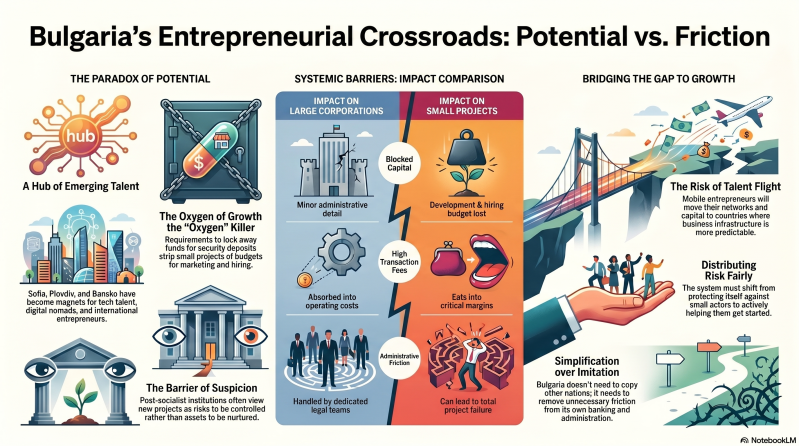
The Problem Is Not Bulgaria — The Problem Is Friction
It is important to say this clearly: Bulgaria does not lack potential. On the contrary. That is precisely why the frustration becomes so strong.
Because everything that could make the country a strong place for small businesses, digital services, international collaborations, and new business models already exists here.
But potential is not enough.
Potential needs the right soil.
A new project must be able to get started quickly. It must be able to receive payments. It must be able to test the market. It must be able to keep enough capital to develop. It must feel that the bank, the state, and the infrastructure around the business are at least partly working with the project — not only protecting themselves from it.
When a new business is met with demands for large security deposits, high transaction fees, and blocked income, the system sends a very clear signal:
“We believe in entrepreneurship — but first you must prove that you can already afford to survive without support.”
That becomes a paradox.
Blocked Capital Kills Small Projects
For a large company, a blocked amount may be nothing more than an administrative detail. It does not affect daily operations in any significant way. The capital, staff, lawyers, and financial systems are already in place to handle such things.
But for a small project, the same requirement is something completely different.
That blocked capital can be the development budget.
It can be the marketing budget.
It can be the first hire.
It can be technical support.
It can be money for suppliers.
It can be the buffer needed to dare to continue.
When that money is locked away, the ability to move is also locked away.
And a new project does not survive by standing still. It survives by moving, testing, changing, selling, learning, and improving.
Liquidity is oxygen.
When the oxygen is removed, it does not matter how good the idea is.
Bulgaria Risks Losing the People Who Want to Build
There is a dangerous consequence here.
People with ideas are mobile today. They can compare countries. They can register companies elsewhere. They can work digitally. They can move capital, networks, and projects to places where they feel the systems work better.
If Bulgaria wants to keep entrepreneurs, freelancers, digital nomads, and international project builders, the country must understand that lower living costs are not enough.
It is not enough that rent is lower than in Stockholm, London, or Berlin.
It is not enough that there is good internet.
It is not enough that Sofia has a growing IT scene.
It is not enough that Bansko is attractive to international people.
If the business infrastructure feels heavy, unpredictable, or capital-blocking, many will still look elsewhere.
For an entrepreneur, time and movement matter more than almost anything.
The Big Problem: Suspicion Before Opportunity
One of the most frustrating things in many post-socialist systems is that institutions often seem to begin with suspicion.
They do not first see the project as a possible asset.
They first see it as a possible risk.
This is historically understandable. Bulgaria has gone through transitions, crises, corruption, weak institutions, and a long journey from communist central planning to a market economy. But if the country wants to take the next step, this mentality has to change.
A modern entrepreneurial country cannot build its future by first suspecting the person who is trying to create something.
Control is needed.
Rules are needed.
Security is needed.
But they must be balanced with trust.
Without trust, nothing grows.
Bulgaria Does Not Need to Copy Anyone — But It Needs to Simplify
It is easy to say that Bulgaria should copy Dubai. But in reality, Bulgaria does not need to become Dubai.
Bulgaria needs to become a better version of itself.
The country has its own culture, its own history, its own place in Europe, and its own strengths. But it needs to remove unnecessary friction for people who want to build.
It should be easier to start.
Easier to receive payments.
Easier to deal with banks.
Easier to grow from small to stable.
Easier to test an idea without capital being locked unnecessarily.
This is not about removing all risk. It is about distributing risk fairly.
Because right now, it often feels as if the smallest actor is forced to carry the heaviest burden.
And that is backwards.
Bulgaria Has Everything to Gain
The sad part is that Bulgaria actually has an enormous amount to gain by improving this.
If the country makes it easier for new projects, more international entrepreneurs may stay. More Bulgarians may dare to start businesses. More young people may see a future in the country instead of leaving. More small ideas may grow into real companies. More local services may be created. More jobs may emerge.
This does not always require massive reforms.
Sometimes it begins with something as simple as not suffocating a new project at the beginning.
Not demanding unreasonable blocked capital.
Not eating up margins with fees.
Not treating every new entrepreneur as a problem.
Not forgetting that the person building something is also helping to build the country.
Conclusion
The story is really about a Bulgaria standing at a crossroads.
On one side, there is enormous potential: people, creativity, lower costs, tech talent, a beautiful living environment, international interest, and a growing entrepreneurial spirit.
On the other side, there are old structures, heavy administration, banking systems that protect themselves first, and payment solutions that can become expensive before a project has even begun to create stability.
The ideas are not missing.
The will is not missing.
What is sometimes missing is a system that says:
“We see what you are trying to build. Let us help you get started.”
Bulgaria can become much more than a country people move to for lower costs.
It can become a country where people build the future.
But then the system must stop standing in front of the door.
It must start opening it.

By Chris...
Add comment
Comments