

The Image That Wants to Be Shared
The image is dramatic. An airport full of people, luggage, children, elderly travellers, tired faces, and a large text claiming that Americans are leaving the United States in record numbers. It also claims that more people moved out of America last year than moved in, for the first time since the Great Depression.
It is exactly the kind of image designed to be shared quickly, to awaken emotion, and to confirm something many people already feel: that something has changed in the United States.
But that is precisely why we must be careful. Because what feels true is not always exactly true. And what may be statistically uncertain can still say something important about the time we live in.
That is where an honest analysis begins.

America Was More Than a Country
For more than a century, the United States has been the great magnet of the world. Not just a country, but an idea. A promise. A global stage where people from every corner of the planet could step in and say: here I will begin again. Here I will build something. Here my children will have a better life than I had.
The American dream was never equally true for everyone. But it was powerful enough to make people sell everything, leave their families, cross oceans, and start again from nothing.
That is why it carries such symbolic weight when Americans themselves begin to talk about leaving. Not only young backpackers, digital nomads, or retirees looking for cheaper sunshine in Portugal, Mexico, or Thailand. But ordinary Americans saying: I can no longer afford this. I cannot stand the politics anymore. I do not feel safe. I do not want my children to grow up in this climate. I want to be able to get sick without going bankrupt.
The Claim Is Too Simple
This does not mean that the United States has suddenly become a country in mass flight. Nor does it mean that a social media image should be accepted as absolute truth.
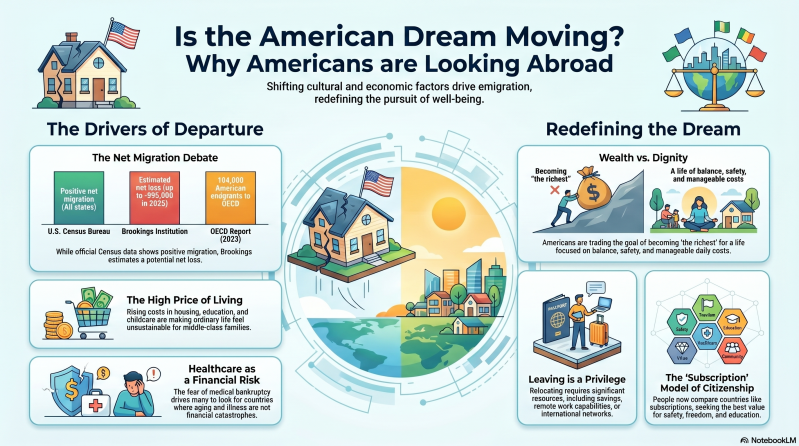
The official picture is more complicated. The U.S. Census Bureau stated in 2026 that international net migration declined sharply during 2025, but that all states still had positive international net migration according to its method — meaning more people arrived from abroad than left.
At the same time, Brookings Institution made another estimate, suggesting that total U.S. net migration in 2025 may have been negative, somewhere between minus 10,000 and minus 295,000 people. If true, that would be the first such case in at least half a century.
So there are two different pictures. And both say something.
Two Statistics, Two Stories
The official statistics say: wait, do not exaggerate. The United States is still a country people move to.
The Brookings estimate says: but something very unusual has happened to the flows. Fewer people are coming in. More people are leaving or being forced to leave. And the migration system has changed quickly.
It is important to separate three things: Americans who voluntarily move abroad, immigrants who leave the United States, and people who are deported or disappear from the statistics because of changed migration policy.
Social media likes to mix all of this into one simple story: “Americans are leaving.” But if net migration falls or becomes negative, it does not automatically mean that millions of American citizens have packed their bags and left the country. It may also be caused by fewer new immigrants, more removals, stricter visa rules, and increased immigration enforcement.
The Movement Is Still Real
Even so, there is a real movement of Americans looking for life outside the United States. OECD reported that 104,000 American citizens emigrated to other OECD countries in 2023, with Spain, the United Kingdom, and Canada among the common destinations.
That does not include the whole world, since many Americans also move to Mexico, Central America, Southeast Asia, and other places not fully captured in such comparisons. But it shows that the phenomenon exists.
Then there is the great uncertainty: no one knows exactly how many Americans live abroad. The often-repeated figure of nine million has circulated for years, but it is uncertain. The American state does not systematically count its citizens abroad in the same way it counts the population at home. Independent estimates often land lower, perhaps around four to five and a half million.
This makes the debate vulnerable to exaggeration. When no one has a perfect number, almost anyone can use statistics as a weapon.
We Do Not Need to Exaggerate
But we do not need to exaggerate to see the pattern.
The United States has become expensive. Very expensive. Housing, healthcare, insurance, education, childcare, and everyday life have made many people with completely normal incomes feel poor in a country that still describes itself as the richest in the world.
That may be the greatest crack in the American dream: not that people can no longer become rich, but that ordinary people can no longer be sure they can live a dignified everyday life.
When Retirement Becomes a Financial Calculation
For a retiree, the difference can be brutal. An American pension that feels insufficient in California or Florida may go much further in Mexico, Portugal, Greece, Bulgaria, or Thailand.
According to recent summaries, around 712,000 Americans receive Social Security payments at addresses outside the United States, but that number probably underestimates the number of retirees living abroad because many do not fully register their foreign address.
Here there is a clear parallel with Europe. Swedes, Britons, Germans, and Dutch people also leave expensive home countries for places where their pensions go further.
It is not always about adventure. Sometimes it is simply about dignity. Being able to pay the rent. Being able to eat out sometimes. Not sitting alone in an overpriced apartment waiting for the next bill.
Healthcare Changes the Question
For Americans, however, there is an additional dimension: healthcare.
In many European countries, we can complain about healthcare systems, waiting times, bureaucracy, and shortcomings. But in the United States there is a deeper financial fear connected to illness.
Getting sick can mean financial catastrophe. Needing medicine, surgery, or long-term treatment can affect an entire family’s economy.
For many Americans, the question therefore becomes not only “Where do I want to live?” but “Where do I dare to grow old?”
That is a heavy question.
Politics as a Reason to Leave
Then there is politics.
The political climate in the United States has become harder, more polarized, and more existential. People no longer feel that the other side simply has the wrong opinions. They feel that the other side threatens their future.
This applies to both right and left. For some, America has become too conservative, religious, and harsh. For others, it has become too progressive, bureaucratic, and divided.
Many feel that the country is no longer a shared project, but a battlefield.
Changing Problems, Not Finding Paradise
That is when people begin to look toward other places. Not necessarily because other countries are perfect. Most people who have moved know that no country is perfect.
Bulgaria has its bureaucracy. Sweden has its naivety and locked systems. Portugal has a housing crisis. Spain has unemployment. Thailand has visa rules.
But when you leave a country, you do not only leave problems. You exchange problems. And sometimes you prefer new problems to the old ones.
This may be the core: people do not always move to find paradise. They move to regain freedom of movement.
Every Suitcase Contains a Decision
This is where the airport image becomes powerful. It shows people with suitcases. Simple. Almost ordinary.
But inside every suitcase there is a decision. Someone has given something up. Someone has sold a house. Someone has left a job. Someone has grown tired of waiting for politicians to solve things. Someone has decided that life is too short to remain stuck.
But an honest article must also say this: being able to leave is still a privilege.
Many Americans who suffer the most from high costs, poor healthcare, violence, poverty, or political unrest do not have the possibility of moving abroad. They do not have passports, savings, remote jobs, pensions, language skills, or international networks.
They remain where they are. Just as many Swedes, Bulgarians, or Britons remain inside systems they no longer believe in.
Leaving Is Also a Sign of Resources
Leaving is therefore not only a sign of crisis. It is also a sign of resources.
It is often the middle class, retirees, digital workers, entrepreneurs, and people with international experience who can take the step. They can turn dissatisfaction into action. They can do what others only dream of.
That does not make their decision less real. But it does say something about who becomes visible in the story.
At the same time, there is another group: those who leave the United States not because they love the world, but because they no longer recognize their own country.
That is a sadder migration. It is not about wine on a terrace in Lisbon or laptop work from Bali. It is about loss. About watching your homeland change into something where you no longer feel at home.
Why the Image Spreads
Perhaps that is why images like this spread so widely. They do not only function as news. They function as emotional evidence.
People share them to say: see, I am not crazy. Something is happening. The country is changing. People are leaving.
But we must be alert to simple drama. Social media loves collapse. It loves large headlines, capital letters, and easy conclusions.
“Americans Are Leaving the U.S. in Record Numbers” sounds better than “Migration statistics are uncertain; some indicators show a sharp decline in net migration, while official estimates still show positive migration.”
The second version is more accurate. But no one shares it on Facebook.
The Real Question
The big question is not whether every word in the image is correct. The big question is why so many people are ready to believe it.
The answer is that it fits into a larger feeling: that old centers are losing their certainty.
The United States is still powerful. Still rich. Still technologically dominant. Still culturally influential.
But it is no longer equally obvious that the world only wants in. And it is no longer obvious that those born there want to stay at any price.
That is historically interesting.
From Future Symbol to Question Mark
During the twentieth century, the United States was often the symbol of the future. Europe was the old world. America was the new.
There were the cars, the highways, Hollywood, rock music, computers, Silicon Valley, the moon landing, fast food, jeans, the dream of the house and the garage.
Now many young Americans look at Europe and think: maybe there I can have vacation, healthcare, a calmer pace, cheaper education, and a life that is not only about work.
That is a mental shift.
Europe Should Not Feel Too Superior
But Europe should not congratulate itself too quickly.
Many Europeans are also tired of their systems. Many young people leave Bulgaria, Romania, Greece, Spain, and Italy because they do not see opportunities at home. Many Swedes leave Sweden because their pension is not enough, because safety feels broken, or because they no longer recognize the country.
This is not only an American story. It is a global story about people who no longer wait for the state to give them a functioning life.
We live in a time when people compare countries the way they compare subscriptions.
Where do I get the most life for my money? Where can I work digitally? Where is there safety? Where is there freedom? Where can my children go to school? Where can I grow old? Where can I stop feeling hunted?
That is new.
The Country You Were Born In Is No Longer Always Your Fate
In the past, the country you were born in was often your destiny. Now, for many, it is more like a starting point.
Not for everyone, but for enough people to change societies.
Digital work, international networks, and global information allow more people to think: why am I actually staying?
That is where the image, despite its exaggerations, touches something true.
It says: even Americans are now asking that question.
When the Dream Itself Starts Moving
And when people in the world’s most mythologized immigration country begin to wonder whether life might be better somewhere else, then it is not only statistics.
It is a cultural signal.
It means that the old story of success, freedom, and unlimited opportunity now has competition from other stories: balance, healthcare, safety, time, humanity, lower costs, and a life that does not require you to win every day simply to survive.
Perhaps the American dream is not dying.
Perhaps the dream is moving.
A Different Definition of Freedom
Perhaps people are no longer searching for a country where everything can become the biggest, fastest, and richest.
Perhaps they are searching for a life where everyday life actually works. Where children can go to school without fear. Where you can get sick without financial panic. Where you can work in order to live, not live in order to work. Where a normal life does not feel like failure.
That is the honest picture.
The Real Headline
No, we should not uncritically believe every viral post claiming that America is emptying out. The United States is not standing empty. People still move there. Many still want a part of its energy, its market, its universities, and its opportunities.
But yes, something has changed.
More Americans are looking outward. More are questioning the price of the dream. More are realizing that freedom is not only about being able to become a billionaire, but also about being able to live without constant fear of the next bill.
Perhaps this is the real headline:
Americans are not only leaving a country.
They are leaving a story that no longer feels true.

By Chris...
Add comment
Comments