

An Article That Opened Something Bigger
When I wrote about Bulgaria’s Eurovision victory, my starting point was simple: Dara won the contest, but the real question was whether Bulgaria could win what comes next. It was not about diminishing the victory. Quite the opposite. It was about taking it seriously. Because such a victory is not only a musical moment. It is a door opening. The question is always what a country does when that door stands slightly ajar.
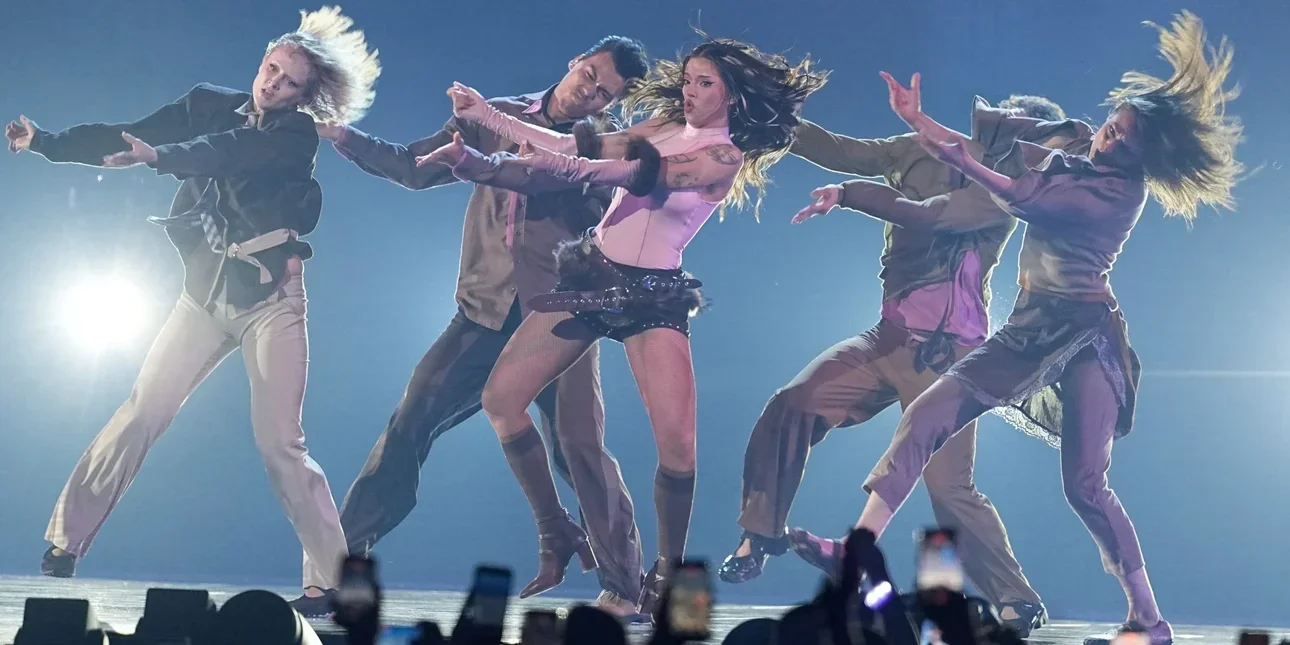
The reactions to the article quickly showed that the question touched something deeper than Eurovision. People did not only begin discussing the song, the artist or the result. They began discussing Bulgaria. The country’s self-image. Its capacity. Its history. Its pride. Its fear of failure. Its ability to surprise.
And perhaps that is exactly where the article became interesting. It was never really only about Eurovision. It was about a country that often has more to offer than the outside world sees, but which does not always manage to carry its story beyond its own borders.
The Defence of Pride
Among the comments, a strong Bulgarian reaction quickly became visible. Not aggressive, but clear. There was a sense of: do not underestimate us again. Many Bulgarians are used to their country being viewed from the outside with a certain condescension. As if Bulgaria must always prove its place at the table. As if the country always starts at a disadvantage, regardless of what it actually achieves.
That is why the Eurovision victory became something bigger than the contest itself. It became a counterargument. A reminder that Bulgaria can win. That Bulgaria is not only a country others pass by, use as a cheap labour market, visit for holidays or mention in passing when talking about Europe’s margins. Suddenly, Bulgaria stood at the centre.
One comment captured this well: the victory was compared to Bulgaria’s fourth place in the 1994 FIFA World Cup. That is interesting, because comparisons like that say a great deal about what a national moment means. It is not only about the achievement itself. It is about the memory of a whole country standing still. People feeling: we exist. We can. We matter.
In such a moment, criticism becomes sensitive. Even a constructive question can be perceived as yet another foreign doubt. Another voice saying that Bulgaria may not be able to handle it. That must be understood. But at the same time, that is precisely why the question matters.
Because if Bulgaria truly wants to win what comes next, the country must also be able to tolerate its success being discussed seriously.
Between Pessimism and New Self-Confidence
One of the most interesting things in the reactions was the Bulgarian self-image. Several comments touched on an old national habit: expecting things to go wrong. That kind of pessimism does not exist only in Bulgaria, but it is clearly present there. It has historical roots. It comes from decades of political failures, corruption, broken promises, young people leaving the country and a sense that the system often stands in the way of the people.
But now something else is happening.
In a short period of time, Bulgaria has gained several symbolic victories. The country has taken steps into Schengen. The euro is on its way into everyday national life. Sporting achievements have lifted confidence. Major international events have shown that the country can actually host more than it perhaps believes itself. And now Eurovision.
One can see this as a series of isolated events. Or one can see it as something more: a possible mental turning point.
Perhaps Bulgaria is beginning to leave part of its old self-image behind. Perhaps the country is slowly starting to understand that it does not always have to stand on the sidelines. Perhaps the Eurovision victory is a cultural expression of something bigger: a country beginning to want to be seen on its own terms.
But self-confidence is not the same as structure. And that is where the challenge lies.
From 18th Place to Winner Performance
A post on X captured something important about Bulgaria’s victory: the way the staging was upgraded from something that could have looked like an 18th-place performance into something that felt like a winner “needs to be studied.” Link to X
That observation is more important than it may first appear.
Because it points directly to the heart of the Bulgarian question.
Maybe Bulgaria’s victory was not only about the song. Maybe it was not only about Dara’s voice, charisma or national support. Maybe the real lesson is that the performance was transformed. Something that could have disappeared in the middle of the scoreboard became something sharp, memorable and competitive because the presentation changed.
That is a crucial point.
In Eurovision, potential is not enough. A good song is not enough. A talented artist is not enough. Everything must be translated into image, movement, rhythm, camera language, light, costume, atmosphere and emotional clarity. The audience must understand the performance instantly. They must feel it before they analyse it.
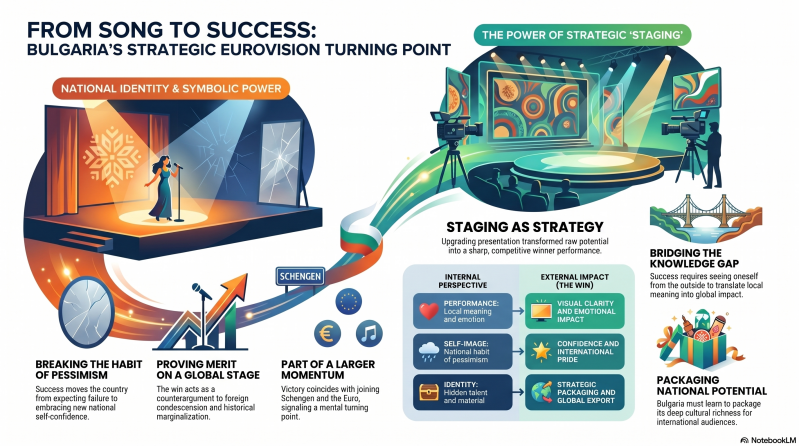
That is where staging becomes strategy.
And that is also where the metaphor becomes much bigger than Eurovision.
Because Bulgaria often has the material. The country has talent, culture, landscapes, music, folklore, film locations, IT competence, hospitality and creative people. But the material is not always packaged in a way that the outside world can immediately understand.
Dara’s performance may therefore become a symbol of something larger: when Bulgarian potential is framed correctly, it can compete at the highest level.
This is not a small lesson.
It suggests that Bulgaria does not necessarily need to become something else. It does not need to copy Sweden, Italy, the United Kingdom or the Netherlands. It needs to learn how to stage itself.
That is the real word here: staging.
A country also has staging.
How does it present its cities?
How does it present its culture?
How does it present its creative industries?
How does it present its tourism?
How does it present its modern identity?
How does it present its contradictions?
If the staging is weak, even strong content can be overlooked. If the staging is powerful, the same content can suddenly look like a winner.
That may be the most valuable lesson from Dara’s Eurovision victory.
Bulgaria did not only win because it had something. Bulgaria won because, for once, what it had was presented with enough force, clarity and confidence for Europe to understand it.
What Bulgaria Thought Was Needed — and What Was Actually Needed
But beyond the staging upgrade, there is an even deeper lesson.
What I see is the difference between what Bulgaria thought was needed and what was actually needed.
That difference is knowledge.
Not talent.
Not emotion.
Not pride.
Not ambition.
Knowledge.
The knowledge to see oneself from the outside.
In the first version of the performance, Bulgaria had the artist. Bulgaria had the song. Bulgaria had the energy. Bulgaria had the cultural material. But it did not yet seem to fully understand how that material would be perceived by an international audience.
It may have worked locally. It may have felt strong in a Bulgarian context. It may have carried meaning for those who already understood the codes, the energy, the references and the emotional weight. But Eurovision is not a local room. It is a European stage where everything must be understood instantly.
There is no time to explain.
The image must speak.
The camera must translate.
The movement must clarify.
The costume must support the story.
The light must build the emotion.
The staging must turn inner meaning into outer impact.
That is the missing knowledge in many Bulgarian contexts. Not the lack of ability. Not the lack of creativity. Not the lack of effort. But the lack of external perspective.
To stand outside oneself and ask:
How does this look to someone who does not already love us?
How does this feel to someone who does not know our internal references?
What is unclear?
What is too much?
What is not enough?
What needs to be simplified?
What needs to be amplified?
What needs to be translated?
That is a difficult kind of intelligence. It requires humility. It requires experience. It requires the ability to separate pride from presentation.
And it requires a willingness to accept that what feels powerful from the inside may not yet be powerful from the outside.
This is perhaps Bulgaria’s larger challenge as a country.
Bulgaria often has the content, but not always the external gaze. It knows what it feels inside, but not always how it appears from outside. It knows its own warmth, its own beauty, its own humour, its own music, its own landscapes, its own chaos and its own stubborn life force. But the outside world does not automatically understand that.
It must be shown.
It must be framed.
It must be translated.
That is true in music. It is true in tourism. It is true in business. It is true in culture. It is true in events. It is true in politics. It is true in national branding.
A country can have enormous potential and still be misunderstood if it cannot see how it appears to others.
That is why Dara’s transformation matters. It was not only a better Eurovision performance. It was a demonstration of what happens when raw potential is given the right external shape.
The first version may have shown what Bulgaria believed was enough.
The winning version showed what Europe actually needed to see.
And that gap — between internal belief and external impact — is exactly where Bulgaria’s future opportunity lies.
If Bulgaria can learn from that gap, not defensively, but intelligently, then Eurovision may become more than a victory. It may become a national lesson in presentation, strategy and self-awareness.
Those Who Say Eurovision Is Only Entertainment
Another line in the comments was sceptical. Some argued that Eurovision is nothing more than television entertainment. A show. Glitter. Voting. An evening of European spectacle. And of course there is truth in that. Eurovision is entertainment. It is a television product. It is choreography, lighting, costumes, cameras, emotion and dramaturgy.
But the fact that something is entertainment does not mean it is unimportant.
Modern entertainment is economy. It is tourism. It is technology. It is communication. It is urban development. It is hotel nights, restaurant visits, transport, press trips, sponsors, brands, logistics and international exposure. A single final evening is only the visible top of a much larger system.
It is possible to dismiss Eurovision as superficial. But then one misses what events like this actually do. They create images of countries. They put cities on the map. They drive visitors. They create press. They show what a country can handle in full public view.
The song itself is not the whole question. Everything around it is.
And that is where Bulgaria now faces its real test.
The Culture Is Already There — But the Export Is Missing
One strong argument in the discussion was that Bulgaria already has a deep culture. Orpheus was mentioned. Classical composers were mentioned. Bulgarian musical tradition, choral singing, folk music and the country’s historical depth were brought forward. That is an important reminder.
Bulgaria is not starting from zero.
It is not a country without culture that suddenly happened to win a song contest. It is a country with layers of history, music, myths, rituals, rhythms and expression. It is a country where the old and the new often exist side by side in a way that few Western European countries still have left.
But that is precisely why the question becomes even clearer: if Bulgaria has had this cultural richness for so long, why is so little of it widely known outside the country?
That is where the problem lies. Not in the absence of culture, but in the absence of international packaging. Bulgaria has content. Bulgaria has colours. Bulgaria has voices. Bulgaria has faces. Bulgaria has traditions that could fascinate the world. But the country has often lacked the machinery that transforms culture into export, narrative and position.
Eurovision cannot replace Bulgaria’s deep culture. But Eurovision can become an opening into it.
If the country uses the moment correctly.
The Great Risk: Short-Term Thinking
One of the most accurate comments was about short-term thinking. About opportunism. About the risk that different actors begin pulling at the victory for their own gain, rather than building something together. That may be the greatest danger now.
When a country suddenly receives attention, people quickly want to own the story. Politicians want to be seen. Companies want to connect their name to the success. Organisations want to position themselves. Consultants want to sell solutions. Local actors want their share of the cake. Everyone says they want to help, but not everyone is necessarily working for the whole.
If this happens, the Eurovision victory risks becoming fragmented. Instead of a national platform, it becomes a collection of smaller interests. Instead of strategy, there are short-term gains. Instead of building Bulgaria’s international position, it becomes an opportunity for internal status games.
This is where Bulgaria must be alert.
A country can lose the value of a victory without losing the victory itself. The trophy remains. The memory remains. But the opportunity can slip away.
International Expertise Is Not a Defeat
Another important question is technology and production. Can Bulgaria host Eurovision at the required level? Some answer yes, without hesitation. Others are more cautious. The truth is probably somewhere in between.
Bulgaria has more capacity than many outside the country believe. There are arenas, technicians, television competence, film production, stage workers, creative agencies, IT people and individuals who can work hard under pressure. The country is not empty of competence. It would be arrogant to claim that.
But Eurovision is a special kind of machine. It is not just a large event. It is a huge live international television production where every second must function. It involves broadcast, stage changes, lighting design, camera direction, delegations, press, security, audience flows, networks, electricity, backup systems and thousands of details.
That is why the question should not be whether Bulgaria can do everything alone. The question should be how Bulgaria best combines its own capacity with international experience.
Bringing in external expertise is not a defeat. It is professionalism. Large events are always built by mixed teams. The host country provides identity, place, soul and story. International experts can contribute systems, experience and technical security.
The important thing is not that Bulgaria does everything alone.
The important thing is that Bulgaria leads it well.
The Question of Diversity Cannot Be Avoided
Eurovision is also something more than music and technology. It is a cultural space where questions of identity, diversity and acceptance often become visible. That means Bulgaria as a host country will not only be judged by lighting rigs and hotel capacity. The country will also be judged by its social atmosphere.
Here there is a challenge.
In parts of Bulgaria, there is still an attitude that can be summarised roughly as: “We have nothing against people who are different, as long as they are not too visible.” That is tolerance, but not necessarily acceptance. Eurovision will challenge this. The contest carries with it an audience, a culture and a symbolism in which visibility is central.
If Bulgaria wants to use the hosting opportunity fully, the country must understand that Europe is not only coming to look at a stage. Europe will also feel the atmosphere. Is this an open country? Is this a safe country? Is this a country where different people can feel welcome?
That does not mean Bulgaria must become something other than Bulgaria. But it does mean that the country must show a version of itself generous enough to include more than the traditional image.
This may become one of the most important cultural effects of the entire hosting opportunity.
A New Story About Bulgaria
The most exciting thing about the reactions to the article is that they show how charged the image of Bulgaria is. The country is not uninteresting. Quite the opposite. It creates emotion. People defend it. Others criticise it. Some doubt. Some hope. Some laugh at the fact that we take Eurovision so seriously. Others see exactly how much is at stake.
That means Bulgaria has something valuable: a story that has not yet been fully written.
Many countries in Western Europe are already packaged. We know what we are expected to think of them. Sweden is innovation, pop music and welfare. Italy is style, food and history. France is culture and elegance. The United Kingdom is pop, television, theatre and tradition. Spain is life, colour and tourism.
But Bulgaria is more unclear in the eyes of the outside world. That can be a weakness. But it can also be a strength.
Because a country whose story has not yet been completed can still shape it.
From Moment to Direction
Dara’s victory gave Bulgaria a moment. The reactions to the article show that this moment has already begun to become something more: a conversation about direction.
What does Bulgaria want to be? A country that occasionally surprises, but then returns to old patterns? Or a country that uses success to build confidence, structure and international visibility?
It is easy to be proud. It is harder to organise pride. It is easy to celebrate. It is harder to create long-term value. It is easy to say that others underestimate Bulgaria. It is harder to prove the opposite through professional execution.
But that is precisely why this is such an important time.
Because perhaps Bulgaria’s greatest challenge is not to show the world that the country has talent. That has already happened. Perhaps the greatest challenge is to show the world that Bulgaria can cooperate, plan, deliver and think beyond the next round of applause.
Now the Next Contest Begins
The Eurovision victory is already historic. No one can take that away from Bulgaria. Dara has written herself into the country’s modern cultural history. But historic moments gain their true meaning only through what follows them.
If Bulgaria succeeds in using this victory to lift music, tourism, creative industries, international cooperation and a more open self-image, Eurovision will become much more than one evening. It will become a turning point.
If, on the other hand, the country gets stuck in internal prestige, short-term thinking, political symbolism and fragmented interests, the victory risks becoming another powerful but isolated moment.
That is why the discussion matters.
Not because Eurovision is the most important event in the world. But because the way Bulgaria handles Eurovision may say something about the country’s next step.
Dara won the contest.
But now Bulgaria has been given a bigger task: to show that the country can not only create a historic moment, but also build a future from it.

By Chris...


Add comment
Comments