

Loud discussions are already taking place about where Bulgaria should host Eurovision 2027. Sofia, Burgas, Varna and Plovdiv are being mentioned. Each city has its supporters, its arguments and its pride. Someone points to the sea. Someone points to the infrastructure of the capital. Someone points to tourism. Someone points to the symbolic value of not always placing everything in Sofia.
But the truth is far less romantic.
Eurovision is not an ordinary concert. It is not a festival. It is not a national gala evening. Eurovision is one of Europe’s largest live television productions, with an enormous technical apparatus that must be built, tested, rehearsed, secured and delivered without the world noticing how complicated everything really is. After DARA’s victory with “Bangaranga”, Bulgaria is now in a position where the country must not only celebrate, but quickly start thinking like a professional host nation.
This is where the discussion must move to another level.
The question is no longer: Which city would be the most beautiful place for Eurovision?
The question is: Which city can carry Europe’s largest television machine without collapsing?

There Is No Time to Build a Dream
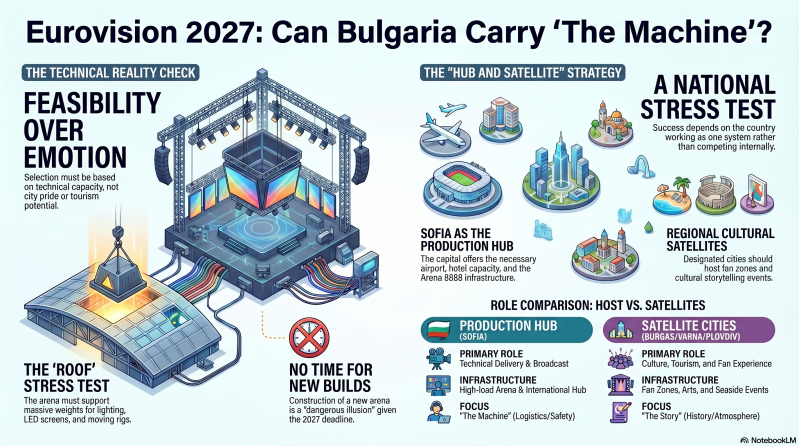
The first thing to understand is the time factor. There is realistically no room to start dreaming about a completely new arena that must be built from scratch and still be completed, tested, certified and technically ready for Eurovision 2027.
An arena is not finished simply because the roof is in place and the seats are installed. For an event like Eurovision, far more is required. The arena must be able to carry heavy rigging. It must have the right loading routes. It must be able to handle trucks, OB vans, camera technology, stage construction, LED screens, lighting rigs, sound systems, fibre connections, backup power, security zones, press areas, delegation spaces and audience flows.
And all of this must not only fit inside and around the arena. It must function at the same time.
That is why a new build is a dangerous illusion. On paper, one can always draw the perfect arena. But Eurovision is not carried out on paper. Eurovision is carried out in reality, with cables, steel, people, time pressure, fire exits, safety regulations and television minutes that cannot go wrong.
Building something new sounds impressive. But building something new under pressure can become a national own goal.
Sofia Is Being Mentioned for a Reason
It is no coincidence that Sofia is already emerging as the most realistic option in the discussion about the host city. The capital has the international airport, hotel capacity, proximity to national authorities, security resources and the most obvious existing arena candidate: Arena 8888 Sofia, formerly Arena Armeec. The arena is reported to have a maximum concert capacity of around 17,900, although the actual Eurovision capacity would likely be significantly lower because the stage, cameras, green room and technical areas take up enormous space.
But even if Sofia is the most realistic option, that does not mean Sofia is automatically ready.
This is where many discussions become too superficial. People look at audience capacity. They look at the map. They look at hotels. But Eurovision is often decided by things the audience never sees.
Can the roof carry the enormous weight of lights, motors, truss, sound, screens and special technology?
Are there enough rigging points?
Is there enough free height?
Are there loading access points at the right level?
Can a broadcast compound be built outside the arena?
Can delegation flows be separated from audience flows?
Can police, fire services, medical teams and security work without disturbing the production?
Can the arena be locked down for Eurovision for a long period of time?
These are the questions that decide everything. Not how beautiful the city looks on a postcard.
The Roof Is Not a Detail — The Roof Is a Main Issue
For someone without production experience, the roof may sound like a technical detail. But for Eurovision, the roof can be the difference between possibility and impossibility.
A modern television production of this size depends heavily on what can be hung above the stage. Lighting rigs, LED, sound, cameras, motors and decorative elements weigh an enormous amount. Everything must also be able to move safely, be programmed precisely and be approved according to strict safety requirements.
If the roof cannot handle the load, other solutions must be found. That may mean building free-standing structures from the floor. This steals space, affects sightlines, reduces audience capacity, complicates camera angles and makes the production more expensive. It can also force compromises that affect the entire visual expression of the show.
And Eurovision is not a production where you want to start compromising on the basic conditions.
That is why the first step should not be a political discussion between cities. The first step should be an independent technical audit of every possible arena. Not a brochure. Not a press conference. Not a mayor’s statement.
A real production inspection.
Burgas and Varna May Be Fantastic — But Is That Enough?
Burgas and Varna have strong emotional arguments. The sea, tourism, atmosphere, summer, international visitors, hotels and the opportunity to show another side of Bulgaria than the capital. It is easy to understand why many people would like to see Eurovision there.
But Eurovision is not governed by emotion. It is governed by feasibility.
A coastal city can be fantastic for fan zones, concerts, side events, tourism campaigns and international PR. But the main show requires an indoor arena with the right capacity, the right height, the right roof load, the right backstage areas, the right loading access, the right security zones and the right technical infrastructure.
It is not enough that the city wants it. It is not enough that the audience likes the idea. It is not enough that local politicians see a chance for marketing.
If the arena is not right, the city is wrong.
That is the brutal truth.
Plovdiv, Burgas and Varna Should Not Lose — They Should Be Used Smartly
But that does not mean the rest of Bulgaria should be pushed aside. On the contrary.
The smartest solution would be to think: Sofia as the production hub, Bulgaria as the host country.
Sofia can carry the television production itself. But Burgas, Varna and Plovdiv can carry the story of Bulgaria.
Burgas can create Eurovision by the Black Sea, with concerts, fan events and an international summer atmosphere.
Varna can showcase Bulgaria’s coast, culture and young energy.
Plovdiv can show history, architecture, art and European cultural depth.
Sofia can take responsibility for the technical delivery.
That would be much stronger than turning this into an internal war between cities. Eurovision 2027 can become an opportunity for all of Bulgaria, but only if the country understands the difference between the main production and the national framework around it.
Not everyone needs to host the final in order to benefit from Eurovision.
Logistics Are Not Glamorous — But This Is Where Eurovision Is Decided
What many people do not see is that Eurovision is a logistical organism. Everything affects everything.
If trucks cannot enter in the right order, the stage build is affected.
If security flows do not work, rehearsals are affected.
If the press does not have functioning work areas, the image of the event is affected.
If delegations get stuck in transport, the schedule is affected.
If hotel distribution fails, the entire hosting operation is affected.
If the technical teams do not get enough installation time, the broadcast is affected.
That is why a city with better infrastructure is often a safer choice than a city with a more beautiful view.
Eurovision is not about creating one beautiful evening. It is about creating a controlled month of production, rehearsals, international presence and live broadcasts.
What the audience sees in three minutes per artist is built on weeks of discipline behind the scenes.
Bulgaria Must See Itself From the Outside
This may be the most important point. Bulgaria has enormous creative power. The country has talent, energy, culture, musicians, dancers, technicians and a unique feeling that Europe has now noticed through DARA’s victory. But winning Eurovision is one thing. Hosting Eurovision is something entirely different.
Now Bulgaria must see itself from the outside.
Not ask: “What do we think we can manage?”
But ask: “What will the EBU, the delegations, the press, the fans and the television world see?”
That is a completely different level of self-examination.
For a country that wants to show it can do more than the outside world expects, it is crucial not to let pride come before professionalism. The danger is not that Bulgaria lacks ability. The danger is that Bulgaria underestimates the task.
It would be better to create a technically safe Eurovision in Sofia than a symbolically bold Eurovision somewhere else that risks becoming chaotic.
A Serious Upgrade Is More Realistic Than a New Build
If Arena 8888 Sofia becomes the main candidate, the focus should quickly move to upgrades. Not cosmetic upgrades. Not new signs and a bit of paint.
This is about production-level reinforcement.
Roof and rigging capacity must be checked.
Electrical capacity and backup power must be reviewed.
Fibre and broadcast routes must be secured.
Loading zones and production areas must be planned.
Security flows must be tested.
Audience entrances, evacuation routes and backstage areas must be clearly separated.
Green room, press centre, delegation spaces and artist logistics must be planned from the very beginning.
It must also be understood that Eurovision takes over an arena for a long time. The host arena must not only be technically possible. It must also be practically and economically available.
This Is Not a City Competition — It Is a Stress Test of the Country
Eurovision 2027 will be more than music. It will be a stress test of Bulgaria’s modern self-image.
Can the country cooperate beyond city prestige?
Can authorities, security, culture, tourism, technology and television production work as one system?
Can Bulgaria present itself as a European country with control, warmth and professionalism?
Can the country lift all of Bulgaria without making the main production unnecessarily risky?
This is where Bulgaria has its real opportunity.
DARA’s victory gave the country attention. Now Bulgaria must manage that attention. And it will not do so by shouting the loudest about which city deserves it most. It will do so by choosing the place with the greatest chance of delivering.
Conclusion: Choose With the Production Brain, Not the Heart
Bulgaria is facing a historic moment. The country can use Eurovision 2027 to show a modern, creative and capable Bulgaria. But the decision must be made with a cool head.
There is probably not enough time to build a new arena that can become the production machine Eurovision requires. Therefore, the focus must be on existing arenas, realistic upgrades and a location where the television production can be carried out safely.
Right now, much points towards Sofia. Not because Sofia is necessarily the most loved option. Not because Sofia must always get everything. But because Sofia probably has the best combination of arena, airport, hotels, security, authorities, technical workforce and international logistics.
But the rest of Bulgaria should not stand outside. On the contrary. Let Sofia carry the final. Let Burgas, Varna and Plovdiv carry the celebration, the culture and the story.
Then Eurovision can become something bigger than a competition inside an arena.
It can become Bulgaria’s opportunity to show Europe that the country can not only win on stage — but also deliver behind the stage.
Because that is where the truth is found.
Not in the applause.
Not in the press photos.
Not in city politics.
But in the rigging, the roof, the logistics, the security, the cables, the rehearsals and all the people who make sure the show can actually go on.

By Chris...
Add comment
Comments