

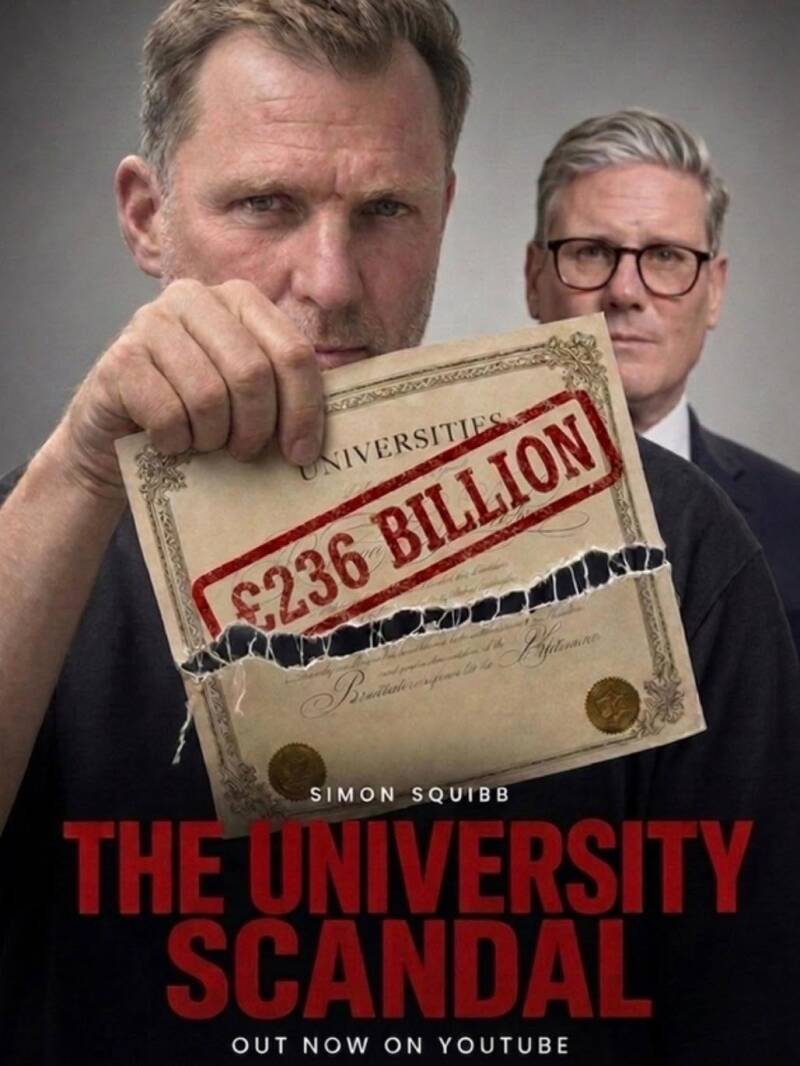
Simon Squibb has thrown a firebomb into one of the most sensitive social questions of our time: the university system. He says, bluntly, that millions of people have been misled. That young people have been sold a dream, taken on enormous loans, followed the instructions of parents, teachers, politicians and society — only to end up with debt, uncertainty and no obvious place in the labour market.
Those are strong words.
But perhaps that is exactly why they are needed.
Because the real question is not whether education is good or bad. Knowledge is not the problem. Learning is not the problem. Studying medicine, law, engineering, research, architecture or other professions where deep formal knowledge is required is not the problem. The problem begins when university is sold as the only safe road to a good life.
That is where the deception begins.
For generations, young people have been told the same thing: do well in school, get good grades, go to university, graduate and get a good job. It has become almost a religious mantra. A social ritual. A promise. But the question is whether that promise still holds.
For more and more young people, it does not.
They leave university with debt, but without clear direction. They have a degree, but no obvious employment. They did what the system told them to do, but the system does not keep its side of the deal. So we have to ask: did they receive an education, or did they buy an expensive product in the belief that it would give them security?
When Security Became a Product
The most interesting part of Simon Squibb’s criticism is not that he attacks university as an idea. The most interesting part is that he describes university as a financial product sold to young people before they understand what they are signing.
An 18-year-old taking out a student loan is often making the first major financial commitment of their life. Many have never had a proper job. Many have never negotiated a salary. Many have never paid rent, run a business, understood interest, inflation, repayment thresholds or how the labour market actually works. Yet they are expected to make decisions that may affect their finances for decades.
This is where the system becomes morally questionable.
Because if a private company sold an expensive product to young people while implying that the product would almost certainly lead to financial success, we would demand clarity. We would demand risk information. We would demand that the customer understands what they are buying. We would ask: what happens if the product does not deliver? What happens if the promise is not fulfilled?
But when university does the same thing, we call it an investment in the future.
That is strange.
Especially when the labour market has changed faster than many educational institutions have managed to adapt. AI is transforming office work, analysis, design, programming, administration, marketing and communication. Employers demand experience even from new graduates. At the same time, young people continue to be drawn into courses that do not always have a clear connection to work, entrepreneurship or real competence.
So the question is no longer: is university worth it?
The question is: for whom, at what price, and with what honest promise?
The Old Map No Longer Matches the Terrain
There was a time when university was a rare path. Those who continued into higher education often gained a clear advantage. The degree opened doors. The labour market was more predictable. Professional roles were more stable. An education could carry a person through an entire working life.
That time is gone.
Today, professions change faster than course plans. Many young people are educated for tasks that are already being automated. Others are educated in fields where competition is so intense that the degree is only an entry ticket to even more uncertainty. It is no longer enough to have studied something. You must be able to do something. Create something. Solve something. Build something. Lead something. Understand people. Understand systems. Understand reality.
Here lies a crucial difference between theoretical education and real competence.
You can study project management for years without understanding what happens when the rain comes, the stage is delayed, the truck is in the wrong place, the crew is tired, the client is nervous and the audience is waiting outside the gates. You can study entrepreneurship without ever having had to sell anything, fail at anything, negotiate anything or stand alone with responsibility. You can study communication without understanding how people react under pressure.
That does not mean theory is worthless.
But theory without reality easily becomes decoration.
The Undervalued Intelligence of Experience
Society has long overvalued the academic path and undervalued practical intelligence. The intelligence that sits in the hands, the eye, the timing, the experience and the ability to see what is about to go wrong before it goes wrong.
It is the intelligence that has built houses, stages, factories, roads, festivals, boats, workshops, restaurants, logistics systems and functioning teams. It is the intelligence that allows an experienced person to enter a place and immediately feel: there will be a problem here. Not because they read it in a book, but because the body recognises the pattern.
That kind of knowledge has often been treated as less refined.
Academic knowledge has been given status. Practical knowledge has carried society.
That is a strange injustice.
Because when something truly has to work, we do not always call the person with the most academic credits. We call the person who knows what must be done. The person who has been there before. The person who can create order from chaos. The person who does not just talk about responsibility, but can carry it.
In a time when AI can write reports, create presentations, analyse data and produce text in seconds, practical connection to reality becomes even more valuable. AI can help us think faster, but it does not always know what is true in the real world. It does not know how a stage feels in the rain. It does not know how a crew reacts when information is poor. It does not know what a client’s fear looks like five minutes before opening.
The human being with experience knows.
The Status Trap of University
Part of the problem is status. University has become more than education. It has become identity. For many families, it is proof that the child has succeeded. For many young people, it becomes a way to postpone adulthood. For society, it becomes attractive statistics: more highly educated people, more graduates, more people fitting into the story of progress.
But status does not pay the rent.
And a degree does not guarantee meaning.
Many young people do not go to university because they truly know what they want. They go because they do not know what else to do. It is not always a free choice. It is often social pressure. Parents mean well. Schools mean well. Politicians mean well. But goodwill can still cause harm if it leads people into debt, passivity and false expectations.
Perhaps the most dangerous part of the system is that it makes young people believe they are not allowed to start living until they are fully educated.
First school.
Then university.
Then an internship.
Then the first job.
Then maybe the dream.
But why?
Why should a young person who wants to start a business wait three or four years before beginning? Why should someone who wants to create film, music, design, technology, events, crafts or digital products first sit inside a system that may not even teach what the market needs? Why should young people take on debt before they have tested whether their ideas work?
We should teach young people to begin earlier. Test earlier. Fail cheaper. Build smaller. Learn faster.
That is how real competence grows.
A New Educational Contract
We do not need to abolish university. But we do need to abolish the lie that university is the only road to a good life.
We need a new educational contract between young people and society. A contract that tells the truth:
University may be the right path for some.
Apprenticeship may be the right path for others.
Entrepreneurship may be the right path for some.
Vocational training may be more valuable than an academic degree.
Practical experience may be as strong an investment as lecture halls.
And no young person should take on debt without fully understanding the consequences.
Such a system would give young people more real choices.
It would also require companies, entrepreneurs and experienced professionals to take greater responsibility. If we criticise the university system, we must also build the alternatives. We must create internships that are not unpaid exploitation. We must create mentorship that is more than fine words. We must create projects where young people are given responsibility, but also support. We must teach finance, sales, self-leadership, problem-solving, AI, communication and practical production.
It is not enough to tell young people: start a business.
We must also show them how.
The Future of Education Is Reality-Based
The education of the future should be more like a real project than an isolated course. Young people should be allowed to build something that will actually be used. They should meet customers, budgets, deadlines, technology, conflicts and consequences. They should learn that an idea is not worth much until it has met reality.
At the same time, older and experienced people should be given a new role. Not as obstacles. Not as nostalgics. But as mentors, producers, bridge-builders and reality-checkers.
There is enormous experience in people whom society often sorts away after 50 or 60. People who have built, led, failed, risen again, solved problems and seen trends come and go. That experience should be connected with young people’s energy and the tools of AI.
There lies a new educational model.
Not university against entrepreneurship.
Not theory against practice.
Not young against old.
But a new weave where experience, technology, creativity and real projects are bound together.
The Real Betrayal
The greatest betrayal is not that university costs money. The greatest betrayal is that young people often do not hear the truth.
They are not told that a degree does not guarantee a job.
They are not told that debt can follow them far into adulthood.
They are not told that some courses have a weak connection to the labour market.
They are not told that entrepreneurship, craftsmanship and practical competence can be equally valuable paths.
They are not told that working life does not reward paper as much as the ability to create value.
This is what Simon Squibb puts his finger on.
He uses big words. Perhaps too big at times. But behind the words lies an uncomfortable truth: the education system has become too good at selling expectations and too poor at delivering real future capability.
We do not need more young people who do the right thing according to old rules and still end up in the wrong place.
We need more young people who receive the right information, the right support and the real opportunity to build their own paths.
Conclusion: Knowledge, Yes – Blind Obedience, No
It is time to stop treating university as a sacred institution that cannot be questioned. Anything that costs so much money, affects so many lives and is sold with such big promises must be able to withstand scrutiny.
That does not mean we should tell young people never to study. It means we should say: study if it is truly the right path. Understand the cost. Understand the risk. Understand the alternatives. Do not choose university out of fear. Choose it because it leads somewhere you actually want to go.
And to society, we should say:
Stop selling security where there is no longer any guarantee.
The future will not belong only to those who have spent the longest time in classrooms. It will belong to those who can think, create, adapt, collaborate, use new technology and understand reality.
University can still be one road.
But it must never again be presented as the only road.
Because real education does not always begin in the lecture hall.
Sometimes it begins backstage.
Sometimes in a workshop.
Sometimes in a failed business.
Sometimes on a construction site.
Sometimes in a conversation with a mentor.
Sometimes in the courage to say: I will no longer buy the old lie.
Knowledge is freedom.
But only if it leads to real understanding.

By Chris...
Add comment
Comments