

It is one of the most common phrases in modern working life:
We are looking for a driven person.
The words appear in job advertisements everywhere. Companies want people who are independent, committed, solution-oriented, courageous and willing to take responsibility. The ideal candidate should not need to be managed in every detail. They should identify opportunities, spot problems and make things happen.
It sounds good.
But what happens when the driven person actually starts behaving like a driven person?
What happens when the new employee discovers that the company’s routines do not work? When safety is neglected? When leadership is unclear? When the same mistakes are repeated because nobody wants to take responsibility? What happens when the manager is part of the problem?

Suddenly, that drive is no longer quite so appreciated.
The person who was recruited for being proactive is told that they should listen more. The person who was encouraged to think independently is advised not to move too quickly. The employee who points out obvious problems is described as negative, difficult or disloyal.
The message becomes clear:
Be driven, by all means—but sit still in the boat.
Drive Is Attractive in Theory
When employers talk about driven employees, they often mean someone who works hard, takes responsibility and delivers results without constantly asking for support. The person should preferably solve problems during evenings and weekends, cover for an understaffed organisation and keep the operation running when management has failed to plan properly.
That kind of drive is convenient.
It costs the manager nothing. On the contrary, the driven employee compensates for the organisation’s weaknesses. They work a little faster, take another phone call, solve one more problem and make sure that the customer does not notice that the system behind the scenes is beginning to fall apart.
But drive has another side.
A genuinely driven person is rarely satisfied with putting out the same fire every day. Sooner or later, they begin asking why the fire keeps starting.
Why is there no functioning routine?
Why is responsibility unclear?
Why is information always delivered too late?
Why are decisions being made by people who lack practical knowledge?
That is when the situation changes.
The employee is no longer simply helping the organisation survive the day. They are beginning to expose why the organisation is not functioning properly.
That is much more sensitive.
When the Problem Is Turned into a Person
In a healthy organisation, it is valuable when someone identifies a weakness. A secure manager listens, investigates and asks for solutions. Mature leadership understands that criticism of a method is not automatically criticism of the people involved.
But in an insecure organisation, something very different often happens.
Instead of discussing the problem, management begins discussing the person who raised it.
Why are you always so critical?
Why can you not just do what everyone else does?
Why do you have to question everything?
Why are you creating a bad atmosphere?
It is an effective way of shifting attention. The issue itself disappears. The broken routine, poor planning or safety risk moves into the background. What remains is an individual employee who must now defend their attitude.
The effect becomes even stronger when nobody else dares to speak.
Ten people may be fully aware of the same problem, but if only one person says something openly, management can present the issue as though it exists only in that person’s mind.
The person who tells the truth becomes isolated.
And when a lone voice points to something uncomfortable, it is often easier to silence the voice than to change the organisation.
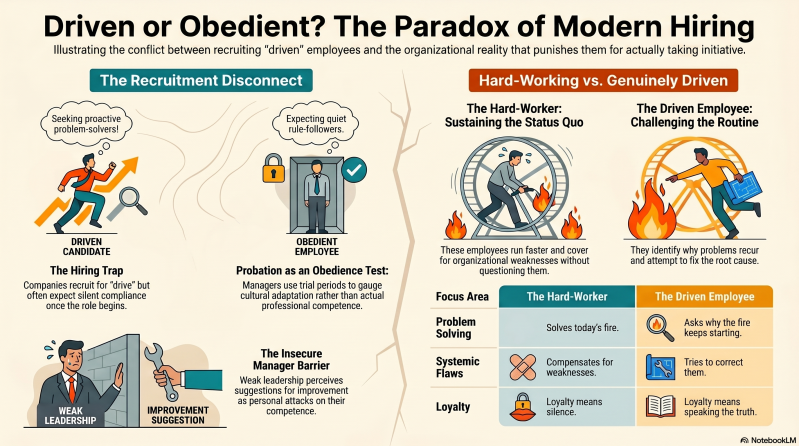
Probation as an Obedience Test
A probationary period is supposed to give both employer and employee a chance to assess whether the cooperation works. That is reasonable in principle. Qualifications, interviews and references can never fully demonstrate how someone will perform in practice.
The problem begins when probation is used as a silent obedience test.
The main question is no longer whether the employee is competent.
Instead, the questions become:
Will the new employee adapt to the existing culture?
Will they accept the way we have always done things?
Will they understand which questions must not be asked?
Will they remain quiet until their position is secure?
A new employee is in a vulnerable position. They want to prove themselves, build trust and demonstrate their value. At the same time, a newcomer often notices things that long-term employees have stopped reacting to.
What has become normal to the established staff may seem completely unreasonable to someone arriving from outside.
It may involve a lack of information, poor working conditions, favouritism, safety risks or managers who blame others whenever something goes wrong. The new employee may genuinely believe that speaking up will be appreciated. After all, the company said it wanted someone driven and solution-oriented.
But the employee may quickly discover that the words in the job advertisement meant something else.
The employer wanted initiative—but only initiative that did not disturb the balance of power.
“Sit Still in the Boat” Is Not Always Good Advice
There are situations in which waiting is sensible. A newcomer does not have the complete picture. Organisations are complex, and not everything that initially appears strange is necessarily wrong. There may be historical reasons, contractual obligations or practical limitations that the employee does not yet understand.
It is therefore wise to listen, observe and understand the context before reaching conclusions.
But the phrase “sit still in the boat” is also used to defend things that should be changed.
In those situations, it really means:
Do not make the manager uncomfortable.
Do not point out that the planning is failing.
Do not ask who is responsible.
Wait until your employment is secure.
The problem is that some issues cannot wait. If people are at risk of injury, money is being wasted, customers are being misled or the working environment is damaging employees, silence is not neutral.
Silence then becomes a way of allowing the problem to continue.
Sitting still in the boat sounds wise—until you realise that the boat is heading directly towards the rocks.
The Insecure Manager Hears a Personal Attack
A secure manager does not need to be the most knowledgeable person in every situation. That is one of the most important lessons of leadership.
A manager’s role is not to master every technical detail alone. It is to create an environment in which knowledge can be used.
When an employee identifies a problem, a secure manager can say:
“Tell me what you have noticed.”
“What do you think the consequences will be?”
“How could we solve this?”
An insecure manager hears something completely different.
When the employee says, “This routine is not working,” the manager hears, “You are incompetent.”
When the employee says, “This is a safety risk,” the manager hears, “You have failed.”
When the employee says, “We need to rethink this,” the manager hears, “I should be in charge instead of you.”
The reaction then becomes personal. The manager defends their position rather than investigating the issue.
In the worst cases, the probationary period becomes a tool for removing the person who has seen too much.
Experience Can Be Perceived as a Threat
Senior employees often find themselves in this situation.
Experience means recognising patterns. Someone who has worked through many projects, crises and organisational changes can often see at an early stage where a certain development is heading.
That is not pessimism.
It is pattern recognition.
An experienced person may see that the schedule is unrealistic, the budget will not hold, the distribution of responsibility is flawed or a safety problem is likely to become worse. They may also understand the consequences because they have seen similar situations before.
For a secure organisation, that experience is invaluable.
For a weak manager, the same experience can feel threatening.
The experienced employee is harder to convince with empty statements. They are not satisfied with hearing that “everything will work out.” They ask who will make it work, when it will happen and what resources are available.
Experience cuts through the façade.
This may be one reason why senior candidates are sometimes rejected during recruitment. They are described as overqualified, expensive or difficult to shape.
But sometimes the real reason is something else:
They have seen too much to be easily silenced.
A Driven Person Must Also Be Strategic
At the same time, driven employees need to understand that the way an issue is raised matters.
Being right does not automatically mean that you will succeed in creating change.
A person may move too quickly, criticise someone publicly or present a long list of problems without suggesting a realistic way forward. Frustration may take over, particularly when the problem seems obvious.
That is human, but it is not always effective.
Anyone who wants to change something often needs to combine courage with strategy.
Document what is happening.
Describe the risk clearly.
Show the likely consequences.
Present possible solutions.
Separate the person from the method.
Choose the right time and the right forum.
This does not mean softening the truth until it becomes harmless. It means presenting the message in a way that makes it harder to dismiss.
Even so, there are organisations in which no level of diplomacy is enough. In those environments, the very desire to improve the business is perceived as a threat.
At that point, the problem is no longer communication.
The problem is the culture.
Companies Need to Be More Honest
Perhaps employers should be more honest in their job advertisements.
Instead of writing, “We are looking for a driven person,” some should write:
“We are looking for someone who works hard within our existing structure.”
“We appreciate initiative as long as it is approved from above.”
“We want employees to take responsibility, but management decisions should not be questioned.”
At least that would be honest.
Because there is an important difference between a hard-working person and a genuinely driven person.
The hard-working person runs faster.
The driven person asks whether the organisation is running in the right direction.
The hard-working person solves today’s problem.
The driven person tries to understand why the same problem appears every day.
The hard-working person compensates for weaknesses.
The driven person wants to correct them.
The second type demands more from leadership. It requires managers who can be questioned without feeling threatened. It requires organisations that understand that loyalty does not always mean silence.
Sometimes, the most loyal person is the one who says what nobody else dares to say.
What Does a Culture of Silence Cost?
When a critical and competent employee disappears during the probationary period, management may feel relieved.
The conflict is gone.
The team becomes quieter.
Nobody asks uncomfortable questions.
But the problem has not been solved.
It remains inside the organisation.
Perhaps it grows slowly. Perhaps it becomes more expensive. Perhaps it causes more skilled employees to leave. Eventually, the weakness may become too serious to hide.
By then, the person who first warned about it is no longer there.
A culture of silence creates obedience in the short term but weakens the organisation in the long term. When employees learn that criticism is punished, they stop reporting problems.
Management then receives less and less accurate information and begins making decisions based on an increasingly polished version of reality.
Eventually, leaders may genuinely believe that the organisation is functioning well—because nobody dares to tell them otherwise.
Driven or Obedient?
Employers therefore need to decide what they actually want.
Do they want people who genuinely think independently?
Or do they want obedient employees who work hard but do not disturb anyone?
Both types may serve a purpose, but they are not the same.
A genuinely driven person will eventually notice things that need to change. They will ask questions, suggest new approaches and sometimes challenge decisions.
That is not a flaw in their personality.
That is the very nature of drive.
If an employer cannot handle this, perhaps they should stop using the word in recruitment.
Because anyone who wants initiative without questions, responsibility without influence and commitment without criticism is not looking for a driven person.
They are looking for someone who obeys.
When the Boat Needs to Change Course
The phrase “sit still in the boat” is based on the idea that movement creates instability. Sometimes that is true. Panic and poorly considered action can make a situation worse.
But stability is not always the same as safety.
A boat can remain perfectly still and still drift towards the rocks.
In that situation, the person who stands up and gives a warning is not the problem. The problem is the person who continues steering in the wrong direction while demanding that everyone else remain silent.
Working life needs more people who dare to see, think and speak.
But it also needs managers who understand the difference between disloyalty and responsibility.
A genuinely driven employee is not always comfortable to have around.
Sometimes they are the person who says that the emperor has no clothes, that the plan will not work or that the safety measures are inadequate. Sometimes that is exactly the person who saves the project, the company’s finances or the people around them.
But only if the organisation listens.
Otherwise, the driven employee is removed at the end of the probationary period while everyone else remains seated in the boat.
Still, silent and obedient.
Heading towards the same rocks that someone already tried to warn them about.

By Chris...
Add comment
Comments