

The Story of Studio Vivaldi, the Music House in Mölndal, and VMA
There was a time when music was not created by opening a laptop at the kitchen table. There were no ready-made drum loops to download, no digital amplifiers, and no hundreds of audio tracks that could be edited at almost no cost. Anyone who wanted to record music needed microphones, tape machines, mixing consoles, technicians, and above all, access to a real studio.
For many young bands, the step from the rehearsal room to the recording studio was almost impossible to take. Studios were expensive, the technology was complicated, and the doors of the record companies were often closed. But on Kvarnbygatan in Mölndal, during the late 1970s and early 1980s, something began to grow that tried to change all of that.
It was called Vivaldi Studios.
Studio Vivaldi was not simply a place where musicians recorded their songs. The operation developed into a complete music house with recording studios, rehearsal rooms, education, a music café, publishing activities, record releases, and promotion. There was also VMA, the part of the organisation that worked to carry the music forward from the rehearsal rooms and the studio to the stages and the audience.
It was an idea far ahead of its time.
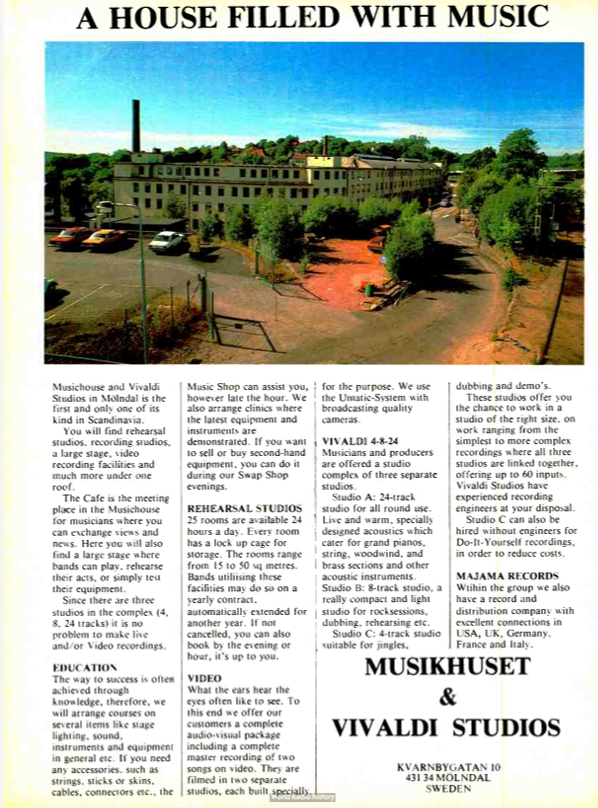
An Old Industrial Environment Filled with Music
Vivaldi Studios was located in an older industrial setting in Mölndal’s Kvarnby district, close to the waterfalls and former factory buildings that had shaped the area for generations. The building had previously belonged to an industrial world where machinery, textiles, and production had been at the centre of daily life.
Now the rooms would be filled with a different kind of energy.
Among those involved in building the operation were Marcello Manci and Björn Asplind. According to documentation from Mölndal City Museum, they largely built up the facilities themselves. This was not simply a matter of buying a mixing console and placing a few microphones in a room. The premises had to be rebuilt, soundproofed, and adapted. Technical equipment had to be installed, cables had to be laid, and rooms had to be designed so that music could be recorded at a professional level.
In a recording studio, the room itself is part of the instrument. The materials of the walls, the shape of the ceiling, and the size of the space all affect the sound of drums, guitars, and voices. A badly designed room can create resonances and make a recording sound muddy. A well-designed room can give the music life.
Building a studio therefore required both technical knowledge and musical understanding.
But the vision for Vivaldi was much greater than that.
From Recording Studio to Music House
A complete musical environment grew around the studio. Historical accounts describe how Vivaldi included three recording studios, a music café, a music publishing company, a record label, and a large number of rehearsal rooms.
At one point, around 44 groups are said to have rehearsed in the building.
It must have created a very special atmosphere.
Behind one door, perhaps a heavy metal band was rehearsing. In the next room, a progressive rock group might be working through complicated time signatures. Somewhere, a singer was trying to find the right note, while a sound engineer in the studio adjusted microphones around a drum kit.
In the corridors, musicians met who might otherwise never have crossed paths. Someone needed a bass player. Someone else was looking for a drummer. One band had a concert but lacked equipment. Another had written songs but did not know how to record them.
In this way, Vivaldi became a social and creative meeting place. The technology alone was not what made the house important. It was the people.
Many of the most important moments in music history emerge in environments like these. Someone hears a band through a wall. A musician is recommended to another group. A producer discovers a singer. A new band is formed over a cup of coffee.
Long before expressions such as creative hub, innovation environment, and cultural incubator became fashionable, Vivaldi had created something that resembled all three.
Knowledge Was Meant to Be Shared
One of the most interesting parts of Vivaldi’s activities was its educational work.
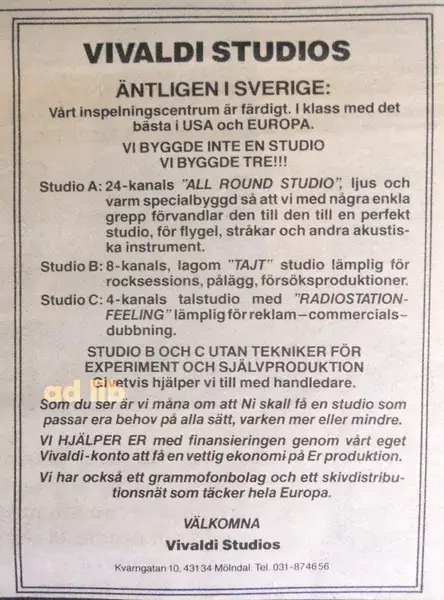
In an advertisement from 1980, Vivaldi Studios presented what it described as Sweden’s first school for recording technology and studio design. The courses focused both on how to work as a sound engineer and on how to build a studio of your own.
It can be difficult today to understand how important this was.
A young musician can now learn recording technology through thousands of videos online. Within minutes, it is possible to find tutorials on microphone placement, compression, mixing, or acoustics. In the early 1980s, such knowledge was much more closed and difficult to access.
It was often passed from an experienced engineer to an assistant. Anyone who did not have access to a professional studio also had little chance of learning the craft.
Vivaldi tried to open up this world.
The studio therefore became more than a place for established artists. It became a school for future sound engineers, producers, and studio designers. Students were able to work with real equipment and learn in the same environment where the technology was actually being used.
This was characteristic of Björn Asplind’s later work. He went on to become deeply involved in music and audio education. The experience gained at Vivaldi contributed to a broader effort involving Swedish music houses, educational materials, and training programmes for sound engineers.
What began in a building in Mölndal spread much further.
Professional Technology and International Ambitions
Vivaldi was not a simple demo studio in a converted garage. It was equipped with professional technology and built with the ambition of competing at a high level.
Sound engineer and studio designer Bo Hansén has spoken about his involvement in the studio and about the installation of an Echoplate EP-2. This was an electromechanical plate reverb, a large device in which a metal plate was set into motion in order to create reverberation.
Before digital technology became dominant, this was one of the most advanced ways of giving voices and instruments a larger, richer sound. Plate reverbs were used in professional studios around the world.
Vivaldi’s ambitions were also noticed outside Sweden. In 1983, the operation was featured in the international industry magazine International Musician and Recording World. The music house in Mölndal was presented as Studio of the Month and described as a house filled with music.
That was a significant recognition.
At a time when the great studios of London, Los Angeles, and New York dominated the imagination of the music industry, a studio in Mölndal was receiving international attention. Not only because of its technical equipment, but because of the complete concept behind it.
Vivaldi demonstrated that a studio could be part of a larger ecosystem.
VMA – The Road from the House to the Stage
But music does not come alive merely by being recorded.
It needs to meet an audience.
This was where VMA entered the picture. VMA was connected to the wider Vivaldi environment and worked as a promoter. The exact legal structure and the full meaning of the abbreviation are difficult to establish through the digital archives available today, but its function was clear: someone had to build the road between the artists and the venues.
A promoter works at the point where music meets reality.
The job involves contacting organisers, booking venues, marketing concerts, and convincing people to buy tickets. It involves finances, posters, transport, equipment, schedules, and agreements. It is work that is rarely seen from the stage, yet it determines whether the concert happens at all.
Through VMA, the world of Vivaldi could continue beyond the walls of the building.
A band could, in the best possible scenario, begin in one of the rehearsal rooms, develop its songs, record them in the studio, and then receive help reaching stages and audiences. The publishing and record-label activities could handle the music itself, while the promotional side worked with performances and exposure.
It formed a complete chain:
From idea to rehearsal.
From rehearsal to recording.
From recording to release.
From release to the stage.
It is precisely this complete structure that makes Studio Vivaldi so historically interesting.
The Bands That Came and Went
There is no complete public record of all the artists who rehearsed or recorded at Vivaldi. Much of the activity took place during a period when information was not preserved digitally.
Instead, the story is scattered.
It can be found on the back covers of old vinyl records. It exists on cassette tapes stored in boxes, in newspaper advertisements, photographs, posters, and forgotten binders. Above all, it survives in the memories of the people who were there.
The band Nadir is one example of a group that recorded material at Studio Vivaldi. Recordings by other groups have also been identified over the years as having been made there. Some were released on vinyl. Other recordings may have remained only on cassette or master tape.
It is likely that many of the bands never became nationally known.
But that does not make the operation less important.
Music history is not made only by artists who sell millions of records. It is also made by all the local groups that rehearse night after night, by technicians learning their craft, and by promoters creating the first opportunities to perform.
For a young musician, the first studio recording can be a life-changing moment, even if the record never reaches the charts.
Suddenly, the music becomes real.
A Legacy That Reached Beyond the Building
The experience gained at Vivaldi later influenced the development of music houses and music education in other places. Björn Asplind continued working with models for music houses within Swedish study associations and with educational material covering recording, lighting, rhythm, and music production.
The idea was that musicians needed more than a rehearsal room.
They needed knowledge, structure, and access to technology. They needed a place where they could develop together with others.
That idea may seem obvious today, but it was far more radical when Vivaldi was first established. At that time, the music industry was often divided into separate and closed worlds. The rehearsal room was in one place, the studio in another, the record company somewhere else, and the concert organiser in yet another world.
Vivaldi tried to bring all of these parts together under one roof.
When the Echo Still Remains
Buildings change. Companies close and people move on. Mixing consoles are replaced, master tapes disappear, and posters fade.
But some places leave an echo behind.
Studio Vivaldi was one of those places.
Its importance did not lie only in which records were made there or which equipment stood in the control room. Its importance lay in the idea itself: to create an environment where music could develop from the first uncertain rehearsal into a finished recording and then continue onward to an audience.
Studio Vivaldi, the Music House, and VMA together represented a time when people built opportunities with their own hands. They constructed walls, laid cables, installed equipment, and opened doors for musicians.
For some, Vivaldi may have been nothing more than an address in Mölndal.
For others, it was the place where they first heard their own voice through real studio monitors. The place where the band began to take shape. The place where they learned how a mixing console worked, or where someone gave them their first concert opportunity.
It was a house where music was not only recorded.
It was rehearsed, taught, discussed, promoted, and performed.
And even though the instruments in the old rooms fell silent long ago, the story lives on — in the people, the recordings, and the Swedish music scene that Vivaldi helped to build.

By Chris...
Add comment
Comments