

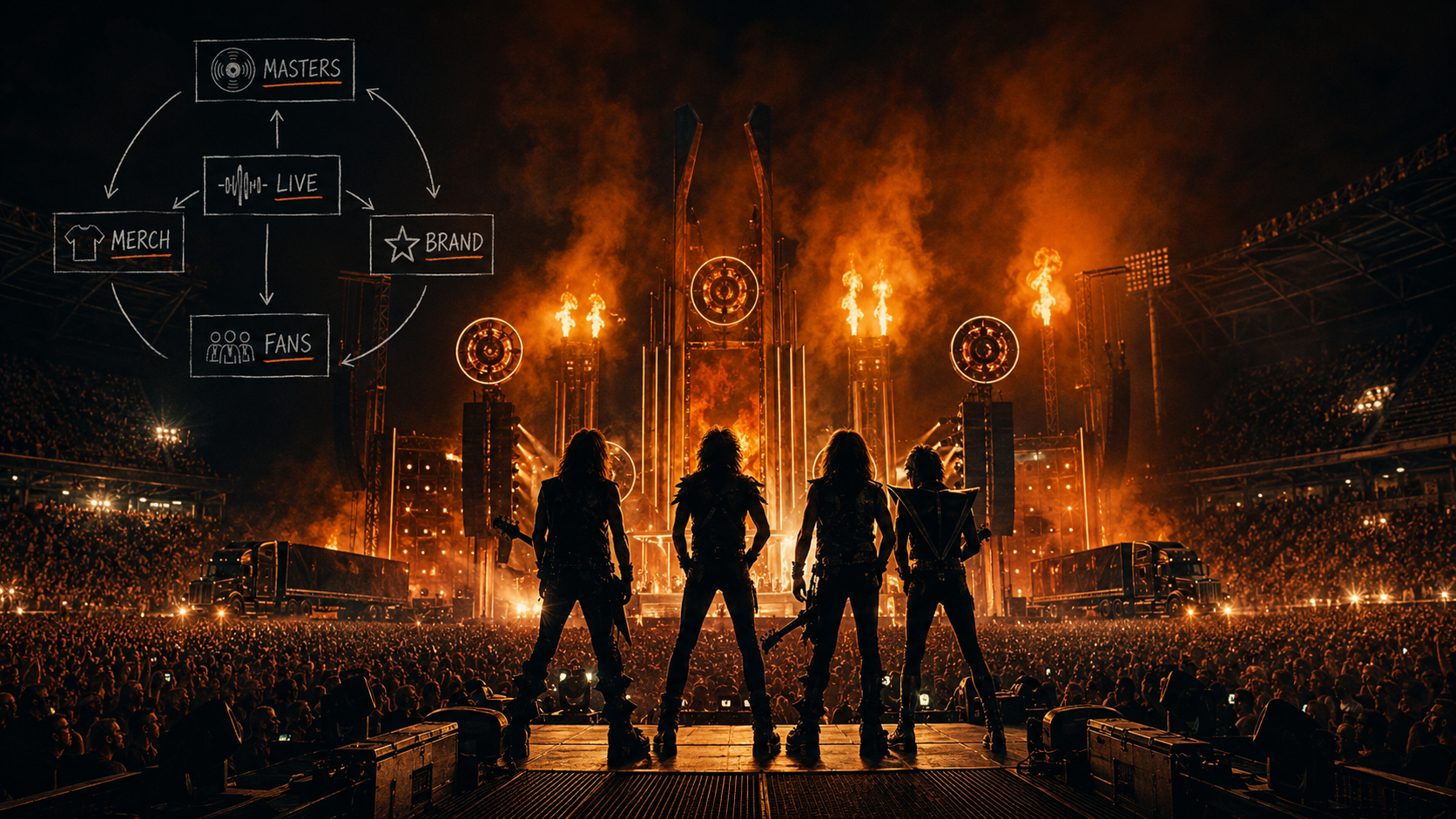
For most new bands and artists, the dream begins in the right place: a rehearsal room, a bedroom studio, a borrowed microphone, one great chorus, and the feeling that something real might be starting.
The danger comes later.
Too many artists spend years trying to get discovered without asking the question that matters most: if success comes, what will still belong to you?
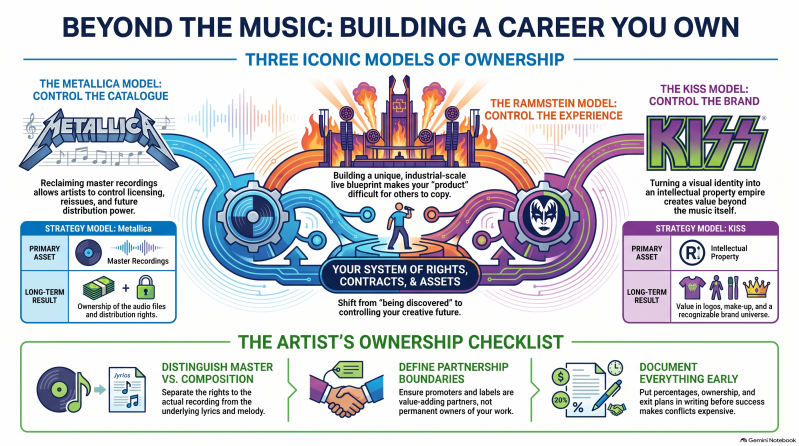
Metallica, Rammstein, and KISS offer three powerful answers. Metallica built long-term control around recordings, catalogue, brand, and fan relationships. Rammstein created one of modern music’s most disciplined live-production machines. KISS turned a rock band into a global intellectual-property empire.
None of them became successful because of contracts alone. They became successful because they made music and live experiences that people cared about. But their business choices ensured that, when the success arrived, they were not simply employees inside someone else’s system.
That is the lesson for emerging bands and artists everywhere.
Whether you are making metal in Bulgaria, punk in Brazil, electronic music in Berlin, hip-hop in South Africa, indie rock in Sweden, or pop from a bedroom in the Philippines, the scale may differ. The principle does not.
Music is art. But a music career is also a system of rights, decisions, contracts, data, relationships, and assets. If you do not understand that system, somebody else will. And they may own the best parts of the future you create.
The Song Is the Beginning, Not the Business
A great song can create attention. A strong video can create momentum. A powerful concert can turn strangers into fans.
But none of those things automatically creates a sustainable career.
Around every release sits a whole structure:
- the master recording
- the songwriting and composition
- publishing rights
- the artist name and logo
- merchandise
- ticketing
- visual content
- live-show concepts
- social media accounts
- fan data and email lists
- sync opportunities in film, television, games, and advertising
- production files, artwork, photography, and archive material
Many new artists see these things as boring details. They want to write, record, release, and play. That is understandable. But the boring details are often where the money, control, and freedom live.
When you are unknown, it is easy to give rights away. A label offers money for recording. A producer offers to handle everything. A manager promises connections. A promoter says they can get you on a festival stage. A distributor offers a deal that sounds impressive but quietly takes control of your recordings.
None of these people are automatically the enemy. A good label, manager, producer, promoter, booking agent, or investor can move a career forward faster than an artist can alone.
But you must understand the deal.
What are you giving away? For how long? What are they investing? What do they actually have to deliver? And what happens if they stop doing the work?
The best partnerships make an artist stronger. The worst ones make an artist visible while someone else owns the future.
Metallica: Control the Catalogue
Metallica’s story is often reduced to record sales, stadium tours, and enormous wealth. But one of their most important victories happened in the world of contracts.
Like many young bands of their era, Metallica signed a traditional major-label deal. The label owned the master recordings. That was standard practice. Labels paid for recording, manufacturing, distribution, and promotion. In return, they controlled the recorded product.
But Metallica and their management, Q Prime, understood something many artists only discover too late: a master recording is not just a song release. It is an asset that can earn for decades.
In 1994, at the commercial peak that followed The Black Album, Metallica renegotiated with Warner. A key part of the agreement meant that the band’s master recordings would eventually revert to them.
In 2012, that happened. Metallica took control of its masters and launched Blackened Recordings.
That does not mean that every dollar from every Metallica song goes directly into the band’s bank accounts. There are publishers, distributors, streaming platforms, producers, employees, taxes, advisers, and other costs. Music is never that simple.
But ownership changes the position of power.
When you own the master, you have a stronger say over licensing, reissues, deluxe editions, archive releases, distribution deals, films, games, documentaries, and future uses of your music. You are not only waiting for a royalty statement from someone else. You own the recording.
For a new artist, that matters more than ever.
Your first single may only receive a few thousand streams. But the song could be rediscovered five years later. It may fit a film scene. It may become a gaming sync. It may become the track fans find through a viral clip. It may be the song that defines your career.
If you gave away the master forever at the beginning, someone else may benefit from the moment you finally break through.
Know What You Actually Own
One of the most dangerous sentences in music is: “We own the rights.”
Which rights?
The master recording is the actual recorded version of a song: the audio file released to Spotify, YouTube, vinyl, CD, or any other format.
The composition is the underlying song: lyrics, melody, chords, and musical structure. This is usually connected to songwriting and publishing.
These can be owned by different people.
A band may own its masters but have assigned publishing rights to someone else. A songwriter may own their publishing share but have no control over the released recording. A producer may have royalty participation. A featured artist may have a share. Session musicians may need written agreements.
Before you enter the studio, ask:
Who owns the master?
Who wrote the song?
What percentage does each writer own?
What does the producer receive?
Are session musicians paid in full, or do they have future claims?
Can the music be licensed without every band member agreeing?
What happens if a member leaves?
Put the answers in writing.
Most music conflicts do not begin with evil intentions. They begin with friendships, enthusiasm, vague memories, and the sentence: “We will sort it out later.”
Later is where problems become expensive.
Rammstein: Control the Experience
If Metallica is a lesson in controlling recorded music and long-term assets, Rammstein is a lesson in controlling the live experience.
Rammstein do not simply go on stage and play songs. They create an industrial-scale world. The stage, lighting, pyrotechnics, timing, costumes, sound, visual language, safety systems, transport, crew culture, and audience expectation are all part of one recognisable product.
When you see a Rammstein stadium show, you are not just seeing a concert. You are entering a carefully designed universe.
That level of control is commercially powerful because it makes the product difficult to copy.
A local promoter can book a venue. A festival can build a stage. A production company can provide equipment. But they cannot easily recreate the specific Rammstein experience. The identity belongs to the band and its production ecosystem.
Rammstein do not build every truss, operate every lamp, or employ every local worker directly. Their stadium productions rely on specialist suppliers, local crews, venue staff, safety authorities, and professional partners.
But the band’s side controls the blueprint.
They define what the show is. They set the production standard. They bring their own key people, systems, creative direction, touring infrastructure, and technical knowledge. Local partners are not asked to invent Rammstein. They are asked to execute the Rammstein model.
That is a completely different position from an artist who arrives at a venue, accepts whatever production is available, plays their set, and leaves with little control over the result or the business around it.
The lesson for new artists is not: “Hire a stadium.”
The lesson is: build a show that is recognisably yours.
KISS: Turn the Band Into a World
If Metallica teaches artists to protect the catalogue, and Rammstein teaches them to control the live experience, KISS teaches a third lesson: build a brand that can exist beyond the music itself.
KISS understood early that the band was not only four musicians, a setlist, and a collection of albums. It was a visual language. The make-up, characters, logo, costumes, stage personalities, fan-club identity, and attitude made KISS instantly recognisable even to people who could not name a single song.
That recognition became commercial power.
For decades, KISS turned the band into a licensing universe: T-shirts, posters, comic books, pinball machines, toys, games, collectibles, and products that ranged from the obvious to the absurd. Some fans disliked it. Others loved it. But the strategy was clear: every product reinforced the identity of the band and made the KISS world larger.
The important lesson is not that every artist should put their face on a lunchbox.
The lesson is that a powerful artist brand is an asset.
A logo is not decoration. A visual identity is not an afterthought. A fan club is not merely a mailing list. A limited-edition shirt is not only merchandise. Together, they create a world people can enter, identify with, collect, and carry into their daily lives.
KISS also shows the final stage of intellectual-property value. In 2024, the band sold its music catalogue, name, likeness, trademarks, and iconic face-paint designs to the Swedish entertainment company Pophouse in a deal reported at more than $300 million.
The buyer did not only purchase old songs. It acquired a complete cultural universe with potential for exhibitions, films, avatars, licensing, merchandise, and future experiences.
That is what happens when a band becomes bigger than its current members, latest album, or next tour.
For emerging artists, the point is not to think about a nine-figure sale before releasing your first song. The point is to understand that every decision shapes your future value.
Choose a name you can protect. Create a visual identity that people recognise. Use merchandise that genuinely belongs to your world. Protect your logo, photography, artwork, and concepts. Build a community that feels part of something.
Metallica’s model says: own the music.
Rammstein’s model says: own the show.
KISS says: own the world around both.
Promoters Are Partners, Not Owners of the Artist
There is a myth that artists must choose between total control and working with promoters. That is not true.
The strongest touring model is not about eliminating every outside partner. It is about making sure the artist is not passive inside the deal.
A promoter should contribute real value: local market knowledge, venue relationships, marketing, ticketing, risk, staffing, permissions, logistics, and financial guarantees. In return, they earn a fair share of the business.
But an artist should understand the structure.
Who rents the venue?
Who carries the financial risk?
Who pays production costs?
Who owns the ticketing data?
Who controls merchandise?
Who chooses support acts?
Who has final approval over the show?
Who owns video footage and recordings from the concert?
What happens if the show sells out?
Rammstein’s strength is not that they live in a world without promoters. Their strength is that the promoter is part of a much larger artist-controlled system. The show does not become someone else’s product simply because it happens in someone else’s stadium.
For a new band, this may begin with a smaller question: can we produce our own club night? Can we bring our own visuals? Can we sell our own shirts? Can we film the show? Can we collect email addresses? Can we negotiate a fair deal instead of accepting the first offer?
Small control becomes larger control over time.
Napster and the Value of Your Work
Metallica’s Napster lawsuit remains one of the most controversial moments in modern music history.
The band discovered that an unreleased demo of “I Disappear” had leaked online before its official release. Their catalogue was also being shared widely without permission. Metallica sued Napster, and Lars Ulrich became the public face of the battle.
Many fans saw rich musicians attacking ordinary listeners. The backlash was enormous.
But the underlying issue was real: artists should have the right to decide when and how their work is released. If a band has spent months or years creating an album, they should not lose control because technology makes copying easy.
Metallica may have been right in principle, but they learned a hard lesson about communication.
Being legally right is not the same as being emotionally understood.
For artists today, the lesson is clear. Protect your work. Register it. Track where it is used. Challenge theft or misuse when necessary. But communicate like a human being.
Your fans are not simply customers. They are people who have chosen to make your music part of their lives. If conflict comes, explain why it matters. Tell them about the people, time, money, emotion, and craft behind the release.
A career is built on trust as much as ownership.
Touring Is a Product, Not Just Promotion
For decades, touring was often described as a way to sell albums. Today, the model has changed.
Music creates discovery. Live performance creates commitment.
A great live show turns a casual listener into a fan. It creates memories. It gives merchandise meaning. It produces content. It creates stories people tell their friends. It gives the audience something they cannot experience through a phone screen.
Metallica’s stadium machine, Rammstein’s production world, and KISS’s brand universe are three different examples of the same principle: artists become stronger when every part of the experience feels connected.
A new artist does not need flames, towers, trucks, or a million-euro production budget.
But you need to ask: what makes our show ours?
Is it the sound? The lighting? The storytelling between songs? The costumes? The visual world? The way the audience participates? The venue choice? The way the room feels when the first song begins?
The goal is not to look expensive. The goal is to become memorable.
Build something you can repeat, improve, document, and eventually scale.
Build Slowly Enough to Keep What Matters
The pressure on emerging artists is relentless. Post every day. Release constantly. Chase playlists. Buy ads. Play every show. Say yes to every offer.
But speed is not the same as progress.
Your first goal is not fame. It is durability.
Make strong music. Build a real audience. Keep organised records. Register your songs. Save your masters, stems, artwork, contracts, photographs, videos, lyric sheets, and metadata. Build a direct mailing list. Treat your artist name as a real asset. Learn enough about the business to ask better questions.
And above all, make work worth owning.
Metallica’s lesson is to protect the catalogue.
Rammstein’s lesson is to protect the experience.
KISS teaches artists to protect and develop the brand world around both.
Together, they show three routes to long-term strength: own the music, control the live product, and build an identity that fans recognise even when the stage is dark.
Don’t just build a band.
Build the songs, the show, the visual world, the fan relationship, and the future that belongs to you.

By Chris...
Add comment
Comments