

Burgas will host the Eurovision Song Contest 2027, and the city’s Puppet Theatre has already launched a possible mascot: Euroglarus. On the surface, he is a colourful Black Sea seagull – free-spirited, musical and slightly eccentric. But for anyone familiar with Bulgarian cultural history, the word “glarus” carries a far more loaded meaning. It is also the name given to the legendary womaniser of the Black Sea coast – a Bulgarian Casanova who, for decades, sought romance, adventure and foreign women along the country’s holiday beaches. If Euroglarus becomes the mascot of Eurovision 2027, Europe may therefore encounter a character with a far more fascinating backstory than first meets the eye.
On 13 August 2026, it became official: Burgas was selected as the host city for the Eurovision Song Contest 2027. The 71st edition of the competition will take place on the Black Sea coast, with the semi-finals on 11 and 13 May and the Grand Final on 15 May 2027. Arena Burgas will serve as the main venue, while the wider city is expected to become part of the Eurovision experience through Eurovision Village, EuroClub and other cultural activities.
The ambition is clear. The first Eurovision Song Contest to be held in Bulgaria should feel international while remaining distinctly Bulgarian. Eurovision Executive Supervisor Martin Green described Burgas as a city with a strong musical and cultural identity, emphasising the ambition to create something authentically Bulgarian while remaining unmistakably Eurovision. And only days after the announcement, a character appeared who almost feels tailor-made for the role.
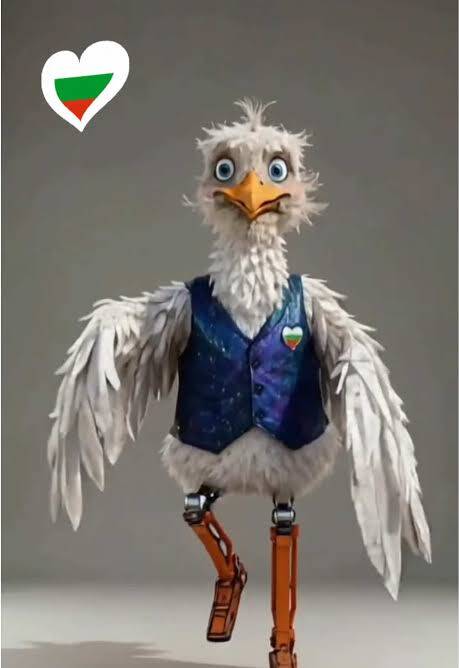
Euroglarus.
The State Puppet Theatre in Burgas presented the idea of using a giant seagull figure as a symbol for Eurovision 2027. The character is a stilt puppet already known from the street performance Burgas Gulls, created under the direction of theatre director Petar Todorov. The theatre describes the seagull as freedom-loving, colourful and artistic – a natural part of Burgas’ identity.
Even the bird’s distinctive cry has been humorously described as part of the city’s musical soundscape.
It is charming.
It is local.
It is visual.
It works perfectly for television and social media.
But this is where things become truly interesting.
Glarus Does Not Only Mean Seagull
To an international Eurovision audience, Euroglarus will probably appear simply as a funny seaside bird.
For many Bulgarians, however, there is another layer.
The word glarus has for decades been used to describe a particular kind of man along Bulgaria’s Black Sea coast – something between a beach flirt, womaniser, charmer and Casanova.
Originally, the word referred to a seabird and was used regionally, particularly along the southern Black Sea coast. In Burgas, the term was documented as early as the beginning of the twentieth century. Over time, however, the same word developed a human meaning: a young man who spent his summers around hotels, restaurants and beaches, particularly interested in meeting foreign female tourists.
The Bulgarian glarus therefore became more than simply a man looking for women.
He became a cultural character.
Almost a folklore figure in his own right.
Bulgaria’s Casanova Was Born by the Sea
Imagine Bulgaria’s Black Sea coast during the 1960s, 70s and 80s.
Bulgaria is behind the Iron Curtain. For ordinary Bulgarians, travelling to Western Europe is heavily restricted.
But every summer, the world comes to Bulgaria instead.
Golden Sands.
Sunny Beach.
Nessebar.
Varna.
Burgas.
Hotels fill with tourists from East Germany, Czechoslovakia, Poland and the Soviet Union, but also with visitors from Western Europe.
Young Bulgarian men work on the beaches as lifeguards, hotel employees, construction workers and service staff.
And suddenly, there are women arriving from a world that might otherwise seem impossibly distant.
Out of this environment grows the mythology of the glarus.
The classic glarus is remembered as young, attractive, tanned, confident and talkative. He knows the beaches, the bars and the hotels. He knows which tourist groups have just arrived.
And above all, he is very interested in foreign women.
Naturally, much of this is folklore. Stories grow every time they are retold.
But the phenomenon became powerful enough to establish itself as part of the collective memory of Bulgaria’s Black Sea coast.
Pandira – The Man Who Became a Legend
And like every good legend, the glarus has his own historical protagonist.
Petko Blagoev-Pandira.
Pandira was a famous lifeguard on the beach in Burgas and has subsequently been described as “the first Bulgarian glarus.”
According to historical accounts, Pandira and four other young lifeguards were already known in 1939 for their athletic physiques, while stories of his romances and encounters with foreign women gradually became part of local folklore.
This changes the picture of the glarus.
The phenomenon was therefore not necessarily created by communism.
It existed before it.
But the socialist period provided almost perfect conditions for it to grow into a larger cultural figure.
The foreign woman did not represent only a summer romance. She could also represent another world – different languages, travel, clothes, music, consumer goods and stories from places that the young Bulgarian man might never have been able to visit himself.
In his own peculiar way, the glarus became a person moving between worlds.
And now, almost a century later, his name may find itself at the centre of Eurovision.
From Casanova to Euroglarus
This is where the situation becomes almost irresistibly funny.
The Burgas Puppet Theatre has, of course, not presented Euroglarus as an erotic character.
Quite the opposite.
Their Euroglarus represents the sea, freedom, creativity, colour and the cultural identity of Burgas. The character is based on the actual bird and on an existing theatrical production.
But culture does not always behave the way marketing departments expect.
Words carry history.
Symbols carry memories.
And when you choose the name Euroglarus, the human glarus inevitably comes along with it.
That means Burgas may have created a Eurovision character with something many modern mascots lack:
a real history.
He does not need to be invented in a conference room.
He does not need an artificial backstory about friendship, music and dreams.
The backstory already exists.
And it is considerably more entertaining.
It May Be Exactly What Eurovision Needs
Eurovision has evolved far beyond the three-minute songs performed on stage.
The host city itself has become part of the product.
The city appears in television broadcasts, social media, artist introductions, opening ceremonies, Eurovision Village and in hundreds of thousands of photographs and videos produced by the fans themselves.
In that environment, a strong symbol can be enormously valuable.
And Euroglarus has one quality that is difficult to purchase:
he comes with a story.
First, you tell people about the seagull.
Then you tell them about Burgas.
Then somebody asks:
“But why is it called glarus?”
And suddenly the door opens into Bulgarian history.
Now we are among lifeguards, holiday resorts, foreign women, hotels and the strange social world of socialist tourism.
There are even stories from Bulgaria’s coast claiming that the militia once sent women undercover to investigate what the local charmers were actually getting up to.
It is difficult to imagine a more colourful background story for a Eurovision mascot.
But Bulgaria Has to Dare to Tell the Story
There is also a risk.
The easiest option would be to polish everything away.
Euroglarus would simply become:
“A colourful seagull symbolising freedom, music and the sea.”
Pleasant.
Safe.
And rather predictable.
The more interesting approach would be for Bulgaria to use its own sense of humour.
There is no need to glorify an old macho culture or present the behaviour of the beach womaniser as some kind of ideal for 2027.
But there is also no reason to pretend that the historical meaning of the word never existed.
It can be told with humour and self-awareness.
The old glarus chased women from across Europe. The new Euroglarus welcomes all of Europe to Burgas.
There is almost an entire campaign in that sentence alone.
The old one stood on the beach waiting for tourists.
The new one stands on the beach waiting for Eurovision.
The old one tried to charm the women of Europe.
The new one has to charm the whole of Europe.
There is something wonderfully Bulgarian about that transformation.
Burgas Can Turn Its Own History Into an Asset
When Burgas was chosen to host Eurovision, the decision was not simply about Arena Burgas.
The wider vision involves hotels, transport, international connections, the commitment of the municipality and the ability to turn the whole city into part of the Eurovision experience.
That means Eurovision 2027 is not only about what happens inside the arena.
The sea is part of the scenery.
The beach is part of the story.
The people of the city are part of the story.
And this is precisely why the glarus fits so strangely well.
The original human glarus was also a product of exactly the same phenomenon: Burgas and the Bulgarian Black Sea coast meeting people from other countries.
He existed because people travelled there.
He existed because languages and cultures met.
He existed because every summer temporarily transformed the coastal cities.
Eurovision will do something remarkably similar in May 2027 – only on an enormous scale.
Artists, journalists, delegations and fans from across Europe and beyond will travel to Burgas, while a television and online audience of hundreds of millions will turn its attention towards Bulgaria.
The question then becomes:
What does Bulgaria want to show them?
A perfectly polished international façade?
Or something that could genuinely only come from Bulgaria?
A Mascot With a Past
Euroglarus is, at this stage, still a proposal rather than a confirmed official Eurovision mascot.
But perhaps the discussion itself is almost as interesting as the final decision.
Because behind this slightly mad-looking bird lies something much larger.
A city.
A sea.
A tourism culture.
A socialist era.
Generations of summer stories.
And the Bulgarian Casanova standing sunburnt on the beach, trying to charm women who had arrived from the other side of Europe.
Almost a hundred years after the stories of Pandira began, the same word could now acquire an entirely new meaning.
The glarus no longer has to chase Europe.
Europe is coming to him.
And if Burgas dares to embrace the whole story – with humour, self-awareness and an understanding that times have changed – Euroglarus could become considerably more than just another colourful Eurovision mascot.
He could become something far more memorable:
an old Bulgarian legend reborn for a new European generation.

By Chris...
Add comment
Comments