

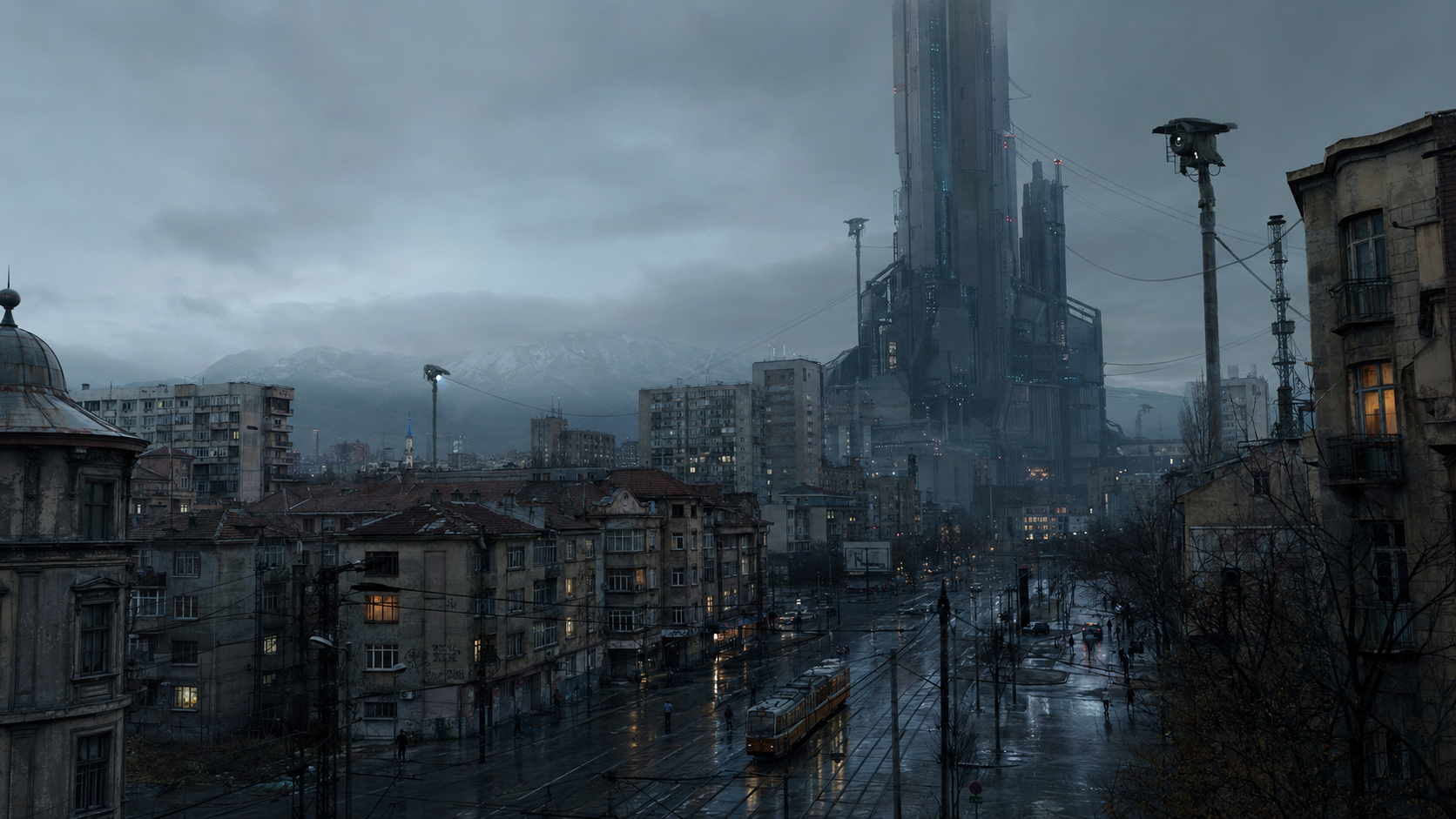
When the player arrives in City 17 at the beginning of Half-Life 2, they are not met by the typical science-fiction city. There are no gleaming spaceports, flying cars or flawless futuristic skyscrapers. Instead, the train stops at a worn railway station where surveillance cameras follow every movement. Outside, ageing façades, narrow courtyards, railway tracks, concrete apartment blocks and public spaces await—places where people appear to have lost control over their own city.
For anyone familiar with Sofia, the environment may feel strangely recognisable.
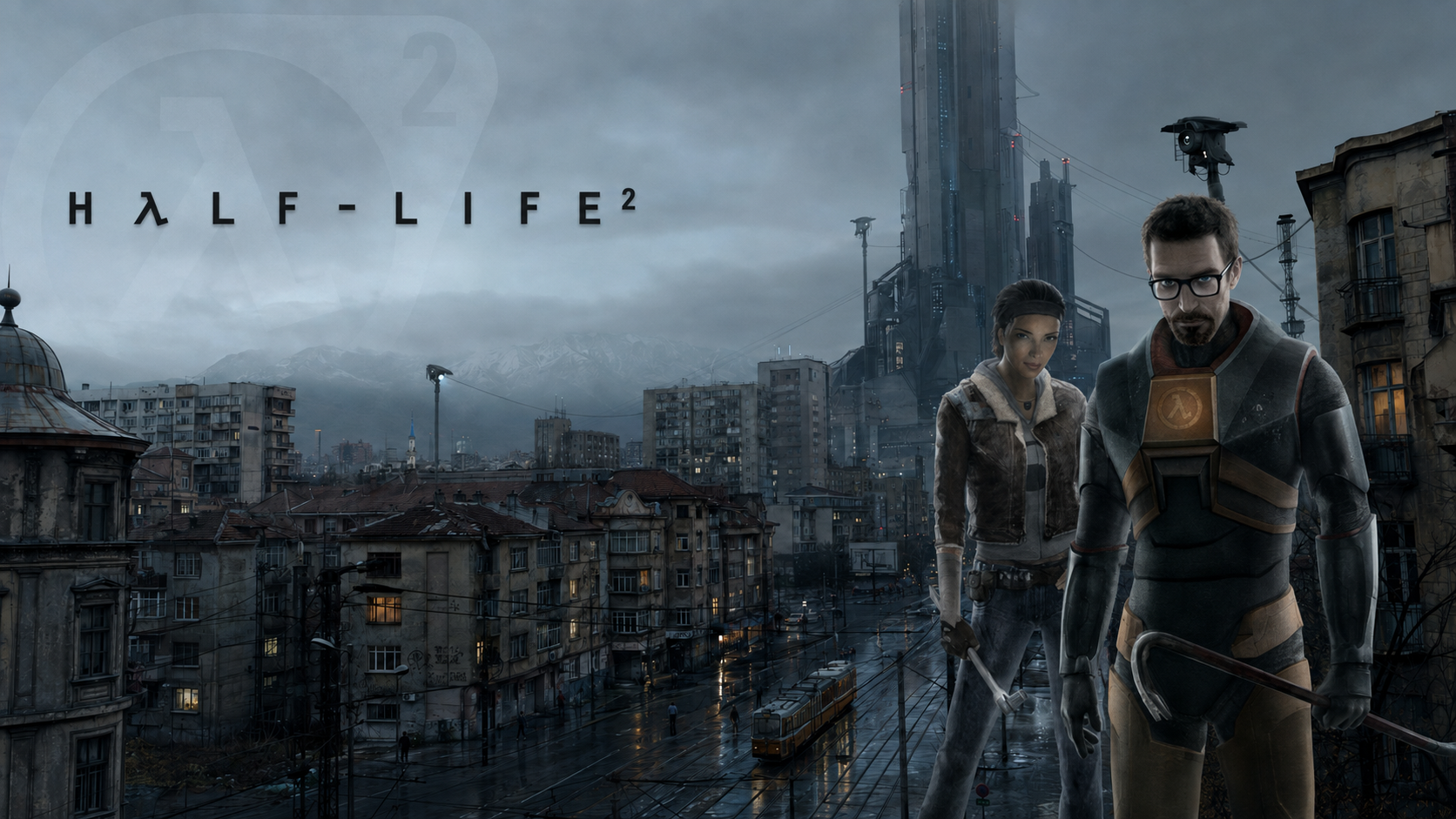
Claims have circulated for years that the buildings and locations in Half-Life 2 were taken from the Bulgarian capital. The claim is not entirely literal—City 17 is not a digital copy of Sofia—but it contains considerably more truth than many people may realise. Sofia was one of the central sources of inspiration behind one of the most famous urban environments in video game history.
The vision was largely shaped by Bulgarian-French artist and designer Viktor Antonov, born in Sofia in 1972. As art director for Half-Life 2, he had a decisive influence on the game’s visual identity. His memories of growing up in communist Bulgaria, together with photographs of Sofia and his experience of European urban architecture, became important building blocks for the fictional City 17.
I Had Already Visited Sofia Without Knowing It
I have played Half-Life since the first game was released in 1998. Its world has therefore followed me through a considerable part of my adult life. When Half-Life 2 arrived in 2004, City 17 became permanently embedded in my memory: the ageing buildings, tram tracks, concrete apartment blocks, railways, inner courtyards and the feeling of a city in which different historical periods had been placed on top of one another.
Many years later, I now walk through the real streets of Sofia.
Sometimes I stop in front of a building, a dark entrance, an old tramline or a worn courtyard and experience a strange feeling of recognition. The location feels familiar, even though I know that I have never stood there before.
The explanation is that, in a way, I already have.
Through Viktor Antonov’s interpretation of his childhood city, I spent years moving through a digital reflection of Sofia’s architecture and atmosphere. I knew City 17 long before I came to know Sofia. Today, the virtual city and the real city sometimes meet inside my own memory.
It is a peculiar experience to discover that a place I once believed to be entirely fictional was partly constructed from real streets, buildings and personal memories. While walking through Sofia, a façade, a tram wire or a hidden courtyard can suddenly open a door back into Half-Life 2.
Perhaps that is why Sofia occasionally feels so familiar. I may never have walked down that particular street before—but Gordon Freeman may very well have done so.
A City of the Future Built from the Past
When Half-Life 2 was released in 2004, it changed perceptions of how a digital world could tell a story. City 17 was not introduced through a long historical explanation. Instead, the player was invited to understand the situation through the environment itself: the residents’ body language, propaganda on the walls, the behaviour of the police, the decay of the buildings and the alien technology that had penetrated the old city.
It was a form of archaeological storytelling. Every building suggested that ordinary life had existed before the occupation. These places had once contained homes, shops, public transport, government offices and families. Now everything had been taken over by the Combine, an alien power that had constructed its surveillance system on top of the existing human society.
This fusion is central to City 17. The old city has not been demolished and replaced. It has been invaded, rebuilt and brought under control. Combine technology clings to the façades like an alien organism. Barricades cut through the streets. Cameras and mechanical structures have been attached to residential buildings. Above everything rises the Citadel—an almost impossibly tall structure dominating both the cityscape and the consciousness of its inhabitants.
The city therefore carries several historical layers at once. There is turn-of-the-century architecture, industrial infrastructure, socialist urban planning and Brutalist concrete, but also an aggressive form of futuristic technology.
This is precisely the kind of layering visible in Sofia, where Roman ruins, Ottoman traces, nineteenth-century European architecture, socialist monuments and modern glass façades can coexist within the same part of the city.
Viktor Antonov’s Sofia
Viktor Antonov grew up in Sofia during a period when Bulgaria was a communist one-party state. He left the country as a teenager and settled in Paris, but carried powerful visual memories of his childhood city with him.
When he later worked on Half-Life 2, he wanted to create something different from the American science fiction that had long dominated popular culture. Many games and films drew from the same visual heritage: Star Wars, Blade Runner, Alien and the architecture of major American cities. Antonov instead recognised the Eastern European city as a largely unexplored environment.
Here was an architecture capable of telling stories about both history and political control. The great squares, monumental government buildings, apartment blocks, trams, industrial areas and dark courtyards created a world that felt real while remaining unfamiliar to an international audience.
Antonov provided Valve’s development team with a large collection of photographs from different parts of Sofia. The images were used as reference material while City 17 was being designed. This does not mean that every individual building in the game can be found at a specific address in Sofia. The inspiration was equally present in the relationships between buildings, the visible wear, the scale, the materials and the overall atmosphere.
City 17 was therefore not Sofia in digital disguise. It was closer to Antonov’s memory of Sofia, reconstructed through dystopian science fiction.
More Than Bulgaria
At the same time, it is important not to make the story too simple. City 17 is a composite Eastern European city. Sofia was a major source of inspiration, but the design also contains elements associated with Belgrade, Budapest, St Petersburg and other cities in the former Eastern Bloc.
Western Europe is present as well. The railway station where the game begins was partly inspired by Gare d’Austerlitz in Paris. Antonov had lived in the French capital and combined his experiences from several European environments. The result was a city that cannot be placed precisely on a map but still feels geographically believable.
The signs, vehicles, electrical wires and residential buildings point towards different parts of Central and Eastern Europe. Some locations strongly resemble Bulgaria, while others could be situated in Serbia, Romania, Ukraine or Russia.
This geographical uncertainty became one of the design’s strengths. City 17 could represent an entire region without losing the feeling of being a specific, functioning city.
It might be described as a concentrated Eastern European experience: beautiful and worn, monumental and human, organised and chaotic at the same time.
Architecture as a Political Language
It is not only the appearance of the buildings that makes the connection with socialist Eastern Europe interesting. City 17 also uses architecture to describe power.
Sofia contains several examples of how urban planning has been used to express political authority. The former Communist Party headquarters, the Largo complex, the broad boulevards and the monumental public buildings were not created solely for practical purposes. They were also designed to communicate the power, stability and control of the state.
In Half-Life 2, the same principle is taken to its most extreme conclusion. The Citadel is not simply a building. It is a political statement. The tower is visible from almost every part of the city and constantly reminds the population of who is in control. It operates like the monuments of power found in real cities, but enlarged to an inhuman scale.
The smaller structures also tell stories of control. Surveillance cameras move like living creatures. Checkpoints regulate the movement of people. Public spaces are stripped of spontaneity. Homes are searched and entire neighbourhoods are sealed off.
The city has become a prison in which the architecture itself acts as the guard.
Antonov’s upbringing under a dictatorship gave him a personal understanding of how political power can be experienced in everyday life. Oppression does not always reveal itself through dramatic acts of violence. It can exist in the presence of government authorities, in the caution of ordinary people, in the design of public spaces and in the persistent feeling of being watched.
The Ordinary Makes the Horror Believable
One reason City 17 remains so convincing is that its environment is not spectacular at every moment. Much of it is deliberately ordinary. The player moves through kitchens, stairwells, laundry rooms, attics, backyards, canals and abandoned industrial buildings.
These are places that rarely receive a leading role in science fiction. By including them, however, the game creates a much stronger sense of reality. If the city had consisted only of futuristic monuments, it would have felt like a film set. Instead, worn wallpaper, old radiators, exposed wiring, storage areas and improvised repairs create the impression that people have genuinely lived there.
Antonov was fascinated by the city’s hidden infrastructure: chimneys, courtyards, sewers, rooftops and dangerous places that most residents rarely see. To him, a city was not simply a collection of decorative façades. It was an entire system of functions, movements and historical relationships.
His approach therefore went beyond thinking about how an environment would appear in an individual image. He considered how the buildings connected, how the streets functioned and what might exist behind the façades.
City 17 needed to feel like a real city even when the player could see only a small part of it.
Sofia as an Unknown Protagonist
Millions of players around the world have, in a sense, walked through an interpretation of Sofia without knowing it. They have seen traces of the city’s architecture, political history and urban identity, but under the name City 17.
For Sofia, this represents an unexpected part of its international cultural heritage. When Bulgaria’s contributions to global culture are discussed, attention is often given to folk music, literature, art, history and archaeology. Far fewer people know that an artist from Sofia helped shape one of the most significant environments in modern video game history.
Half-Life 2 was not merely a commercial success. It influenced an entire generation of developers, architects, artists and digital storytellers. City 17 is still used as an example of how a virtual city can provide orientation, atmosphere and narrative without constantly explaining itself to the player.
Sofia is therefore embedded in modern visual culture in a way that the city itself may not yet have fully recognised.
From Grey Concrete to a Global Aesthetic
For many years, the socialist architecture of Eastern Europe was commonly dismissed as grey, unsuccessful or aesthetically uninteresting. Through video games, cinema, photography and contemporary design, however, these environments have gradually been reassessed. Brutalism has attracted international interest, while monuments, concrete complexes and abandoned industrial sites are increasingly photographed, documented and discussed.
Antonov recognised the dramatic potential of this architecture at an early stage. He understood that decay, contrast and political history could give a fictional world an identity that would be difficult to create from nothing.
This does not mean that Half-Life 2 presents Sofia as a dark and hopeless city. Inspiration is not the same as judgement. Antonov used the environments he knew to create a story about occupation, resistance and human endurance.
There is also warmth in City 17. People help one another, the resistance movement grows, and old homes become shelters and meeting places.
The human city remains alive underneath the system of control. That is precisely why it is worth saving.
A City Between Reality and Fiction
The claim that Half-Life 2 takes place in Sofia is too categorical. The game never states that City 17 is located in Bulgaria, and Valve deliberately created a city combining several geographical and architectural influences.
But dismissing the connection as an internet myth would be equally misleading. Sofia was a decisive visual and emotional source. Viktor Antonov’s photographs, childhood memories and experiences of communist Bulgaria directly influenced how the game world looked and functioned.
City 17 is not Sofia as the city actually exists. It is Sofia transformed through memory, dystopia and artistic imagination.
The next time I walk through one of Sofia’s older neighbourhoods, pass a worn residential building, see tram wires stretching across a boulevard or discover a dark courtyard behind an elegant façade, I will probably experience that familiar sensation again.
Somewhere in the meeting between these buildings, Viktor Antonov’s memories and my own years with Half-Life, the real and virtual cities have begun to overlap.
Millions of people already know a part of Sofia.
They simply know it as City 17.

By Chris...
Add comment
Comments