

It often starts with something small: a hose ruptures, a coupling fails or a seal no longer holds. A few drops of hydraulic oil hit the ground and within moments a limited technical fault can develop into a much larger problem.
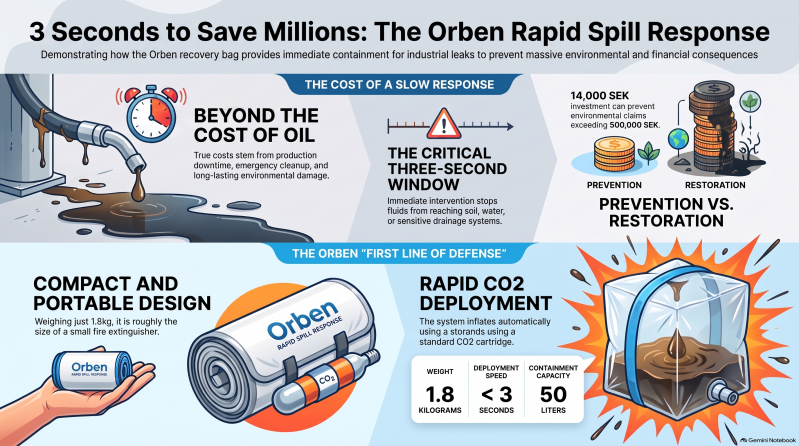
The machine may have to be shut down, contaminated ground can require cleaning, emergency personnel may need to be called in and operations can come to a standstill. The cost is rarely the oil itself. The real cost lies in everything that happens afterwards. It is precisely within this short window of time that the Swedish invention Orben – Oil Recovery Bag – aims to make a difference. The idea is strikingly simple: a compact container that can rapidly inflate and be placed beneath a leak to collect the liquid before it spreads further. According to the article in Proffs, Orben weighs around 1.8 kilograms and, when packed, is roughly the size of a small fire extinguisher. Using a CO₂ cartridge, it inflates in less than three seconds and creates a container with a capacity of around 50 litres. Three seconds. That is also where the entire business idea begins.
Innovation Born in the Real World
Behind the invention is Joakim Stigeborn, and the idea did not emerge from a conference room, a trend report or an attempt to invent the next fashionable startup product. Instead, it appears to have grown out of a concrete problem Joakim personally encountered while working in environments including the petrochemical industry and oil refineries. On one occasion, a leak had to be handled by lifting an open metal tray several metres into the air to collect the oil.
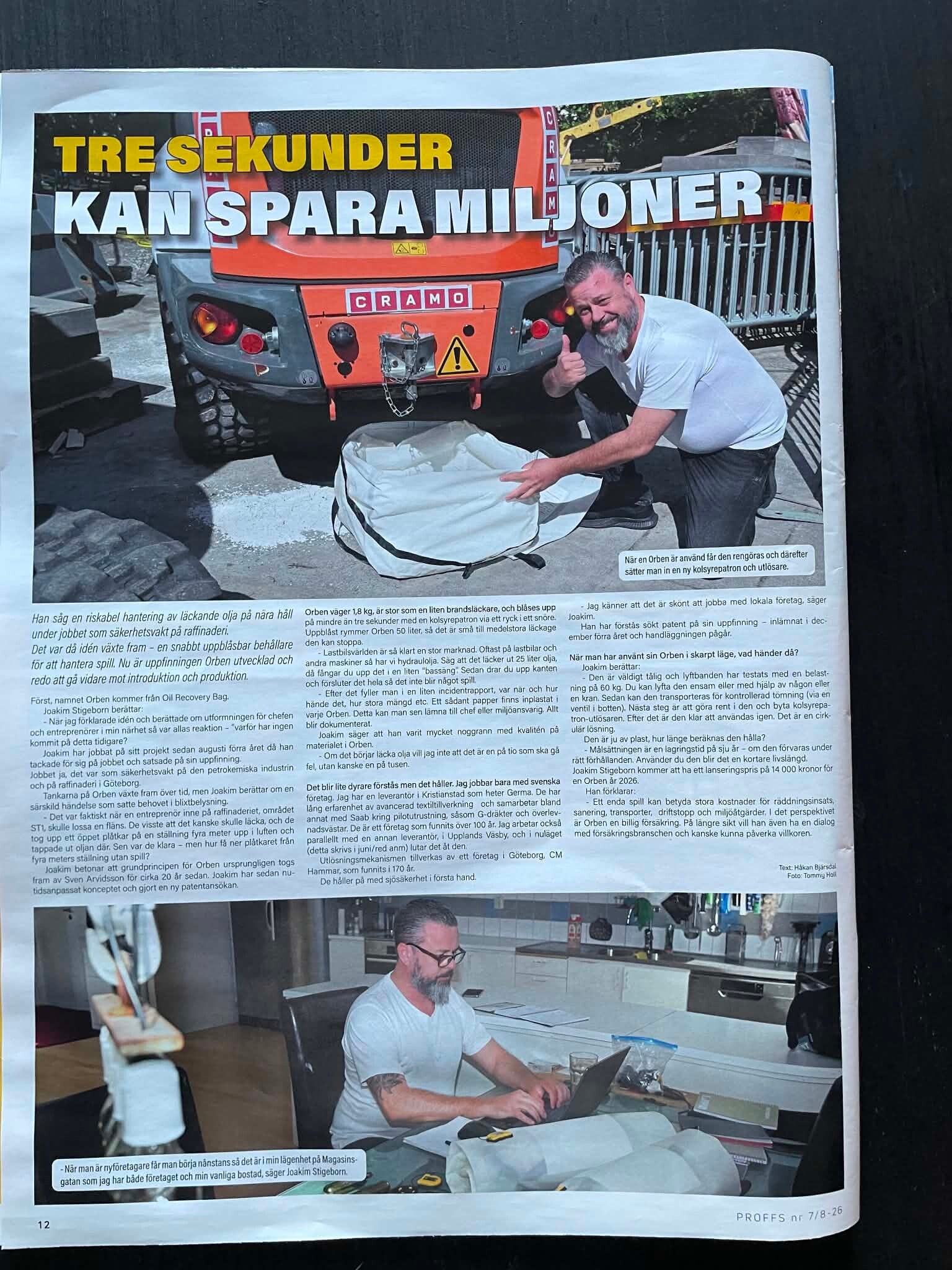
The solution worked to some extent but immediately created another problem: how could the container then be lowered without creating further spillage? It is a classic example of how genuine innovation often happens. Someone sees a problem that everyone else has accepted as normal and asks the simple question: why are we still doing it this way? It does not always require advanced technology to change an industry. Sometimes the breakthrough comes from combining existing technology in a more practical way. In Orben’s case, the solution is a lightweight, portable and rapidly deployable containment unit designed to be available immediately when a leak occurs.
The Product Does Not Stop the Leak – It Stops the Consequences
It is important to understand what Orben actually solves. The product does not repair a hydraulic hose, fix a broken seal or make a failed machine operational again. What it does is buy time. In many incidents, the period between the first leak and the first effective response is decisive. Hydraulic oil or other fluids can spread rapidly across asphalt, soil, drainage systems or sensitive ground. Once that happens, the nature of the situation changes. What began as a technical fault in a machine can suddenly become an environmental incident involving cleanup, reporting, insurance claims, lost production and sometimes public authorities. That is why the headline “Three Seconds Can Save Millions” is more interesting than it may initially appear. It is obviously not the value of fifty litres of hydraulic oil that amounts to millions. It is the chain of consequences surrounding the incident. Cleanup costs money, production downtime costs money, personnel cost money, emergency response costs money and contaminated soil or water can turn a relatively simple breakdown into a long and expensive process. From that perspective, Orben is not primarily a container. It is a damage-limitation tool.
Fifty Litres Can Be Enough to Change the Situation
A capacity of 50 litres will obviously not solve every possible incident. A major hydraulic failure can release significantly larger volumes, but that is not necessarily the point. The first response does not always need to solve the whole problem. It needs to stop or slow the development enough for further action to be taken. The logic is similar to that of a fire extinguisher. A small extinguisher is not intended to fight a fully developed industrial fire; it exists to give people the chance to act during the first critical moments. Orben can be viewed in the same way: as a first line of defence against an environmental spill. If this principle can be demonstrated through testing, documentation and real-world use, the potential application of the product becomes much broader than the environment in which it was first conceived.
A Market Much Larger Than Trucks
Trucks and hydraulic systems are a natural starting point, but hydraulics are everywhere: excavators, mobile cranes, forestry machines, harbour cranes, lifts, industrial machinery, mining equipment, agricultural machinery, service vehicles, railway equipment, ships and airport vehicles. Almost everywhere hydraulic systems are used there is also a risk of leakage. Beyond hydraulics, there may be additional situations where the rapid containment of oils and other liquids is relevant. That is why Orben could potentially be positioned as something broader than a Swedish oil recovery product. Internationally, the concept could be described as a Rapid Spill Response System – a fast first-response solution for fluid leaks. The wording may sound like a small difference, but commercially it is significant. A product solves a specific problem. A system can become part of a company’s operating procedures, environmental policy and safety infrastructure.
Insurance Could Be One of the Most Important Markets
One of the most interesting opportunities may not be transport or construction, but insurance. The article describes Orben as something comparable to an insurance policy, and that idea deserves to be taken further. Insurance companies fundamentally work with risk. If relatively inexpensive equipment can reduce the cost of claims, then its economic value can be much greater than its purchase price. Imagine a transport company, construction group or machinery contractor operating hundreds of vehicles. If documented spill-containment equipment can reduce the likelihood or severity of environmental damage, insurers could eventually have an incentive to encourage its use through recommendations, reduced deductibles, safety requirements or premium structures. If that happens, the market changes completely. The manufacturer no longer has to persuade every individual machine owner that the product is worth having. Instead, the product starts to become part of how an industry defines responsible risk management. Similar developments have occurred with fire alarms, sprinkler systems, anti-theft devices and other safety equipment. Orben is not automatically at that stage, but the business logic is clearly there.
The Strongest Marketing Message Is Time
Orben has another major advantage: it is easy to understand. Three seconds. That message is almost enough on its own to capture attention. Technical companies often make the mistake of marketing industrial products through long lists of specifications, materials, components, manufacturing technologies and standards. All of those things matter once a buyer becomes interested, but they are rarely what makes someone stop and listen in the first place. For Orben, the communication can be remarkably simple: Three seconds. Fifty litres. Stop the spill before it becomes a disaster. The product is also highly demonstrable. A hose begins to leak, Orben is removed from storage, the CO₂ cartridge is activated, the container deploys and the leaking fluid is captured. The entire story can be shown in seconds. At a time when LinkedIn, YouTube, TikTok and short-form video have become increasingly relevant even in industrial B2B marketing, that simplicity is a significant advantage.
From Smart Invention to Industrial Product
There is, however, a major difference between a clever invention and an established industrial safety product. A good idea and a working prototype are only the beginning. Professional buyers in transport, construction, energy, logistics and heavy industry will want answers to detailed questions. How does the material perform at extremely low temperatures? What happens in intense heat? Which oils, fuels and chemicals can it withstand? What happens if it is placed on sharp stones, metal fragments or uneven ground? How does it behave in strong winds or on slopes? How many times can it be reused? How long can the CO₂ cartridge remain in storage? What testing has been completed? Which standards apply? What responsibilities belong to the user and which to the manufacturer? These questions are not arguments against the product. They are exactly the questions that must be answered if Orben is to move from being an interesting Swedish invention to becoming equipment purchased by international companies in significant volumes. Certification, testing, documentation and standardisation may ultimately prove as important as the original innovation itself.
Swedish Manufacturing Can Build Trust
Another interesting aspect of the project is its connection to Swedish suppliers. According to the article, textile components are linked to Germa in Kristianstad, while CM Hammar in Gothenburg is involved with the activation mechanism. That may provide a valuable credibility advantage. In safety-related products, reliability often matters far more than simply finding the lowest manufacturing price. If an Orben unit is expected to remain in a truck, excavator or industrial facility for several years and then perform immediately on the day an incident occurs, the customer must trust every component. This is where industrial experience, documented quality and established suppliers become important. “Made in Sweden” still carries considerable weight in many international industrial markets, particularly in areas associated with engineering, safety, environmental protection and technical reliability.
SEK 14,000 Is Expensive – Until Compared With the Alternative
The article mentions a planned price of approximately SEK 14,000 per unit. For an individual consumer that sounds expensive. For industry, however, it may be almost insignificant if the benefit can be demonstrated. The key is how the price is framed. If the customer thinks, “SEK 14,000 for an inflatable container,” the product may seem costly. If the same customer thinks, “SEK 14,000 to reduce the risk of a SEK 500,000 environmental cleanup,” the calculation changes immediately. At the same time, scale introduces another challenge. A company operating 500 machines would face an investment of SEK 7 million if every machine were equipped with one unit. That makes volume pricing, leasing, service contracts and other business models important. Perhaps the future business is therefore not simply to sell Orben units one by one. The real product may become an entire service package including equipment, inspections, training, cartridge replacement, restoration after use, incident reporting and scheduled maintenance. That would turn a one-time sale into a recurring commercial relationship.
From a Bag to an Environmental Safety System
This may ultimately be the largest opportunity. Instead of thinking of Orben simply as an inflatable recovery bag, it can be viewed as the central component of a complete rapid environmental response system. Each unit could eventually carry an individual serial number or QR code linked to digital documentation showing when it was manufactured, when the cartridge was last inspected, which vehicle or machine it belongs to and when the next service is due. After an incident, the user could record what happened, how much fluid was collected, where the incident occurred and whether the unit requires servicing or replacement. For large fleets and industrial groups, such documentation could also support sustainability reporting, environmental compliance, insurance claims and internal safety management. Suddenly, the proposition is no longer merely about physical equipment. It becomes part of risk management, environmental responsibility and operational preparedness.
A Small Swedish Idea With Much Larger Potential
Perhaps the most fascinating aspect of Orben is therefore not the physical construction itself, but the journey from an everyday industrial problem to a solution that could potentially be deployed at thousands of workplaces. It is innovation in its most practical form: see the problem, simplify it, build the solution, test it and then make that solution so natural that people eventually wonder why it did not always exist. Whether Orben reaches that stage remains to be seen. Patents, certification, production capacity, distribution, financing, partnerships and international sales are all major challenges for a small company. Yet the fundamental idea is unusually easy to understand. When a hydraulic hose ruptures, nobody has time to read a fifty-page manual. Someone needs to react immediately. Three seconds may sound insignificant, but on a motorway, in a factory, at a harbour, in a mine or on a construction site, those three seconds can represent the difference between a manageable technical problem and the beginning of an extremely expensive environmental incident. And that is why a relatively small Swedish invention may contain a much larger idea: the best environmental disaster is the one that never gets the chance to happen.
Link: Rapidcontain.se

By Chris...
Add comment
Comments