

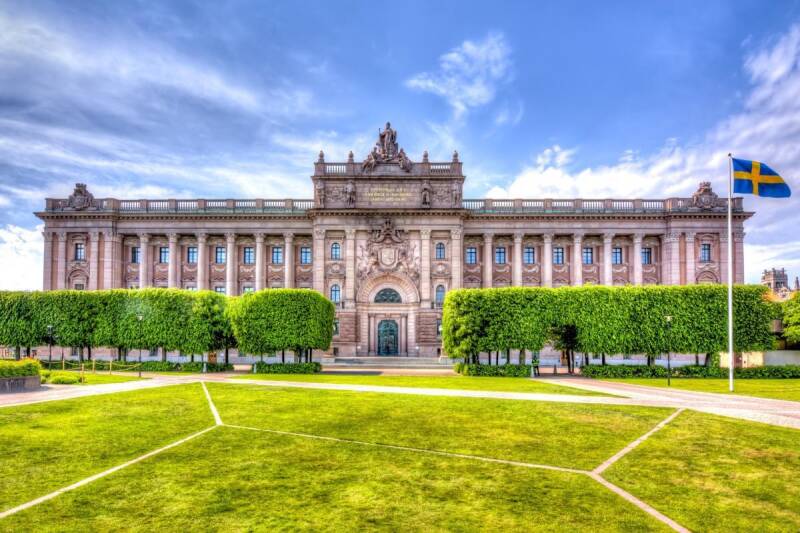
Belgium went 541 days without its political parties managing to form a new federal government. Yet trains continued to run, salaries were paid, schools opened and businesses kept producing. Nor did the economy collapse. Instead, a slightly disrespectful story emerged: Belgium had never functioned better. With Sweden’s general election approaching on 13 September 2026, it is difficult not to ask the forbidden question: Would Sweden also benefit from an extended break from its politicians?
The story that is sometimes attributed to the wrong country
The story is occasionally associated with Holland—or, more correctly, the Netherlands—but the famous example comes from Belgium. Following the parliamentary election on 13 June 2010, the Belgian parties failed to agree on how the country should be governed. Divisions between Dutch-speaking Flanders and French-speaking Wallonia were deep, the party system was fragmented, and disputes concerning money, regional power and the country’s future structure were almost explosive.
Negotiations continued. Weeks became months, months became seasons, and the politicians kept announcing that a breakthrough was just around the corner.
It was not.
A new government was finally able to take office on 6 December 2011. By then, 541 days had passed since the election, giving Belgium the world record for the longest government formation in peacetime. Guinness World Records
This is where the story is usually simplified. Belgium is often said to have been governed by a group of non-political experts while its politicians remained locked in a room arguing. That is not entirely accurate. The outgoing government, led by Prime Minister Yves Leterme, remained in office as a caretaker administration. Its ministers were still politicians, but their mandate was limited, and they were expected primarily to handle routine administration, previously approved decisions and urgent matters.
Less revolutionary, perhaps, but even more interesting.
The country simply refused to stop functioning
The remarkable thing was not that Belgium lacked a new government. The remarkable thing was how little ordinary people appeared to notice.
Government agencies continued working. Pensions were paid. Healthcare continued to function. Companies kept investing and exporting. Municipalities carried on providing services, while the country’s self-governing regions made decisions within their respective areas of responsibility. Society proved to be considerably larger than the group of people normally standing in front of a blue backdrop at government press conferences.
Belgium still had laws, budget procedures, civil servants, courts, municipalities, regional governments, businesses, trade unions, universities and millions of people who went to work every morning. The entire machinery of the state did not need to be reinvented simply because the party leaders could not reach an agreement.
That was when the joke began to spread: Belgium had never worked as well as it did when its politicians were unable to decide anything.
As a joke, it is excellent. As a scientific conclusion, it requires some qualifications. Nevertheless, there is a core of truth in it. An economic study of the period found no evidence that the political deadlock damaged the Belgian economy. According to the researchers’ comparative model, GDP per capita even performed better than it might otherwise have been expected to. Study of Belgium’s government formation crisis
Political decisiveness, it turned out, was not the same thing as economic vitality.
When politics stands still, society is allowed to work
This is the genuinely provocative lesson from Belgium. While the politicians were unable to agree on major new reforms, society continued operating under the rules that were already in place.
No enormous prestige projects had to be launched simply to demonstrate political action. No government agencies needed to be reorganised so that a newly appointed minister could attach their name to a reform. No tax system needed to be changed overnight to provide one party with a symbolic victory to present to its voters.
The public administration was simply allowed to administer.
That may sound like stagnation, but political predictability can be extremely valuable to individuals and businesses. An entrepreneur may not need a new national vision every six months. She needs to know which rules will apply next year. A teacher rarely needs yet another education reform. He needs time, stability and resources to implement the previous one. A nurse does not need the healthcare system to be “restarted” after every election. She needs a system that works even when the cameras are switched off.
Sometimes political inactivity is not the absence of governance. It is the absence of disruption.
Sweden approaches an election – and the promise machine is running at full speed
On Sunday, 13 September 2026, Sweden will elect representatives to its parliament, regions and municipal councils. Early voting begins on 26 August. Swedish Election Authority
As usual, the parties will declare that this particular election is a decisive moment in history. Sweden is always standing at a crossroads. Everything is at stake. The policies of the opposing side threaten the nation’s future, while each party’s own manifesto can somehow solve crime, healthcare waiting lists, energy supply, unemployment, integration and education—perhaps even the weather—before the end of the next parliamentary term.
This is part of the theatre of democracy. Political parties must explain their differences, and voters must be able to choose a direction. But the performance also creates the impression that the country will grind to a halt unless the correct politicians immediately take control of the machinery.
Belgium demonstrated that the controls may not be quite as decisive as politicians themselves would like us to believe.
Sweden has already tested a lighter version
Following Sweden’s 2018 general election, it took a record 134 days before Stefan Löfven could once again be approved as prime minister. Swedish Parliament
There were warnings then as well about uncertainty and political chaos. Yet Sweden did not cease to exist. Government agencies continued working, municipalities collected rubbish, the Social Insurance Agency paid benefits, and people continued complaining about the trains exactly as before. A caretaker government handled routine matters while the Speaker of Parliament attempted to identify a prime minister whom the parliament could tolerate.
A Swedish caretaker government does not formally lack governmental authority. Its only explicit constitutional restriction is that it cannot call an extraordinary election. According to Swedish constitutional practice, however, it should avoid politically controversial decisions and concentrate on routine or urgent matters. Government Offices of Sweden
Sweden is therefore already designed to continue functioning when politics temporarily becomes stuck.
Could Sweden manage for 541 days?
Probably—at least administratively.
Sweden has strong public agencies, relatively independent civil servants, municipal self-government and regions responsible for services including healthcare and public transport. Parliament can continue meeting and passing legislation and budgets. Courts continue to deliver judgements, while government agencies are required to follow existing law regardless of who temporarily occupies the ministerial offices.
Much of what people think of as “the state” is not actually controlled directly from the Government Offices in Stockholm. Preschools are organised locally. Hospitals are governed regionally. The police operate through their own national organisation. Electricity is produced by private companies and municipally owned enterprises. Goods are transported by commercial operators. Civil society, families and workplaces do not wait for a government decision before they begin functioning.
Sweden would therefore not wake up as a lawless wasteland if coalition negotiations dragged on. After several months, many people might even discover that daily life continued more or less as usual.
That might be the greatest political crisis of all.
But experts are not politically neutral magicians
This is where the irony must meet reality. A country can be administered for a limited period without a fully empowered government, but it cannot continue developing indefinitely without making political choices.
Experts can explain how a pension system could be financed, but they cannot objectively decide how resources should be divided between pensioners, families with children, defence and healthcare. Economists can calculate the effects of different tax levels, but they cannot scientifically determine how much equality a society should pursue. Engineers can describe alternative energy systems, but someone must weigh their costs, environmental consequences, security implications and local impact.
That is the role of politics.
Experts also have their own experiences, values and blind spots. A so-called government of experts therefore risks becoming a political government that simply avoids admitting that it is political. That is not necessarily more democratic—only less visible.
Wars, financial crises, pandemics and major social changes also require governments capable of making new decisions and being held accountable for them. Public administration can preserve a system. It cannot decide on its own where the country should go next.
Perhaps Sweden does not need fewer politicians – only less political theatre
The Belgian experience is therefore not an argument for abolishing democracy or allowing civil servants to govern permanently. It is an argument for humility.
Politicians are necessary, but they are not society itself. Their job is to establish direction, address genuine conflicts, distribute common resources and answer to voters. They do not need to micromanage every public agency, rename every reform or treat each parliamentary term as an opportunity to rebuild the country from the ground up.
Perhaps Sweden would function better if politics occasionally did less—but did it properly. If more long-term agreements were allowed to survive elections. If government agencies were given stability. If schools were spared recurring ideological experiments and healthcare avoided being subjected to another organisational model whenever a new political majority took office.
Political activity is not automatically the same thing as political achievement. Sometimes the system mainly produces press releases, investigations, new names for old measures and solemn declarations that the government is “now taking the issue extremely seriously”.
The country might have appreciated it if the issue had been taken moderately seriously from the beginning.
Vote – but demand a little less circus
Sweden does not need to cancel its election and lock the doors of the Government Offices for 541 days. Democracy is far too valuable for that. But the Belgian story provides a useful reminder ahead of Sweden’s election.
A functioning country is not built exclusively by ministers and party leaders. It is built every day by teachers, entrepreneurs, healthcare professionals, engineers, bus drivers, police officers, craftspeople, civil servants, voluntary organisations and people who accept responsibility without first holding a press conference.
The purpose of politics should be to create stable conditions for all of them—not to place itself in the centre of the picture and pretend to be the entire subject.
Belgium did not function because it had no politicians. It functioned because its institutions, regions, public administration and citizens were strong enough to carry on while the politicians argued.
That is a reassuring thought ahead of Sweden’s election.
And possibly a slightly worrying thought for Sweden’s politicians.

By Chris...
Add comment
Comments