

Gothenburg needs a major metal festival. Bananpiren deserves to be filled again with music, people and the energy that once made the site an important part of the city’s festival culture. Göteborg Brinner had almost everything required to succeed: a strong identity, a world-famous host band, an impressive lineup and approximately 15,000 expectant visitors.
The bands delivered. The audience created the atmosphere. Metal returned to the pier.
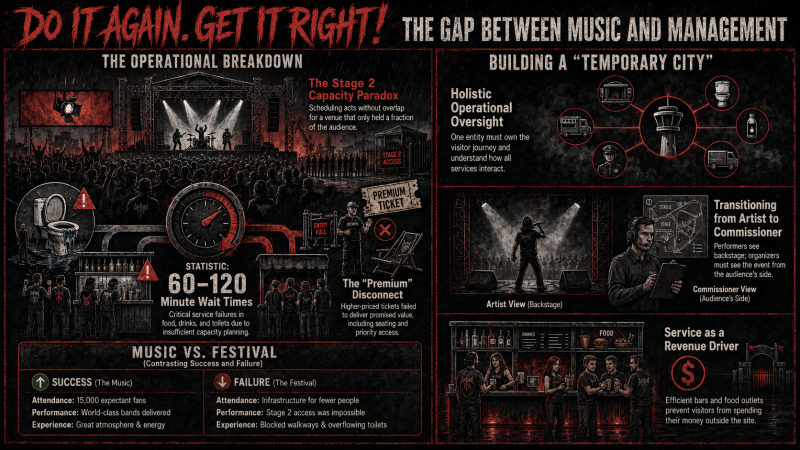
Yet the discussion after the event has been dominated by queues, overflowing toilets, blocked walkways, insufficient food service and a second stage that only a fraction of the audience could access.
That is the harsh reality of event production. The music can be fantastic, but if people cannot eat, use the toilets, move around or see the artists they paid to watch, even the greatest lineup cannot save the overall experience.
Göteborg Brinner successfully produced the concerts. It lost control of the festival surrounding them.
I Know Bananpiren from the Inside
I honestly cannot remember every concert, festival or public event I have helped produce at Bananpiren over the years. There have simply been too many. But I know the site, and I know what you do - and what you do not do - when building an event there.

When the Audience Paid to Stand in Line
The Facebook comments following the festival are remarkably consistent. Visitors describe waiting between 60 and 120 minutes for food. Others say they left the festival grounds, travelled to a restaurant, ate and returned faster than they could have been served inside. Some ordered food outside the site. Many simply gave up.
The same pattern appears around drinks, toilets, merchandise and Stage 2. Queues became so long and poorly organised that they crossed one another and obstructed the natural movement of the audience. The site gradually became a system of queues in which people tried to understand where each line began, where it led and how they could get past it.
These were not isolated teething problems. When several critical services fail simultaneously, it indicates an overall problem with capacity planning. The festival appears to have been designed for significantly fewer people than the approximately 15,000 who attended.
A World-Touring Band Is Not Automatically a Festival Producer
Göteborg Brinner was created by In Flames, with Live Nation involved as an event and ticketing partner. The precise division of operational responsibility has not been publicly explained.
An important distinction must therefore be made. In Flames did not personally manage every bar, toilet, entrance or food outlet. The band members were not drawing queueing systems or emptying urinals. These functions were almost certainly divided among professional producers, contractors and suppliers.
But the organisation appears to have lacked the knowledge required at the commissioning and leadership level to determine whether all these functions could collectively serve 15,000 people.
Touring around the world provides extensive knowledge of music, stages, audiences and touring logistics. But an artist normally experiences a festival after it has already been built. The stages are standing, the electricity is connected, the bars are stocked, the security organisation is working and the toilets have been installed.
The artist’s world primarily consists of transport, dressing rooms, backstage, media, the stage and the journey onwards. From there, the artist rarely sees visitors waiting 90 minutes for a hamburger or wandering around looking for drinking water.
Flying around the world does not make someone qualified to build an airport. Performing at hundreds of festivals does not automatically make someone qualified to produce one.
Stage 2 Reveals the Fundamental Knowledge Gap
Stage 2 provides the clearest evidence of the planning failure.
The festival had two stages, with performances scheduled without significant overlap. This created the expectation that visitors would be able to see every band. At the same time, Stage 2 was indoors and could only accommodate a limited part of the audience.
That equation was never going to work.
When only one band is performing, almost the entire audience’s attention is directed towards the same location. If approximately 15,000 tickets have been sold but the next venue can only accommodate a fraction of those people, disappointment is built into the plan before the gates even open.
Visitors describe missing Gaerea, Napalm Death and other acts because the building was already full. Some left performances on the main stage early to secure a place indoors. Others did not dare to leave Stage 2 and consequently missed the next band outside.
The stage arrangement therefore undermined the very concept of a programme designed to let people watch every performance.
An experienced festival producer should have stopped this model. There were only four realistic alternatives: build a larger second stage, use two outdoor stages with comparable capacity, allow performances to overlap and divide the audience, or reduce the number of tickets sold.
The original arrangement was mathematically incapable of delivering what the programme appeared to promise.
A Festival Is a Temporary City
A concert production revolves around the stage. A festival must operate as a temporary city.
Thousands of people must be transported, searched, informed, fed and provided with water, toilets, waste management, medical support, security and functioning payment systems. They must be able to move around without becoming trapped in opposing crowd flows. Emergency routes must remain accessible, and the organisation must be able to respond when pressure suddenly increases.
For the visitor, the festival is not divided among different contractors. If the food cannot be purchased, it is Göteborg Brinner’s food problem. If the premium toilets overflow, they are Göteborg Brinner’s toilets. If a public bar appears to belong to the premium area, it is Göteborg Brinner’s failure of communication.
Multiple suppliers do not automatically create a functioning festival.
The stage company can build its stage, the caterer can operate its bars, the sanitation provider can deliver the agreed number of toilets and the security company can staff its assigned positions. Every company may technically fulfil its contract while the event as a whole still fails.
Someone must therefore own the complete visitor journey and have the authority to influence every operational function.
The Missing Skill Was Not Labour - It Was Oversight
In Flames did not need to calculate the precise number of toilets or personally design every queue. But as the creator and public face of the event, the band and its senior partners needed enough knowledge to ask the right questions.
They needed to challenge the capacity of Stage 2, demand calculations for food and bar service, examine whether queues would block public routes, ensure that toilets could be maintained throughout the day and establish who had overall operational authority.
The central failure was not that the band lacked detailed knowledge about every individual service. It was that the organisation did not appear to understand how the services would interact or which figures needed to be questioned.
They knew how a great festival should feel from the stage and backstage. What appears to have been missing was someone with enough experience, influence and responsibility to understand the whole event from the audience’s side.
That is the difference between being the artistic creator of a festival and being competent to commission and oversee one.
Premium Without Meaningful Added Value
The premium tickets represent another area where the promise and delivery appear to have diverged.
The premium product was marketed with a separate area, its own bar, seating, premium toilets and faster admission. Visitors instead describe insufficient seating, no dedicated food service, drinks running out, overflowing toilets and, in some cases, a premium entrance moving more slowly than the standard queue.
Premium visitors also received no priority access to Stage 2.
If those accounts are accurate, the product did not provide enough additional value to justify its higher price. The organiser should consider offering some form of goodwill to those affected. It would be a practical way to acknowledge the disappointment and begin rebuilding trust.
Poor Service Is Also Poor Business
The service failures did not only damage the visitor experience. They also reduced revenue.
People who left the festival to eat spent their money elsewhere. Visitors who abandoned the bar queue bought no drinks. Guests who could not reach the merchandise stand purchased no shirts, posters or records.
Better service is not simply an additional cost. It generates income.
More food outlets, efficient bars, pre-ordered merchandise, visible water stations and clear information would allow visitors to spend more while missing less music. The interests of the organiser and the audience are not opposites. In this case, they are closely connected.
The Audience Still Wants Göteborg Brinner
The most encouraging part of the Facebook discussion is that much of the criticism is not directed at the existence of the festival.
Visitors repeatedly praise the music, the bands, the atmosphere, the audience and the return of metal to Bananpiren. Many say they want to come back - but only if the organisers learn from the first edition.
In Flames succeeded in creating the festival’s identity, attracting the right audience and booking a programme that people genuinely wanted to experience. Those are significant achievements.
But the next edition does not primarily need a bigger headliner. It needs a second stage that matches audience demand, more food operators, visible water stations, organised queueing systems, properly maintained toilets, continuous cleaning and someone with operational authority over the entire visitor experience.
Above all, the festival leadership must understand the difference between being a world-class artist and being a competent festival commissioner.
In Flames did not need to operate every function personally. But someone at the highest level needed to understand what those functions required, how they affected one another and when the numbers did not add up.
Otherwise, the result is not a coherent festival. It is a collection of contractors, two stages and 15,000 people placed inside the same perimeter.
Göteborg Brinner deserves another chance. Gothenburg needs this festival, and the audience clearly wants it to continue.
But trust will not be restored by saying that the queues were occasionally a little too long. It will be restored through open self-criticism and a concrete explanation of what will change.
The music burned brightly.
The organisation did not.
Do it again. Get it right.

By Chris...
Add comment
Comments