

Billions have been paid to private providers, yet Sweden still cannot demonstrate that the programme creates more lasting jobs than would have emerged without it
Sweden has developed an extraordinary ability to turn political ambitions into expensive systems that continue long after their weaknesses have become obvious. The healthcare platform Millennium, the industrial dream surrounding Northvolt and the employment programme Rusta och Matcha are very different projects. Yet they share a disturbing pattern: grand promises, substantial public exposure, outsourced responsibility, complex measurements, repeated warnings and remarkably limited personal accountability when the results fail to match the rhetoric.

Rusta och Matcha was presented as a modern alternative to the traditional Swedish Public Employment Service. Instead of allowing Arbetsförmedlingen to perform the work itself, unemployed people would choose among private providers. Competition, freedom of choice and performance-based payments were supposed to create better service and faster routes into employment.
Since 2020, approximately SEK 7.7 billion — around €693 million — has been paid to providers within the programme, according to Dagens Nyheter’s examination.
The central question is therefore brutally simple:
What has Sweden actually received for the money?
A programme designed to look successful
On paper, Rusta och Matcha sounds reasonable. An unemployed person receives an individual coach who can help with applications, CVs, employer contacts, interviews, vocational direction and education. The individual chooses a provider, while the provider receives basic compensation for participation and additional payments when the person enters employment or regular education.
The present version, Rusta och Matcha 2, was introduced in April 2023 after the original programme had been criticised. Payments are divided into several stages. Half of the result-based compensation can be paid after three months in employment or education, with the remainder paid after six months.
This creates the appearance of a result-oriented system. But the word “result” conceals an important weakness. The official figures combine employment and regular education. They do not always distinguish between full-time and part-time work. Nor do they demonstrate that the provider caused the outcome.
A person who finds a job independently can still generate result compensation for the provider. A person who would have entered education without any coaching can also be counted as a success.
The programme therefore measures what happened after participation — not necessarily what happened because of participation.
The state’s own evaluation found no significant employment effect
The strongest criticism does not come from disgruntled participants, political opponents or ideological critics of privatisation. It comes from the state’s own researchers.
An IFAU evaluation published in 2024 used randomisation to compare people assigned to the original Rusta och Matcha programme with comparable jobseekers receiving other forms of support.
Its conclusion was deeply uncomfortable: Rusta och Matcha was more expensive, but did not produce significantly better results in wage income or lasting employment. Providers also received higher payments for participants assessed as more difficult to place, but these participants did not achieve better labour-market outcomes.
The current version has been modified, and it would be incorrect to claim that an evaluation of the original model automatically proves that Rusta och Matcha 2 has failed. However, a full effect evaluation of the present version is not expected until 2027. Until then, the Swedish state cannot scientifically demonstrate that the revised programme creates a significant number of additional jobs.
Arbetsförmedlingen reports that its average cost per participant has fallen from SEK 21,760 to SEK 19,520 — approximately from €1,960 to €1,760. That is a reduction of about ten per cent. But making an ineffective or unproven intervention cheaper does not automatically make it effective. Arbetsförmedlingen itself acknowledges that the earlier service cost more without producing better labour-market results.
Linda, 37: judged by a system she did not know existed
Statistics describe the system from above. The experiences of unemployed people reveal what it feels like from below.
Linda Hellman, 37, had been unemployed for almost a year when Aftonbladet reported on their experience. Linda had been assessed by Arbetsförmedlingen’s statistical profiling tool without knowing that the assessment had taken place.
Arbetsförmedlingen officially describes the system as a statistical assessment tool rather than a fully autonomous AI decision-maker. Nevertheless, the model processes personal information and estimates an individual’s distance from the labour market. According to Aftonbladet, factors include gender, age, country of birth, municipality, unemployment history, education and registered disability affecting work capacity.
The recommendation then appears on the employment officer’s screen. It can indicate that the jobseeker is too close to the labour market to receive Rusta och Matcha, suitable for the programme or in need of more extensive support.
Arbetsförmedlingen emphasises that the final decision must be made by a human officer. But when an opaque statistical recommendation appears inside an overloaded public administration, it inevitably influences the conversation. A recommendation does not have to be formally binding to acquire institutional power.
Linda described the profiling as demeaning and questioned why an unemployed person was not considered worthy of a genuinely human assessment. Since entering Rusta och Matcha, Linda had applied for an average of 28 jobs per month without finding employment. The support consisted largely of meetings every second week and remote lectures described as outdated.
This is the gap between the programme’s promise and the participant’s experience. The system calls it individual support. The participant experiences another schedule, another lecture and another demand to submit applications.
Anita, 60: from 36 years of work to “adult daycare”
Aftonbladet also reported the experience of “Anita”, whose real name was withheld. She had worked at a brewery throughout her adult life. After 36 years, she suffered burnout and entered unemployment at the age of 60.
When Arbetsförmedlingen wanted to place her in Rusta och Matcha, she initially refused. She still had more than 100 days of unemployment insurance remaining, but was suspended from compensation for five days. Faced with the possibility of losing further income, she entered the programme.
Her experience consisted of group meetings, short films from Arbetsförmedlingen and online lectures about becoming more attractive to employers. She called it an “adult daycare”. After completing the activities, she was still unemployed.
These personal accounts cannot establish the average effect of the entire programme. Some participants undoubtedly receive committed coaches, useful contacts and meaningful support. Earlier surveys have also shown that many participants are more satisfied with private coaches than with Arbetsförmedlingen itself.
But satisfaction and employment are not the same result. It is possible to appreciate a coach without obtaining a job. It is also possible to dislike a programme and still find work independently.
The personal testimonies matter because they reveal something the spreadsheets cannot measure: humiliation, repetition, fear of sanctions and the experience of being processed rather than helped.
Five providers, €191 million — but only 23 to 27 documented six-month results per 100 participants
Five of the largest recipients in Dagens Nyheter’s compilation are Arbetslivsresurs, Arcus, Lernia, EnRival and Eyes4Work. Together, they received approximately SEK 2.12 billion — around €191 million — from Arbetsförmedlingen between 2020 and July 2025.
The following comparison uses Arbetsförmedlingen’s official July 2026 result file. The outcome shown is the stricter second result stage: a participant must have remained in employment or regular education for six months.
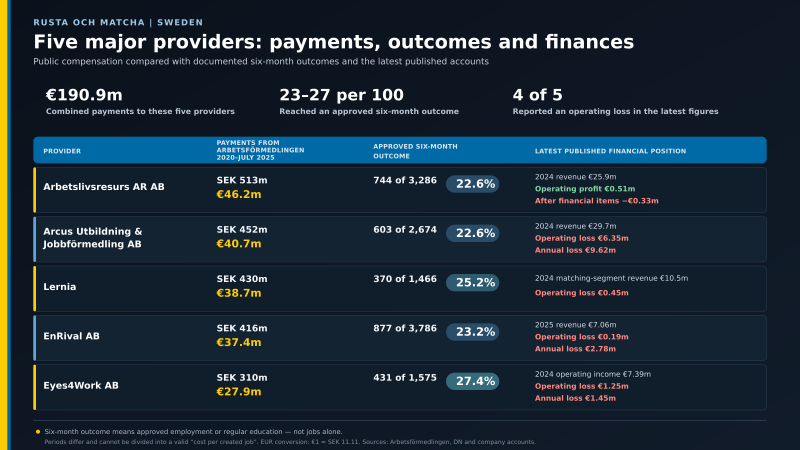
The payment period, current participant cohort and company accounting years are different. It would therefore be dishonest to divide the accumulated payments by the current outcomes and present the answer as a precise cost per job.
Nevertheless, the comparison exposes the scale of the problem. Among these providers, only approximately 23 to 27 participants out of every 100 reached a documented six-month result in employment or regular education.
The remaining 73 to 77 participants cannot automatically be described as still unemployed. Some may have found work that was not approved or registered within the result system, while others may have left for different reasons. But they did not generate the programme’s stricter six-month result during this official measurement.
Even more seriously, the percentages do not tell us how many jobs the providers actually created.
Arbetsförmedlingen admits that many would succeed without the programme
In its 2026 report on improving cost-effectiveness, Arbetsförmedlingen made a remarkably candid admission. The average participants directed to Rusta och Matcha 2 were estimated to have a 25–30 per cent probability of entering employment or regular education even without receiving support from a provider.
The authority explicitly warned that providers could receive both basic and result-based compensation for participants without having created any added value. It also acknowledged that the existing model continued to provide excessively strong incentives to prioritise participant volume over high-quality support.
This is fundamental. The five companies’ documented six-month results range from 22.6 to 27.4 per cent. Those raw figures cannot be directly compared with the estimated 25–30 per cent probability because participant composition differs between providers and the measures are not identical. But the figures certainly do not prove substantial added value.
They show outcomes close to the level Arbetsförmedlingen says might occur without the intervention.
That does not prove that every provider is ineffective. It proves that the state’s public statistics are inadequate for demonstrating how many additional, lasting jobs taxpayers are buying.
This is not primarily a story about excessive corporate profit
It would be tempting to describe Rusta och Matcha simply as private companies becoming rich from unemployment. The latest financial reports do not support such a simple accusation.
Arbetslivsresurs reported a small operating profit in 2024 but a negative result after financial items. Arcus recorded a substantial loss. Lernia’s matching segment lost money. EnRival and Eyes4Work also reported negative annual results.
In other words, the system appears capable of producing poor value for the state without producing stable profitability for the companies performing the work.
That makes the design even more questionable.
A well-functioning outsourced service should create three things: measurable public value, genuine help for the individual and economically sustainable conditions for competent providers. Rusta och Matcha struggles to demonstrate any of the three consistently.
The danger is that serious providers cut staff, withdraw from less profitable areas or leave the market, while companies focused on volume, standardised meetings and minimal delivery learn how to survive longest within the administrative rules.
The market then selects for compliance rather than competence.
When failed contracts become the quality-control system
Arbetsförmedlingen has begun removing weak providers. In 2025, it terminated 94 provider agreements after introducing stricter result conditions. In April 2026, a further 57 agreements involving 37 providers were terminated.
This shows that the authority is responding to criticism. But it also reveals how many underperforming operations were allowed to participate before meaningful intervention occurred.
A provider can have a one-star rating and still meet the minimum quality requirement if its weighted outcome reaches 20 per cent. Termination generally requires repeated low ratings, an outcome below 20 per cent and an agreement that has been active for a sufficient period.
Such safeguards may be legally necessary, but from the participant’s perspective they mean something uncomfortable: unemployed people can spend months inside an underperforming service while the state gathers enough evidence to remove it.
They become the test subjects in the quality-control process.
Millennium, Northvolt and the politics of avoiding responsibility
Rusta och Matcha is not financially identical to Millennium or Northvolt. Millennium was a regional healthcare IT procurement. Northvolt was a privately owned industrial project supported by a web of public grants, guarantees and infrastructure commitments. Rusta och Matcha is a national labour-market service purchased continuously from hundreds of providers.
The comparison concerns political behaviour rather than identical accounting.
Millennium had already cost Västra Götaland approximately SEK 3.8 billion — around €342 million — before the region moved towards abandoning it. The negotiated cost of exiting the agreement was reported at a further SEK 657 million, or roughly €59 million. Regional leaders themselves described the outcome as a failure.
Northvolt became a symbol of how political enthusiasm, strategic ambition and public backing can outrun operational reality. Warnings are treated as obstacles to progress until the project becomes too large, prestigious or politically sensitive to question honestly.
Rusta och Matcha follows the same psychological structure. The programme has been renamed, redesigned, measured, adjusted and defended. Each new version allows politicians and administrators to argue that criticism concerns the old model, while proof of the new model’s effect remains somewhere in the future.
Governments change. Ministers change. Political colours change. The administrative machine survives.
The unemployed person carries the risk
For the provider, a participant represents compensation, reporting and a possible result payment. For Arbetsförmedlingen, the participant becomes a case number, a statistical profile and an entry in a performance file. For the politician, the participant becomes evidence that something is being done.
For the unemployed person, however, participation is not an abstract policy experiment.
It can determine whether benefits continue. Refusing an activity may lead to sanctions. Missing meetings can affect compensation. Changing provider requires new contacts and more administration. The person is expected to remain motivated while repeatedly attending lectures about CV writing, personal branding and interview techniques that may bear little relationship to the real reason employment is unavailable.
Those reasons may include age discrimination, illness, disability, inadequate language support, regional job shortages, outdated qualifications or employers unwilling to take a chance on someone with a long period of unemployment.
No number of motivational webinars can manufacture a suitable vacancy where none exists.
Sweden must begin paying for additional value — not administrative activity
Rusta och Matcha does not necessarily need another cosmetic reform. It needs a different standard of proof.
Providers should be evaluated according to the additional results they create compared with realistically comparable jobseekers who do not receive the service. Employment and education must be reported separately. Full-time and part-time work must be distinguished. Pay levels, contract length and employment sustainability should be visible. Provider-level figures should be published in a form an ordinary participant can understand.
Participant experiences must also become part of quality control. Arbetsförmedlingen says that participant reviews are intended to complement provider ratings, but their publication has been delayed by technical problems. A system based on individual choice cannot function properly when individuals lack reliable information about what previous participants experienced.
Automated profiling should be transparent, independently audited and explainable to the person being assessed. No unemployed person should discover through a newspaper that personal characteristics were processed by a model that influenced the support they received.
Finally, compensation must depend primarily on demonstrated added value. Arbetsförmedlingen itself is considering reducing the share of basic compensation and increasing the share connected to lasting results. That is necessary, but it will still fail if providers are rewarded for outcomes participants were already likely to achieve independently.
A costly programme without a clear owner
The fundamental problem with Rusta och Matcha is not that every coach is incompetent or that every provider is dishonest. Many people working inside the system undoubtedly try to help. Some participants receive valuable support and some find employment.
The problem is that goodwill is not evidence of effectiveness.
After almost €700 million in provider payments, Sweden should be able to answer three elementary questions:
How many lasting jobs were created because of the programme?
How much did each additional job cost?
Which providers consistently created results beyond what their participants were likely to achieve without them?
The state still cannot provide clear answers.
That is why Rusta och Matcha deserves to be discussed alongside Millennium and Northvolt — not because the projects are identical, but because they expose the same weakness in Swedish public decision-making. Ambition is rewarded. Launches are celebrated. Responsibility is divided. Warnings are absorbed by new committees and revised models. When the promised result fails to appear, the system changes its terminology and continues.
Meanwhile, the unemployed person remains unemployed, the provider submits another report and the taxpayer receives another explanation.
Sweden does not lack employment programmes.
It lacks the courage to close the ones that cannot prove that they work.

By Chris...
Add comment
Comments