

There are people whose importance cannot be measured simply in albums, concerts, or years spent on stage. They become part of a country’s cultural memory. Their voice can suddenly open a door to another time, while still feeling completely alive in the present.
Zvezdomir “Zvezdi” Keremidchiev is one of those people.
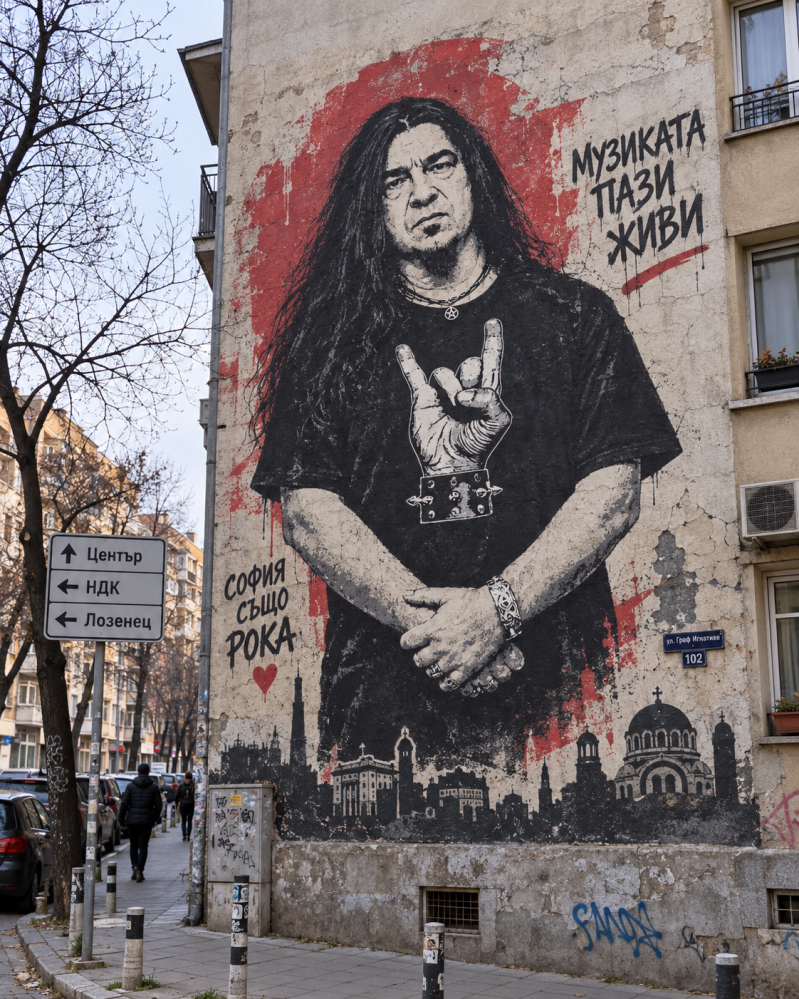
For anyone who grew up with Bulgarian rock, his name hardly needs an introduction. Zvezdi is above all associated with Ahat – Ахат, a band that has been part of Bulgaria’s rock history since the 1980s. But describing him only as “the singer of Ahat” would be far too limiting.
He is a musician, a stage personality, a storyteller, a co-creator of an entire musical era, and still an active part of the world he helped build.
I met him recently under far simpler circumstances than the large stages that have defined much of his life. We had dinner, drank beer, and talked. About music, people, Sweden, Bulgaria, production, GoSo, Studio Bohus, and about what can still be created.
What struck me was not primarily that I was sitting across from one of Bulgaria’s great rock personalities.
It was how little he needed to prove it.
Perhaps that is where true experience begins to show.
When someone no longer needs to prove who they are.
A path that could have led somewhere completely different
Zvezdi’s story contains almost that classic detail shared by many great musicians: life could easily have taken him in an entirely different direction.
As a young man, he was preparing for entrance exams for naval military education and was taking mathematics lessons. But during a rehearsal, Bulgarian singer Georgi Hristov heard him and encouraged him to apply to the music conservatory instead.
Zvezdi did.
And he was accepted.
The plans for a different career disappeared, and music began to take over.
Looking back, it may seem almost inevitable. At the time, it was anything but.
He had grown up listening to names such as Tom Jones, Paul Anka, Lili Ivanova and Emil Dimitrov. Then came the encounter with Black Sabbath and Deep Purple.
That changed the direction.
Heavy rock offered another language, another kind of energy, and perhaps above all another way to express power.
That power would later become inseparable from Zvezdi’s own voice.
November 1986
The road to Ahat passed through the bands Sound and Oasis.
Denis Rizov invited Zvezdi to become the singer of Sound, and the group gradually developed more original material under the name Oasis. Several ideas and songs from that period would later live on in Ahat.
In November 1986, the musicians who would become Ahat came together.
Zvezdi, Bozhidar Glavev, Antoan Hadad, Antoniy Georgiev, and later drummer Yuri Kotsev began shaping what would become one of Bulgaria’s most important hard rock bands.
They rehearsed in a small basement in Studentski Grad in Sofia.
It is a beautiful contrast.
From a basement to some of the country’s biggest stages.
From young musicians discussing what kind of music they wanted to make, to a band whose songs, decades later, remain part of Bulgaria’s cultural soundtrack.
There is something universal in that story.
Almost every important musical movement begins somewhere where nobody outside the room fully understands what is being born.
Ahat and a Bulgaria in transformation
Ahat emerged at a time when Bulgaria was approaching enormous social change.
Rock music was not simply entertainment.
It carried an energy of freedom, individuality, resistance, and a refusal to accept the predictable.
The album “Походът – Pohodat”, “The March”, became a milestone.
One of its songs, “Черната овца – Chernata Ovtsa”, “The Black Sheep”, grew far beyond its original role as a rock song and became, for many, a generational marker.
It became something people carried with them.
That level of significance cannot be manufactured through marketing.
A hit can be created.
A career can be built.
But for music to become part of people’s identity, something else has to happen.
The listener has to begin carrying the music forward themselves.
That is what happened with Ahat.
And at the centre of that music stood the voice.
Zvezdi.
Standing beside some of rock’s biggest names
Throughout his career, Ahat has shared stages and major concert contexts with some of the true giants of international rock.
Deep Purple, Iron Maiden, Black Sabbath and Scorpions are among the major international acts whose Bulgarian concerts have included Ahat.
It is easy to list names like these as trophies.
But Zvezdi’s own perspective reveals something more interesting.
He has spoken about the importance of receiving recognition from people such as Ronnie James Dio and Bruce Dickinson.
For a rock singer, reactions like that carry a different weight than a press review or sales figures.
They come from people who themselves belong to the absolute highest level of the genre.
At the same time, Zvezdi has spoken with great realism about the challenge of supporting major international acts.
An audience waiting for its idol is not automatically interested in the band playing before them.
You have to win the room.
Ahat did that again and again.
That says a great deal about the quality of a band.
And perhaps even more about its backbone.
More than Ahat
Zvezdi’s career has never been limited to a single musical structure.
He has also been strongly associated with Analgin, worked with many other musicians, and moved between projects where hard rock has taken different forms.
One particularly interesting example of his range is Nikolo Kotzev’s Nostradamus – The Rock Opera.
When the rock opera was staged in Bulgaria, Zvezdi took on the role of The Inquisitor.
The project itself was internationally ambitious, bringing together major rock voices and musicians across borders. The Bulgarian stage version also involved international singers, a rock band, orchestra, choir and ballet.
It revealed another side of Zvezdi.
His voice does not only work in front of a traditional hard rock band.
It can carry a character.
A drama.
A story.
Forty years – and still nervous before the stage
Perhaps one of the most revealing things about Zvezdi comes from an interview he gave in the summer of 2026.
After roughly four decades on stage, he described how he still feels that familiar tension before walking out in front of an audience.
The feeling remains until the first chord is played.
There is an important difference between people who have simply worked for a long time and people who still love what they do.
Indifference usually arrives when passion disappears.
Zvezdi still seems to care.
And the audience still seems to care about him.
In 2025, Ahat reunited in a largely classic line-up for an extensive tour together with B.T.R., performing in ten Bulgarian cities.
Zvezdi once again shared the stage with Antoan Hadad, Antoniy Georgiev-Tonto and Denis Rizov, while B.T.R. drummer Iliyan Dikov performed with both bands.
In 2026, Ahat is also marking its 40th anniversary, with plans connected to celebrating the band’s history and bringing the full force of Pohodat back into the spotlight.
That is not nostalgia in the museum sense.
It is music that is still being used.
Still being played.
Still being heard.
When experience meets new music
When we met, the conversation naturally moved toward Sweden and the work being built between Bulgaria and the Swedish music environment.
I told him about GoSo, about the collaborations with Sweden, and about Studio Bohus.
And, of course, we talked about Tear The Abyss.
Zvezdi listened.
There is something very revealing about playing new music to someone who has heard bands, singers, producers and studios for almost his entire adult life.
It is difficult to hide behind presentations.
Either something is there or it is not.
His reaction was immediately positive.
He was impressed both by the sound of the band and by the production.
To me, that means more than a polite “it sounds good.”
It comes from someone whose frame of reference spans several generations of hard rock, from the development of the Bulgarian scene to encounters with some of the biggest names in international rock.
But the conversation did not stop with TTA.
We began talking about possibilities.
About people.
About Denis Rizov.
About future collaborations.
And perhaps that is exactly what makes Zvezdi interesting even after forty years.
He does not seem to be stuck in the question of what he has done.
He remains interested in what can still be done.
A name, but above all a human being
It is easy to turn people into monuments.
Especially when they have a history like Zvezdi’s.
But monuments stand still.
Zvezdi Keremidchiev does not feel still.
When I met him, there was no need to live on old achievements.
The conversation could move freely from the history of rock to new productions, from Bulgaria to Sweden, from people he has known for decades to a band he had heard for the first time only moments earlier.
The day after our dinner, he drove us back to Sofia.
It is a small detail, really.
But sometimes small details tell you more about people than long biographies do.
Behind the powerful rock voice, the stages, Ahat, Pohodat, the tours, and all those years of Bulgarian rock history is a man who still appears genuinely curious about other people.
Perhaps that is what makes real experience valuable.
Not that you know everything.
But that you still want to know more.
Zvezdi has already left his mark on Bulgarian music history.
Nobody needs to argue that point.
His voice is there.
The songs are there.
And generations of people carry their own memories connected to them.
But perhaps the most exciting thought is that the story does not appear to be finished.
After all those years, the desire remains remarkably simple:
To continue.
To continue singing.
To continue creating.
To continue meeting people.
And perhaps that is exactly why Zvezdi Keremidchiev still matters.
He is not only a voice from the history of Bulgarian rock.
He is still part of its future.

By Chris...
Add comment
Comments