

Some cities become inseparable from music. Liverpool has The Beatles. Seattle has grunge. Detroit has Motown. Nashville has country. Birmingham became a cradle of heavy metal. And then there is Gothenburg — the Swedish port city that, during the 1990s, created a musical language that is still heard in heavy music all over the world.
Among metal fans, the term The Gothenburg Sound hardly needs an introduction. It refers to the melodic form of death metal that emerged around a relatively small group of young musicians in Gothenburg in the late 1980s and early 1990s.
There was never really an organised movement behind it. No one sat down in a meeting and decided that Gothenburg should have its own sound. No marketing agency invented the term.
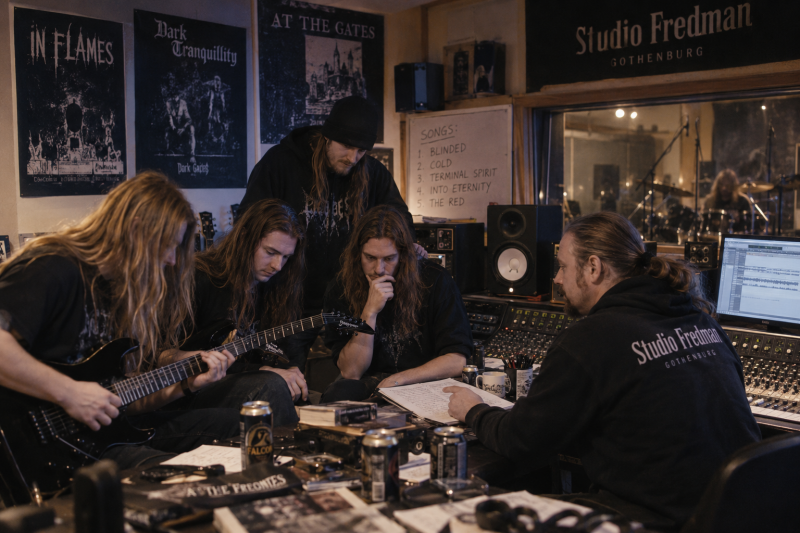
It began with young people, rehearsal rooms, cassette tapes, record stores, beer, guitars and a shared love of extreme music.
The result became something much bigger.
Gothenburg changed the way death metal could sound.
When brutality met melody
Death metal was already established internationally when the Gothenburg scene began to take shape. In the United States, Florida had become a major centre for bands such as Death, Morbid Angel and Obituary. In Sweden, Stockholm was also developing an important scene with bands such as Entombed and Dismember.
But Gothenburg began moving in another direction.
The musicians kept the aggression of death metal — heavily distorted guitars, fast drums and extreme vocals — while introducing much more melody.
The guitars could play harmonies that might just as easily have come from Iron Maiden or the British heavy metal wave of the previous decade. Classical music, folk influences, thrash metal and traditional heavy metal were blended with death metal.
Suddenly, a song could be both brutal and beautiful.
That is perhaps where the essence of the Gothenburg Sound can be found.
In the contrast.
Melodies that could almost have been played on an acoustic guitar were placed on top of aggressive drums and walls of distorted guitars. The guitars often worked together in harmonies. The riffs became memorable in a way that gave even extreme music almost immediate melodic hooks.
It was still death metal.
But death metal had developed a different emotional language.
Three bands changed everything
Three names in particular became associated with the creation of the Gothenburg Sound:
At the Gates. Dark Tranquillity. In Flames.
The three bands developed different identities, but together they formed the foundation of what later became internationally known as melodic death metal.
What is fascinating is how small the world surrounding these bands actually was.
Mikael Stanne of Dark Tranquillity has described how several of the musicians lived along the same bus route into Gothenburg. They knew each other, listened to music together and moved within the same relatively small environment.
Looking back, the scene can appear to have been a major international musical movement.
For the people actually living inside it, it was closer to a group of young metal fans who happened to know each other.
That is an important part of the story.
Innovation does not always grow from large resources or carefully constructed strategies.
Sometimes it happens because people with similar passions live close enough to one another for ideas to collide.
Gothenburg became exactly that kind of laboratory.
At the Gates and the album that exploded
If one album must be chosen as the symbol of the Gothenburg Sound, it is difficult to avoid At the Gates – Slaughter of the Soul, released in 1995.
The album was recorded at Studio Fredman in Gothenburg with producer Fredrik Nordström and has become one of the most influential records in modern metal.
Much of the complexity associated with earlier death metal was stripped away.
The music became extremely concentrated.
The riffs were clear.
The melodies were immediate.
The tempo was high.
Tomas Lindberg’s distinctive, desperate vocals sat above the guitars like an open wound.
The result was just over half an hour of music that would influence generations of bands.
Slaughter of the Soul is now widely regarded as a milestone in melodic death metal, and its influence became particularly clear several years after At the Gates originally broke up in 1996.
There is almost a musical paradox in that.
The band disappeared at roughly the same time the rest of the world was beginning to understand how important the album actually was.
Tomas Lindberg died in 2025, but his importance to the development of modern extreme metal is difficult to overstate.
His way of combining brutality, desperation and intellectual darkness became an important part of the Gothenburg identity within metal.
Dark Tranquillity – darkness and depth
The same year that Slaughter of the Soul was released, Dark Tranquillity released The Gallery.
Where At the Gates could be brutally concentrated, Dark Tranquillity were often more atmospheric, complex and melancholic.
Here it became clear that the Gothenburg Sound was never really an exact formula.
It was more of an idea.
Aggression did not have to exclude beauty.
Heaviness did not have to exclude melody.
Extreme music did not have to be one-dimensional.
The Gallery became one of the albums that, together with At the Gates and later In Flames, helped define melodic death metal during the middle of the 1990s.
Dark Tranquillity also continued evolving long after the first Gothenburg wave, becoming a living example of how the sound could change without completely losing its roots.
In Flames opened the door to the world
Then came In Flames.
The album The Jester Race, released in 1996 and recorded at Studio Fredman, became another cornerstone.
Here, the melodies became even more prominent.
The guitar harmonies could resemble traditional heavy metal, while the rhythm section and vocals remained rooted in death metal.
That combination helped In Flames carry the Gothenburg Sound far beyond the original underground scene.
With albums such as Whoracle, Colony and later Clayman, the band grew internationally and eventually became one of Sweden’s best-known modern metal acts.
But perhaps even more important was what other musicians heard in those records.
For young American bands, In Flames and the Gothenburg scene demonstrated that extreme metal could contain strong choruses, melodic guitar themes and clearly structured songwriting without losing its aggression.
That would have enormous consequences.
Studio Fredman – the factory behind the sound
It is impossible to tell this story without Fredrik Nordström and Studio Fredman.
Nordström produced and recorded several of the albums that came to define the Gothenburg scene, including work by At the Gates, In Flames and Dark Tranquillity.
In many ways, he became the link between the musical idea and the actual sound that ended up on the records.
At the Gates guitarist Anders Björler has described Nordström as a central force because, at the time, relatively few studios in Gothenburg had engineers who truly understood how metal should be recorded.
Studio Fredman therefore became more than a local recording studio.
It became part of the infrastructure behind an international sound.
And just as Sun Studio in Memphis, Abbey Road in London or Hansa Studios in Berlin demonstrate, certain places become important far beyond the physical building itself.
Musicians meet.
Producers influence arrangements.
Guitar sounds evolve.
One band hears what another has done.
The next band pushes the idea further.
Eventually, a scene emerges.
From Gothenburg to the United States
The true historical significance of the Gothenburg Sound becomes especially clear when you leave Gothenburg.
During the late 1990s and early 2000s, a new generation of American bands began combining metal with hardcore.
The modern metalcore wave exploded.
Bands such as Killswitch Engage, Shadows Fall and Trivium built parts of their musical language on ideas that had already been developed in Gothenburg.
The melodic twin guitars.
The aggressive verses.
The large melodic sections.
The balance between extreme metal and more accessible song structures.
Publications across the metal world have repeatedly pointed to the way bands such as Killswitch Engage and Trivium carried the Gothenburg legacy forward to a new generation.
The irony is that some of the American bands inspired by Gothenburg sometimes became bigger in the United States faster than their Swedish influences.
In Flames have themselves described situations where they toured America with bands they had influenced while parts of the audience barely knew who the Swedes were.
That is sometimes how cultural influence works.
The original does not necessarily become the biggest.
But without the original, the rest might never have existed.
More than a guitar sound
That is why it is misleading to describe the Gothenburg Sound simply as a particular guitar tone.
It was a way of thinking.
The Gothenburg bands broke down an invisible wall between two ideas that had often been treated as opposites.
Brutality and melody.
Aggression and melancholy.
Underground credibility and accessibility.
That combination is exactly what made the music so exportable.
A listener did not need to understand growled vocals to be captured by the guitar melody.
You did not need to come from the death metal scene to recognise a powerful riff.
And suddenly, extreme metal had found another path into the wider world.
Why Gothenburg?
There is no single explanation.
Gothenburg was an industrial city and a port city with a strong working-class culture.
At the same time, it had music venues, rehearsal spaces and a relatively concentrated network where people could meet.
Perhaps the most important factor was proximity.
When Dark Tranquillity’s Mikael Stanne was asked again in 2026 about the term Gothenburg Sound, he explained that the bands themselves initially almost regarded the label as slightly insulting.
To them, there was no organised genre.
They were friends from the same city, making music and recording in the same studios.
From the outside, however, the world saw something else.
A clearly identifiable regional phenomenon.
That may be one of the most beautiful parts of the entire story.
They were not trying to build a brand.
They were trying to make good music.
The world created the brand for them.
Gothenburg became larger than Gothenburg
Today, the Gothenburg Sound is no longer geographical.
There are bands all over the world playing music with musical DNA that can be traced back to western Sweden.
Japan.
The United States.
Australia.
Germany.
Finland.
The United Kingdom.
Brazil.
In the same way that the blues left Mississippi and punk left London and New York, the Gothenburg Sound left Gothenburg a long time ago.
But the name remains.
That says something about the strength of the impact.
And the story has almost come full circle.
In December 2026, the Gothenburg Symphony Orchestra will perform music associated with At the Gates, Dark Tranquillity and In Flames in a concert titled The Gothenburg Sound, with the music arranged for symphony orchestra without the amplified guitars and growled vocals that once defined the originals.
What began in rehearsal rooms and underground clubs has therefore reached the Gothenburg Concert Hall.
A Swedish cultural legacy recognised around the world
Sweden has exported an enormous amount of music.
ABBA.
Roxette.
Europe.
Ace of Base.
Max Martin’s international pop productions.
But within heavy music there is another Swedish export success that sometimes receives less attention outside the metal world.
Gothenburg did not invent death metal.
Gothenburg did not invent heavy metal.
But Gothenburg demonstrated that the two worlds could be combined in a way that changed both.
At the Gates, Dark Tranquillity, In Flames, Studio Fredman and the people surrounding them collectively created a musical language that thousands of bands have spoken ever since.
That may be the best definition of real cultural influence.
Not how many people know the name of the person who started something.
But how many people continue to use the ideas.
More than three decades after a small network of young metal musicians began experimenting in Gothenburg, their ideas are still heard from festival fields, clubs, rehearsal rooms and arenas around the world.
The guitars begin playing in harmony.
The drums drive forward.
The vocals explode.
The melody remains above it all.
And somewhere, whether the band is standing in Tokyo, Los Angeles, Berlin or Melbourne, you can still hear Gothenburg.
That is The Gothenburg Sound.

By Chris...
THE HALO EFFECT in Berlin, Germany (The Unheard & The Gothenburg Sound)
Add comment
Comments