

Some expressions suddenly regain their weight. For a long time, “The Russians are coming” belonged in history books, family stories and memories of the Cold War. Today, those words feel closer. Russia’s war against Ukraine has made European security a subject of conversation around the kitchen table. When Gotland reappears in reports about military preparedness, an uncomfortable thought emerges: the island we associate with holidays, limestone houses and the sea has already been occupied by Russian soldiers once before.
The feeling that Russia is breathing down our necks deserves to be understood. At the same time, it must not become our only guide. There are differences between historical experience, real security threats and fear that determine how wisely we respond. Gotland gives us a starting point for discussing all three.
The Spring When Gotland Was Occupied
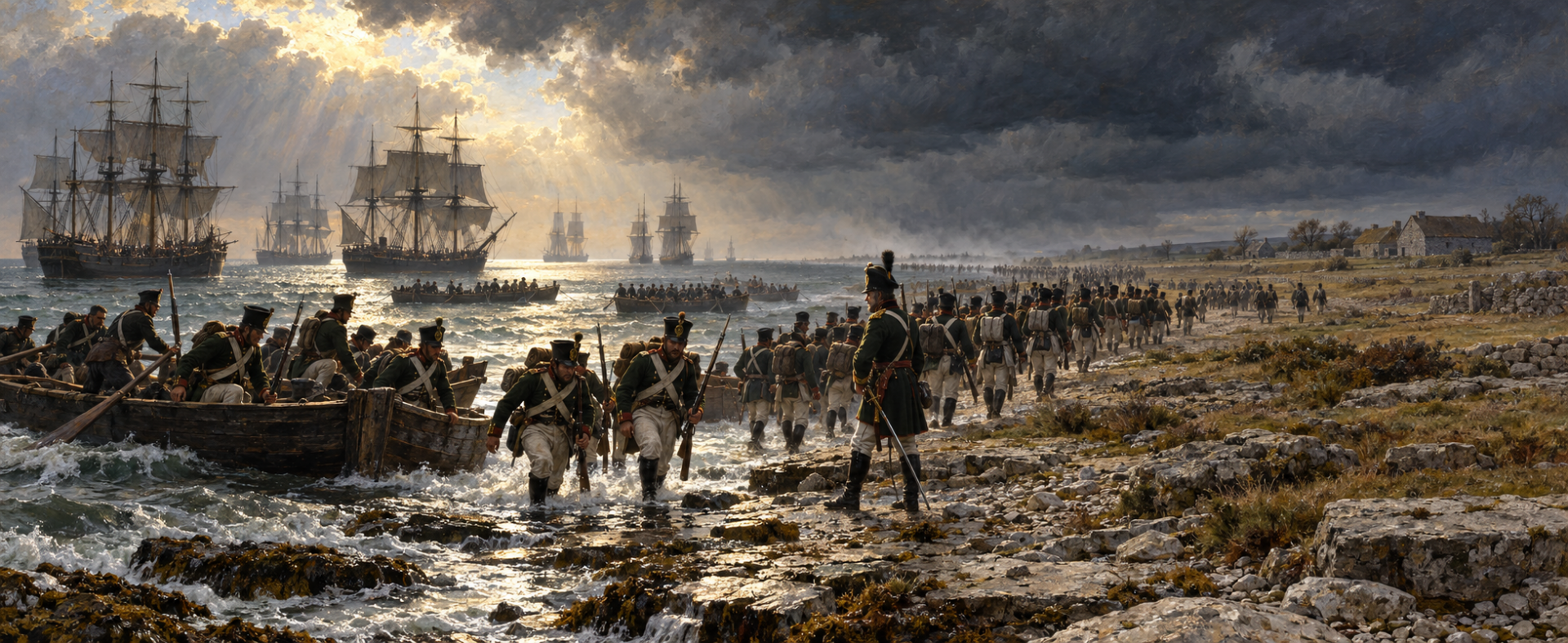
On 22 April 1808, approximately 1,800 Russian soldiers landed at Slesviken in Grötlingbo, on southern Gotland. Their commander, Admiral Nikolai Bodisco, had arrived with nine merchant ships and six artillery pieces. Sweden was at war with Russia, but Gotland lacked a military defence ready for action. A local militia began to assemble, but the county governor, Erik af Klint, judged that resistance would be futile. The island surrendered. On 24 April, the Russians marched into Visby, and Bodisco declared himself governor. www.sverigesradio.se
The occupation was brief. Swedish forces returned while the Russians’ access to reinforcements was cut off. Bodisco surrendered, and on 18 May the Russian soldiers departed from Gotland through Slite. No battle between the armies took place. The episode was limited in scale compared with the war in Finland, but its central question remains easy to understand: what happens when a strategically important place lacks the ability to protect itself?
The Island Is Where It Has Always Been
Gotland’s significance begins with geography. The island lies in the middle of a sea where military movements, trade and supply routes intersect. In 1808, Russia saw an opportunity to establish a naval base and divide Sweden’s war effort. Today, the technology is different, but the importance of the location remains.
This does not mean that whoever controls Gotland automatically controls the entire Baltic Sea. Such statements oversimplify both geography and warfare. However, military capabilities on the island can affect the ability to move through the region and protect transport routes. The Swedish Armed Forces specifically emphasise secure ports, shipping and air transport as prerequisites for moving allied forces.
For those who live on Gotland, of course, this is also home. Strategic maps show positions and ranges; people’s maps show their school, workplace, family and the house where they hope to grow old. Security policy must accommodate both perspectives. Defence serves a purpose that extends far beyond the markings on a map: enabling people to continue living their lives.
Ukraine Has Changed Our Perspective
Russia’s full-scale invasion of Ukraine in February 2022 made it impossible to regard large-scale wars of conquest in Europe as a closed chapter of history. For Ukraine, the question of self-determination is concrete: its territory, society and future are at stake. The EU continues to condemn Russia’s aggression and support Ukraine’s independence and territorial integrity. www.nato.int
For those of us watching the war from a distance, the experience is different: security has become less certain. This does not mean that our situation can be equated with that of Ukrainians. But the war has changed how we read the news and interpret things that previously passed in the background. A military aircraft over the Baltic Sea raises different questions. A defence exercise carries a different weight.
We can mourn this change without wishing to return to ignorance. The old sense of security was comforting, but lasting security must also withstand our seeing the world as it is.
Sweden Is Now Part of a Different Framework
The historical parallel has clear limits. Today’s Sweden is not the Sweden of 1808. Finland joined NATO on 4 April 2023, and Sweden on 7 March 2024. Their membership changed the conditions for collective defence in the Nordic countries and the Baltic Sea region.
On 18 September 2026, Sweden and Germany conducted a joint reinforcement operation on Gotland. German units participated as Swedish coastal missile units were transported to the island, protected by warships and fighter aircraft. According to the Swedish Armed Forces, the operation tested NATO’s plans to reinforce and defend the region. The participating units were then to return to their usual locations. www.forsvarsmakten.se
This is an important difference from 1808: cooperation must work in practice before it is needed in an actual crisis. A defence plan must account for sea crossings, transport, the reception of incoming forces and coordination. Only when personnel and equipment can actually reach their destination do political commitments acquire their full significance.
The Threat Can Arrive Without a Landing
When we imagine a threat to Gotland, we readily picture ships on the horizon and soldiers coming ashore. But vulnerabilities can also lie in the systems that keep everyday life running. Communications, energy supplies and transport need to function long before anyone speaks of a military attack.
NATO launched Baltic Sentry in January 2025 to strengthen the protection of critical infrastructure in the Baltic Sea. The activity involves ships, maritime patrol aircraft and new surveillance technologies, among other assets. It was introduced against a background of damage to undersea infrastructure and concern about destabilising actions.
Precision is essential here. A damaged cable is a real event; who caused the damage, and with what intent, are separate questions. It is reasonable to investigate possible sabotage without prejudging the investigation. Otherwise, our anxiety risks doing the work of anyone seeking to create uncertainty: every disruption becomes an attack, every ambiguity becomes proof.
Feeling Threatened Does Not Tell Us When an Attack Will Come
We need to hold two thoughts at once. Russia’s actions justify stronger preparedness. Yet a Russian attack on Gotland is not an established future outcome. On 30 September 2026, NATO Secretary General Mark Rutte said there was no imminent threat to the alliance’s territory from Russia. That is a current assessment, not a guarantee for all time. www.reuters.com
The distinction matters. If preparedness is presented as proof that war is close, every protective measure becomes another reason to panic. But preparedness can also reduce the risk of attack by making it more difficult and costly.
A society therefore needs language capable of conveying both seriousness and proportion. We must be able to say that the situation is concerning without claiming that catastrophe has already been decided. And we must be able to feel fear without allowing it to determine what is true.
Preparedness Begins With What Has to Work
It is easier to discuss security in terms of large budgets and weapons systems than everyday dependencies. But a society’s resilience is also evident in whether water flows from the tap, healthcare services can operate and people receive reliable information when something happens.
As a practical conclusion from today’s situation, preparedness should therefore be embedded in planning. Who is responsible when normal systems fail? What backup arrangements exist? Can local authorities, businesses and volunteers work together? Have they tested their plans jointly, or does coordination exist only on paper?
These are the same kinds of questions that arise in any complex operation. A plan needs clear roles, functioning resources and people who can make decisions. The difference is that the consequences can be far greater when an entire society comes under pressure. Expertise, maintenance and reliable logistics therefore deserve as much respect as the most visible investments.
Russia Is More Than the Kremlin
The Swedish shorthand “the Russian” carries historical associations, but it can also make our analysis careless. In this discussion, the threat concerns the actions of the Russian state and the decisions of its leadership. An individual does not become responsible for the invasion of Ukraine because of their language or background.
That distinction is necessary if our criticism is to reach the right target. We can be unequivocal about aggression while respecting human dignity. Suspicion of neighbours, colleagues or acquaintances does not make us better at understanding military risks.
Security also depends on trust within our own society. If we allow fear to erode that trust, we weaken something we are simultaneously trying to defend. Firmness towards an aggressive state and respect for individuals can coexist. This requires precision rather than sweeping images of an enemy.
Peace Needs Both Strength and Judgement
There is a temptation to choose between two comfortable extremes: either everything will work out, or war is inevitable. Both release us from the harder task of assessing risks, building capabilities and continuing to seek peaceful solutions.
My conclusion is that military preparedness and diplomatic channels must exist at the same time. Stronger defence can raise the threshold for an attack. Factual communication and political judgement can reduce the risk of misunderstandings and ill-considered decisions. Neither removes uncertainty, but together they provide greater room to act.
Peace also means people’s ability to plan ahead. To start a business, renovate a home, book a trip or hope for their children’s future. The ultimate purpose of security policy is to protect that freedom.
History Warns Us, but Does Not Decide Our Future
Gotland in 1808 shows how quickly an undefended territory can fall under foreign control. The end of the occupation also shows that events can change when resources and the capacity to act are mobilised. History provides experience to think with. It does not provide a ready-made forecast for 2026.
Yes, today it can feel as though Russia is breathing down our necks again. We have reason to take that feeling seriously and examine what lies behind it. But our task is greater than repeating an old cry of danger.
We need to defend our freedom to act, strengthen society’s capabilities and retain our judgement. Gotland must be able to remain both a well-defended island and a place for entirely ordinary lives. That is the future preparedness should make possible. It requires perseverance, shared responsibility and a willingness to safeguard the freedoms of everyday life.

By Chris...
Add comment
Comments