

We have built a society where almost everything is connected. But have we truly understood what happens when someone else takes control of the technology? Ten surprising examples reveal just how vulnerable our modern everyday lives have become.
We still imagine a hacker as someone sitting in front of a computer, trying to steal passwords, bank accounts, or confidential documents. We worry about identity theft, fraud, and someone reading our private messages.
But what if the next major cyberattack isn't about stealing anything at all?
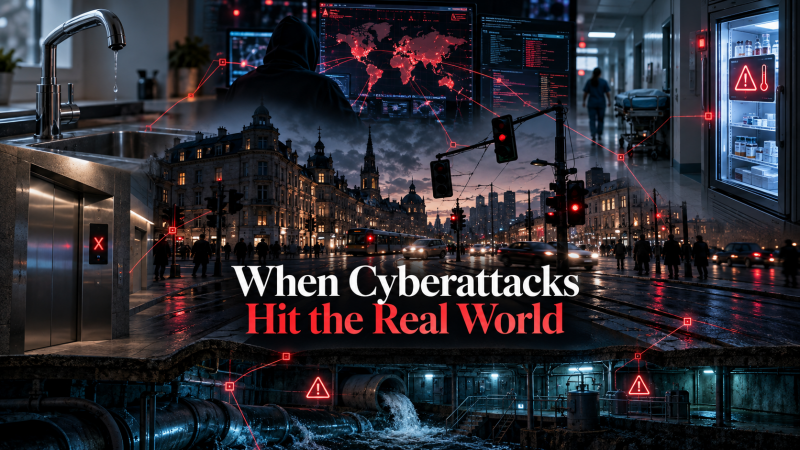
What if it simply turns off the water in your neighbourhood? Stops the elevators in your hospital? Switches off the streetlights? Manipulates the temperature inside medical refrigerators or causes sewage to rise through the underground networks beneath our cities?
It sounds like the plot of a disaster movie.
The problem is that the technology already exists.
In October 2026, widespread cyberattacks were reported against refrigeration systems in French supermarkets. By manipulating the control systems of refrigerators and freezers, attackers reportedly caused temperature changes that destroyed food and disrupted business operations.
The remarkable thing was not that the technology broke down. It was that the technology could be instructed to do the wrong things.
That is a fundamental difference.
For decades, we have been building a society in which more and more physical functions are controlled by software, sensors, networks, and centralised control systems.
We call it digitalisation, automation, and smart infrastructure.
But when we make the physical world digitally controllable, we also make it potentially vulnerable to digital attacks.
Here are ten things most people would never even consider could be hacked.
1. The Water Pressure in Your Tap
We turn on the tap and expect water to flow. It is one of the most basic assumptions of modern society.
But behind that tap are pumps, pressure regulators, reservoirs, and automated control systems. In many municipalities, these installations are monitored remotely.
An intrusion into an inadequately protected control system could affect water pressure, stop pumps, or disrupt distribution.
Imagine an entire residential neighbourhood waking up without running water. Not because a pipe has burst, but because someone has manipulated the control system.
In the United States, authorities have repeatedly warned about cyberattacks targeting water and wastewater infrastructure. Some incidents have involved actual unauthorised access to operational equipment.
The water may still be sitting in the reservoir, yet never reach your tap.
2. The Traffic Lights Controlling an Entire City
We tend to think of traffic lights as fairly simple devices. Red, yellow, and green. But modern traffic management systems are often considerably more sophisticated.
Hundreds of intersections can be coordinated through central traffic management systems. Sensors monitor traffic flows, public transport can receive priority, and signal timings can be adjusted according to demand.
If an attacker successfully disrupts central control or communication systems, the consequences could be extensive.
Not necessarily by creating dangerous green signals in every direction simultaneously. Safety mechanisms are generally designed to prevent such conflicts.
But by causing incorrect signal timings, interruptions, or disrupted coordination.
Imagine rush hour in Sofia, Paris, or Berlin when major intersections suddenly stop operating efficiently.
Cars become trapped in congestion. Buses are delayed. Ambulances struggle to get through.
What appears to be an ordinary traffic problem could actually be a digital attack.
3. Heating in Thousands of Apartments
Across much of Europe, residential buildings are heated through district heating networks or centralised heating systems.
Temperatures, circulation pumps, valves, and heat exchangers can be regulated automatically. These systems are often connected to monitoring centres and external service providers.
This provides better energy efficiency and easier maintenance.
But it also means that functions which previously required physical access can now be influenced digitally.
An attack against sufficiently central components of a heating system could interrupt heat delivery or disrupt temperature regulation across numerous buildings.
In the middle of winter, this could quickly develop from a technical problem into a public emergency.
Particularly for elderly people, those with medical conditions, and families with young children.
There does not necessarily have to be physical damage to the heating plant itself if an attacker can compromise the systems responsible for distribution.
4. Elevators in Hospitals and Skyscrapers
Most people never think about elevators being connected to the internet.
Yet modern elevator systems can be monitored remotely. Technicians can diagnose faults, analyse usage, and sometimes manage maintenance functions through digital interfaces.
That does not mean someone can simply make an elevator fall. Modern elevators have extensive mechanical and electronic safety mechanisms.
However, disruptions to digital control and management systems could cause elevators to stop operating.
Imagine a large hospital where several elevators are simultaneously taken out of service.
Patients cannot be transported efficiently between departments. Equipment and staff are delayed. People with reduced mobility are particularly affected.
This is not about spectacular explosions.
It is about disabling a seemingly insignificant function upon which an entire organisation depends.
5. Medical Refrigerators That Help Keep People Alive
Not every refrigerator contains food.
Hospitals, laboratories, and pharmacies store vaccines, insulin, biological medicines, and other temperature-sensitive products.
Some must remain within extremely narrow temperature ranges.
Modern medical refrigerators can be connected to central monitoring systems that record temperatures and generate alarms.
This is an excellent safety feature, provided the system is properly designed and secured.
But if an attacker manipulates refrigeration controls or temperature information, staff could, in the worst case, receive incorrect information about storage conditions.
Medicines may become unusable. Treatments may need to be postponed. Entire inventories may have to be discarded.
The attacks against French supermarkets demonstrate why this question matters.
The difference between a ruined packet of ice cream and destroyed life-saving medication is enormous.
6. Information Displays in the Metro
We trust digital information displays.
When a sign says the next train will arrive in three minutes, we assume the information is correct.
But that information often comes from central digital systems managing timetables, real-time train positions, disruption notices, and platform information.
These passenger information systems are normally separated from safety-critical train control systems.
However, information itself can be a critical function.
If thousands of people simultaneously receive false messages about cancelled trains, changed platforms, or delays, the result can be confusion and overcrowding.
Passengers gather in the wrong places. Connections are missed. Stations experience abnormal pressure.
We often think information is just information.
But in a society where people act on digital instructions, manipulated information can also produce physical consequences.
7. Ventilation in Operating Theatres
Air conditioning and ventilation are usually associated with comfort.
In hospitals, ventilation can be part of patient safety.
Operating theatres, isolation rooms, and certain laboratories require controlled airflow, filtration, and pressure differences.
These functions are monitored and regulated by technical control systems.
If those systems are manipulated or stop functioning, medical activities may need to be suspended until safe conditions are restored.
That does not mean a digital intrusion automatically causes infections. Hospitals often have dedicated alarms and safety procedures.
But the dependency is clear.
An operation may need to be postponed not because the surgeon is unavailable or the medical equipment has failed, but because the building's technical systems can no longer guarantee the required conditions.
We have made building automation part of modern healthcare.
That means cybersecurity has also become part of patient safety.
8. The Exit Barriers in Car Parks
This may seem trivial compared with hospitals and water treatment facilities.
But imagine a large shopping centre, airport, or arena where thousands of people are trying to leave a parking area at the same time.
Many modern car parks use central digital systems for payments, automatic number plate recognition, access control, and barrier operation.
If the system stops working, exits may become blocked and queues can rapidly grow.
In the worst case, the disruption could affect surrounding roads and make access more difficult for emergency services.
Of course, barriers can often be opened manually.
But the critical question is whether staff know how to do it, whether procedures have been tested, and how quickly the organisation can respond.
A parking management system is hardly the first thing we think about when discussing cybersecurity.
Yet it can become a surprisingly effective source of widespread disruption.
9. Streetlights Across an Entire City
More and more European municipalities are installing intelligent street lighting.
Individual lights can be dimmed according to the time of day, controlled remotely, and monitored centrally. The aim is to reduce energy consumption and simplify maintenance.
That makes both economic and environmental sense.
But if large numbers of streetlights are connected to the same inadequately protected control system, a shared vulnerability may emerge.
An attacker with sufficient privileges could disrupt lighting across extensive areas.
Imagine footpaths, parks, residential streets, and important traffic environments suddenly going dark.
The consequences could include increased insecurity, difficulties navigating, and a higher risk of accidents.
The curious thing is that a streetlight which once needed only electricity may now, in some installations, also depend on functioning digital communication and control.
We have given it intelligence.
But have we also given it sufficient protection?
10. The Sewage Systems Beneath Our Cities
The final example may be the most disturbing.
Beneath our cities lies an extensive network of sewers, pumping stations, level sensors, and automated control systems.
It is infrastructure that almost nobody thinks about until something goes wrong.
Pumping stations transport wastewater through the network and can be monitored from central operational facilities.
If pumps are stopped or level information is manipulated, wastewater can accumulate in the wrong places. Under unfavourable conditions, this can cause flooding or the discharge of untreated sewage.
And this is not merely a hypothetical problem.
Back in 2000, a former contractor manipulated control systems associated with wastewater management in Maroochy Shire, Australia. The attacks caused sewage spills.
It remains a documented historical example of how digital manipulation can produce very real physical and environmental consequences.
Twenty-six years later, our societies have become far more connected.
That should make us think.
The Biggest Problem Is Not the Hackers
After examining these ten examples, it is tempting to conclude that the world is full of dangerous people determined to destroy our everyday lives.
But I believe that misses the most important point.
The bigger problem is that we build systems without always understanding how dependent we become on them.
We invest billions in digitalisation, smart cities, automation, and artificial intelligence. We develop solutions that reduce energy consumption, improve efficiency, and make technical installations easier to control.
I welcome that development.
But I think we discuss the bigger picture far too rarely.
Who is responsible for security when a system consists of equipment from one manufacturer, software from another, internet connectivity from a third, and maintenance personnel from a fourth company?
Who checks that security updates are actually installed?
Who knows which parts of the installation are accessible from the internet?
And who takes control when something unexpected happens?
In my own experience of complex productions and technical projects, one principle has always been fundamental: you must understand what happens when something stops working.
It is not enough to have a plan for when everything goes right.
You must also have a plan for when everything goes wrong.
We Have Built an Efficient Society. But Is It Resilient?
Modern civilisation relies on an extraordinary amount of invisible technology.
We do not see the pumps that deliver our water. We do not see the systems regulating our heating. We rarely think about the software controlling ventilation, traffic signals, or hospital refrigeration equipment.
We only see the results.
Water from the tap. Heat from the radiators. A green light at the intersection. Medicines available when we need them.
And because of that, we often fail to notice how many new digital dependencies have been built into our everyday lives.
The real threat is not that every individual device can be hacked. Not all installations are connected in the same way, and many have well-designed security mechanisms.
The threat is that we do not always know which systems share the same vulnerabilities or how far the consequences can spread when an important component fails.
We have become remarkably good at creating efficiency.
Now we must become equally good at creating resilience.
That means local backup functions, clear security responsibilities, properly protected networks, regular updates, and people who actually understand the systems they are responsible for.
Above all, it means we need to stop treating cybersecurity as an isolated IT problem.
It is about how we build and manage our society.
The Next Cyberattack May Never Appear on Your Screen
There is something almost philosophically strange about this development.
The more advanced our technology becomes, the less we need to think about how it works.
Normally, that is a sign of progress.
But it also means we can become completely dependent on systems we barely know exist.
The day something goes wrong, we may not receive a message saying our personal information has been stolen.
We may simply notice that no water comes out of the tap.
That the heating has stopped working.
That the metro is displaying incorrect information.
Or that every streetlight has suddenly gone dark.
The major cyberattacks of the future may not be about stealing our digital assets. They may be about taking control of the physical world we live in.
And that is why we should be asking a far more important question than how much more of our society we can connect.
Have we truly understood what we are connecting in the first place?
— Chris | ME & Bo Life
Sources and Further Reading
-
CISA: Industrial Control Systems Advisories and warnings about cyber threats targeting water and wastewater infrastructure.
-
FBI and CISA: Joint cybersecurity advisories concerning operators of critical infrastructure.
-
Claroty Team82: Security research into vulnerabilities affecting Danfoss industrial refrigeration controllers.
-
MITRE ATT&CK for ICS: Documentation of attack techniques targeting industrial control and automation systems.
-
ENISA: European analyses of cybersecurity threats to critical infrastructure.
-
NIST SP 800-82: Guide to Operational Technology (OT) Security.
-
Maroochy Shire Sewage Incident (2000): Documented historical case involving manipulation of wastewater infrastructure in Australia.
This article distinguishes between documented incidents and hypothetical but technically plausible attack scenarios. The consequences depend on system architecture, protective mechanisms, and the ability to maintain operations during disruptions.

By Chris...