

October 12, 1994 | Earls Court, London | One of the Most Serious Grandstand Accidents in Rock History
It was supposed to be one of Pink Floyd's great nights of triumph. Instead, the opening concert of the band's London residency turned into a disaster. Hundreds of concertgoers were thrown into a wreckage of steel tubes and collapsed seating sections. Nearly a hundred people were injured. But behind the accident lay something far more troubling than a technical failure: an apparently simple modification to a structure that should never have been carried out without proper engineering verification.
A Night That Was Supposed to Make History
London, October 12, 1994. Thousands of people had gathered at the Earls Court Exhibition Centre to experience Pink Floyd, one of the world's most influential and technologically sophisticated rock bands.
Expectations were enormous.
The group was touring following the release of The Division Bell, and the London concerts were intended to be something extraordinary.
Fourteen performances had been planned at Earls Court. It was an impressive undertaking, featuring a stage production that few other artists could match.
Enormous film projections, advanced lighting effects, lasers, massive sound systems and a production concept refined over decades would create an experience far beyond an ordinary rock concert.
Pink Floyd had become much more than a rock band.
Their concerts were technological and artistic installations in which music, lighting, film, architecture and audience participation worked together.
The audience expected the extraordinary.
But that evening, the extraordinary would take on an entirely different meaning.
Less Than One Minute
The concert began with Shine On You Crazy Diamond, one of the band's most beloved compositions.
The music's slow, atmospheric introduction began filling the enormous arena.
The lights dimmed.
The audience turned its attention towards the stage.
Richard Wright and touring musician Jon Carin had begun playing.
Then the unthinkable happened.
A large temporary seating structure at the rear of the arena began to move. Sections lost their stability, and parts of the grandstand folded beneath the people sitting there.
Within seconds, rows of audience seats were transformed into chaos involving metal tubes, platforms and falling bodies.
The grandstand, which contemporary reports described as having a capacity of approximately 1,200 people, collapsed.
People fell from different levels, in some cases from heights reportedly approaching six metres, or around twenty feet.
Those on the structure were thrown down onto other spectators and pieces of the collapsing framework.
Others became trapped between the twisted sections.
What was supposed to have been an unforgettable musical experience had turned into a major rescue operation in less than a minute.
When Reality Looked Like a Special Effect
There is an almost surreal detail in accounts of the Earls Court disaster.
Some concertgoers initially thought the movement of the grandstand was part of the show.
Pink Floyd were famous for their spectacular productions.
Audiences had become accustomed to unexpected visual effects, vibrations, explosions and dramatic lighting sequences.
When the floor and seats began moving, it was therefore not immediately obvious to everyone that they were witnessing a catastrophe.
But the illusion quickly disappeared.
People screamed.
Steel crashed against steel.
Grandstand sections continued to deform as people desperately tried to escape.
Inside the enormous venue, the combination of darkness, noise and confusion made it difficult for parts of the audience to understand what had happened.
Staff quickly had to communicate that the concert was being stopped.
The house lights came on, and the rescue operation began.
For those already trapped beneath the collapsed structure, every minute mattered.
Almost One Hundred People Injured
Rescue workers, medical personnel and the event's safety teams worked to free people from the wreckage.
The operation took more than an hour.
Injured spectators received treatment at the scene, while others were transported to hospital.
Some suffered injuries to their backs, necks and ribs. Others sustained fractures, minor injuries or severe shock.
The exact figures vary slightly between sources.
One frequently repeated account states that 96 people were injured, 36 required hospital treatment and six remained in hospital overnight. Initial newspaper reports gave somewhat lower figures.
The fact that nobody died remains remarkable.
A grandstand of that size, with hundreds of people falling together with steel components and structural materials, could easily have produced far more devastating consequences.
The concert was immediately cancelled.
For Pink Floyd, whose reputation was built upon technological sophistication and almost complete control over their stage productions, the accident was a shock.
The Real Cause – Three Feet
The most disturbing details emerged later.
This was not simply a grandstand that happened to break.
A 2011 report by Britain's Health and Safety Laboratory, prepared as part of research for the Health and Safety Executive, examined the circumstances behind the collapse.
The seating structure was a prefabricated system designed and engineered to be assembled according to a specific technical configuration.
But once the grandstand had been installed, a problem became apparent.
From some of the front seats, the audience's view of the stage was obstructed by the concert's sound mixing position.
Naturally, this was unacceptable from an audience perspective.
People had paid to see Pink Floyd, not the back of a technical installation.
A decision was therefore made to raise the grandstand.
By approximately three feet.
Just over ninety centimetres.
It might not sound particularly dramatic.
Less than one metre.
But in structural engineering, such a modification can be critical.
The original grandstand had not been designed for this altered configuration. Additional scaffolding was used to support the raised structure.
The modification was carried out without consulting the original designer.
An independent engineer approved the alteration, but according to the later safety analysis, there was insufficient understanding of how the changes would affect the structure's overall stability.
When the grandstand was subjected to loads during the concert, the additional scaffolding system began to fail.
Collapse followed.
Three feet.
An apparently straightforward adjustment intended to improve visibility had become the beginning of one of the most serious accidents in British concert history.
An Accident That Began Long Before the Concert
It is easy to think of disasters as sudden events.
A grandstand falls.
A stage collapses.
A roof gives way.
But the physical collapse is often merely the final step in a much longer chain of decisions.
At Earls Court, the problems began during planning.
The position of the sound mixing area and the location of the grandstand had not been sufficiently coordinated.
The obstruction was discovered only after the seating structure had already been installed.
Then came a familiar problem in event production.
A quick solution was needed.
The original configuration did not work as the organisers intended.
Instead of redesigning the arrangement with the original structural engineer, a modification was made on site.
This is where the accident becomes particularly revealing.
The events industry is full of people who are exceptionally good at solving problems.
Production managers, technicians, riggers, builders and stage crews frequently work under intense pressure.
There is a powerful professional culture built around finding solutions and ensuring that the show can go ahead.
Most of the time, that is a strength.
But when improvisation replaces engineering verification, the same mentality can become dangerous.
Just because a modification appears practical does not mean it is structurally safe.
And approval is only meaningful when it is based on the right expertise, complete information and appropriate inspection.
A System Failure, Not Just a Structural Failure
The British safety report identified weaknesses in planning, inspection procedures and the management of structural modifications.
That distinction matters.
An accident may be triggered by a component failing, but the underlying cause may be an organisation that allowed an inadequately assessed change to take place.
Who was responsible for ensuring that the drawings were followed?
Who had the authority to modify the structure?
Who was supposed to assess how raising the grandstand would affect its stability?
Who had the power to stop the work?
And who ensured that the completed structure actually corresponded to an approved engineering design?
These questions lie at the heart of professional safety management.
It is not enough for an experienced individual to say that something will hold.
Temporary structures must be treated with the same engineering discipline as permanent buildings.
In some respects, they deserve even greater attention because they are assembled quickly, used briefly, dismantled and rebuilt in different environments.
What worked at the previous concert will not automatically work at the next one.
Pink Floyd's Response
David Gilmour spoke after the disaster, making clear that the band was deeply upset and concerned about what had happened.
There was also enormous relief that nobody had lost their life.
The band wanted answers about how the grandstand could have collapsed.
The cancelled concert was rescheduled for October 17, originally planned as a day off.
The damaged seating structure was replaced, and the remaining performances went ahead.
According to the contemporary Pink Floyd publication Brain Damage, the band also sent a complimentary T-shirt and a letter of apology to concertgoers who had been seated in the affected stand.
It was a symbolic gesture.
Of course, no T-shirt could compensate for physical injuries or the fear experienced by those caught in the collapse.
But the gesture demonstrated that the band took the accident seriously, even though responsibility for the grandstand's engineering did not automatically rest with the musicians.
For the audience, however, it was Pink Floyd's concert they had come to experience.
As a result, the band's name would forever be associated with the disaster.
The Invisible Part of a Concert Production
Audiences see the lights, the stage, the artists and the spectacular effects.
They rarely see the structures that make the experience possible.
Beneath stages and grandstands are thousands of components whose performance is essential to safety.
Loads must be transferred through the correct parts of a structure.
Supports must be positioned correctly.
Connections and stabilising elements must function as intended.
A temporary grandstand is not simply a collection of seats.
It is an engineered system.
When hundreds of people sit, stand, move or react to music, the structure must withstand the resulting loads.
Any change in height, support positions or connections can affect the way the system behaves.
That is why it is dangerous to regard these structures as ordinary event equipment that can be adjusted whenever circumstances demand it.
They are buildings in engineering terms, even when they are only intended to remain in place for a few days.
What the Industry Should Learn
The Earls Court disaster remains relevant more than three decades later.
Modern events have become larger, more technologically advanced and often more complicated.
Stages now feature enormous roof systems, giant LED screens, suspended sound arrays and sophisticated rigging installations.
Temporary audience areas are constructed in arenas, parks, city centres and unconventional locations.
Yet the fundamental production culture of the events industry remains familiar.
Everything must be ready by a specific deadline.
The audience will arrive regardless of whether deliveries have been delayed, weather conditions have deteriorated or technical requirements have changed.
But an opening time can never be more important than structural safety.
No structural modification should be carried out without its consequences being assessed by appropriately qualified professionals.
Nobody should assume that a temporary solution is safe simply because it looks stable.
And no production manager should be forced to choose between delivering an event and fulfilling their safety responsibilities.
It is the organisation's responsibility to ensure that such conflicts do not arise.
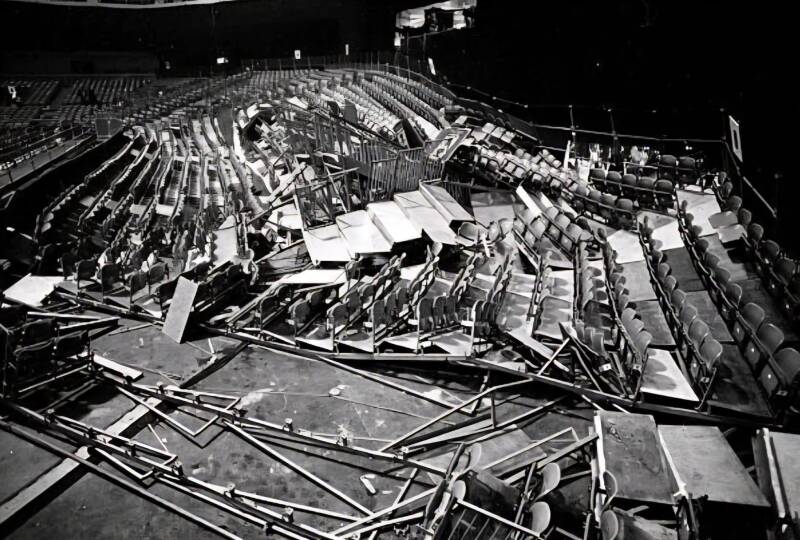
The Photograph That Tells the Story
Photographs from Earls Court reveal a devastating scene.
Where people had been sitting only minutes earlier, waiting for the music to begin, there was now a chaotic landscape of destroyed grandstand sections, seats, platforms and steel tubing.
The images are almost difficult to comprehend.
They do not show an enormous arena destroyed by fire or explosion.
They show what happens when a temporary structural system loses its load-bearing stability.
Perhaps that is precisely why the photographs are so powerful.
They remind us that disasters do not always require dramatic external forces.
Sometimes all that is needed is an incorrect engineering solution and an organisation that fails to recognise its consequences in time.
The Most Important Lesson from Earls Court
Pink Floyd continued their tour.
The Division Bell Tour became one of the most spectacular productions in rock history.
The concerts were later documented through the celebrated live project PULSE.
The music lived on.
But October 12, 1994, also became another chapter in Pink Floyd's history.
An evening when people arrived expecting something extraordinary and instead found themselves in the middle of a catastrophe.
There is a disturbing irony in the fact that the accident happened during Shine On You Crazy Diamond, a composition built around feelings of fragility, loss and human vulnerability.
That evening, vulnerability became frighteningly real.
Yet the most important lesson is not really about Pink Floyd, music or rock history.
It is about how people make decisions under pressure.
We create increasingly sophisticated experiences and technological environments.
We place our trust in specialists, systems and safety procedures.
But ultimately, safety is often determined by what happens when someone discovers a problem and proposes a quick solution.
That is precisely where a firm boundary must exist.
A structure that has been modified is no longer necessarily the same structure that was originally approved.
And when thousands of people are relying on us to get things right, there is no room for assumptions.
What happened at Earls Court on October 12, 1994, was not merely a disaster that fortunately ended without fatalities. It was a reminder that engineering expertise, accountability and a genuine culture of safety must always carry more weight than the desire to get a show started on time.
The show must go on.
But never at any cost.

By Chris...