

An economy under pressure. A younger generation that has had enough. Trade unions mobilising. And growing discontent spreading from social media to the streets. October 17, 2026, could become a significant date in France's modern history. But what is really happening – and why should the rest of Europe be paying attention?
A Nation Running Out of Patience
There are moments in history when a society's frustration shifts from individual dissatisfaction to collective action. Moments when people who previously accepted their circumstances begin questioning why they should continue doing so.
France has experienced such moments before.
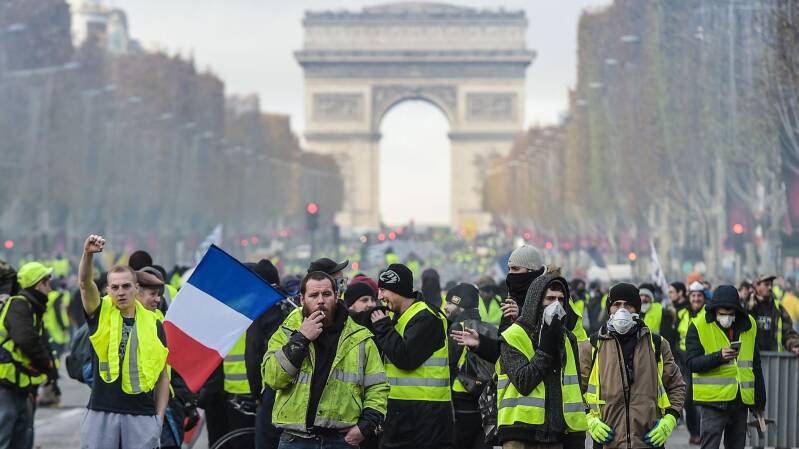
The Revolution of 1789 transformed Europe's political landscape. The student uprising of May 1968 developed into widespread strikes and shook the French state. The Yellow Vest protests of 2018 demonstrated how quickly dissatisfaction with economic conditions could become a nationwide movement.
Now, France may be approaching another turning point.
On Saturday, October 17, 2026, demonstrations and protest actions are planned across the country. The underlying issues include rising living costs, fuel prices, deteriorating public services, and growing frustration with political decisions.
At the same time, a significant student movement has already shaken the country for several weeks.
What makes the current situation particularly interesting is the possibility that these movements could come together.
When young people's frustration meets workers' economic concerns, and organised trade unions join the mobilisation, an ordinary day of demonstrations can develop into something considerably larger.
However, whether October 17 becomes a temporary protest or the beginning of a prolonged social conflict remains an open question.
Young People Have Already Lit the Fuse
The current unrest did not begin with the Yellow Vests. It began in the schools.
Throughout September and October, French secondary school students have protested against teacher shortages, overcrowded classrooms, deteriorating school facilities, and educational conditions that many believe are undermining their future opportunities.
The movement quickly spread from schools in the suburbs of Paris to other parts of the country.
On October 13, approximately 161,500 people participated, according to official estimates, while organisers reported considerably higher figures. The protests have also resulted in school closures, confrontations with police, and widespread public debate.
It would be easy to regard the students' demonstrations as a limited dispute over education policy.
But that would underestimate their significance.
Education represents the future. When young people feel that their opportunities are deteriorating, while society still expects them to study, work, and support future generations, a deeper conflict begins to emerge.
The question is no longer simply about the number of teachers.
It is about what kind of society young people are expected to inherit.
The government has promised measures, including additional substitute teachers, but trade union representatives have questioned whether these initiatives are sufficient to resolve the underlying structural problems.
Historically, precisely this type of conflict has sometimes provided the foundation for larger social movements.
The Yellow Vests – A Movement That Never Completely Disappeared
When the Yellow Vests, Gilets jaunes, began protesting in 2018, their initial grievance concerned increases in fuel taxes.
But the movement quickly evolved.
Behind the demonstrations lay broader frustration over economic inequality, living costs, and the perception that political decision-makers did not understand ordinary people's daily lives.
People from smaller towns and rural communities gathered at roundabouts, road junctions, and fuel depots.
This was not a traditional political movement with a clearly defined leader.
It was a decentralised uprising.
Eight years later, several of the underlying concerns remain.
People are worried about prices, purchasing power, and public services. For those who depend on their cars to get to work, changes in fuel costs can have significant consequences.
Ahead of October 17, groups associated with the Yellow Vest tradition are encouraging people to gather once again.
The major difference is that this time they may demonstrate alongside sections of the student movement and organised trade unions.
On October 13, the major French trade union CGT announced its support for the mobilisation. At the same time, CGT emphasised its intention to resist attempts by the far right to influence the political direction of the protests.
This illustrates an important contradiction.
Many people share frustration over the economy, but they are far from agreeing on which political solutions are needed.
The Economy – The Real Powder Keg
Behind the demonstrations lies a structural problem that is considerably more difficult to address than any single protest.
France's public finances are under severe pressure.
The country's public debt amounts to approximately 119 percent of GDP, while the government needs to reduce deficits and finance extensive public commitments.
The French economy is large, but the room for manoeuvre is limited.
This creates a difficult political dilemma.
On one hand, the government needs to control public spending.
On the other, citizens are demanding better schools, functioning healthcare, greater purchasing power, and public services that meet their expectations.
When the government attempts to limit spending, public dissatisfaction risks increasing.
When it instead allocates more money, deficits and debt may worsen unless the measures are properly financed.
There is no simple solution to this conflict.
France is also a central economy within the eurozone. Prolonged uncertainty surrounding its budget policy could therefore affect investor confidence far beyond its borders.
A single day of demonstrations will not fundamentally change the economy.
But an extended period of recurring strikes, blockades, and political instability could make already difficult economic decisions even more complicated.
That is why the events of October 17 deserve international attention.
What Could Actually Happen on Saturday?
The protest calls include demonstrations in public spaces and the possibility of blockades involving roads, roundabouts, and fuel facilities.
That does not mean all these actions will actually take place.
Digital campaigns can attract enormous attention without translating into equivalent physical participation.
Nevertheless, several possible developments deserve consideration.
The first is that the demonstrations become widespread but short-lived. People gather, protest, and then return to their everyday lives.
The second is that different groups successfully coordinate their activities and continue with additional protest days and strikes.
The third is that the mobilisation develops into a prolonged political conflict affecting transport, commerce, and other essential functions of society.
Which development occurs will depend primarily on participation, the organisations' ability to cooperate, and the government's response.
CGT has already pointed towards further mobilisation on November 5, indicating that parts of the trade union movement are planning beyond the coming Saturday.
The real test will therefore not take place only on October 17.
It will unfold over the following weeks.
A New May 1968?
Comparisons with May 1968 have already begun appearing in European reporting.
That is understandable.
Back then, too, the protests began among students and developed into a much broader social conflict when large numbers of workers joined.
Millions participated in strikes, and the political crisis eventually led to new elections.
But history rarely repeats itself in exactly the same way.
France in 2026 is not France in 1968.
The economy is different, the labour market has changed, and today's social movements are organised to a large extent through digital platforms.
There are also major political differences between the current demonstrators.
Nevertheless, one common question remains:
What happens when people feel that society's institutions no longer offer the future they were promised?
That question is bigger than both education policy and fuel prices.
It concerns the relationship of trust between citizens and the state.
Social Media and AI – The New Protest Machine
One of the most fascinating aspects of the mobilisation is how information spreads.
Previously, organising major demonstrations often required trade unions, political organisations, and established networks.
Today, a video on TikTok can reach millions of people before any traditional organisation has even had time to respond.
Digital posters, hashtags, and AI-generated material can create the impression that a movement already exists.
That impression can, in turn, encourage people to actually participate.
But technology also creates problems.
It can become difficult to determine who is behind a protest call, how widespread the support really is, and whether its visibility is being artificially amplified by automated accounts or manipulated material.
There is also a risk that misleading information will spread rapidly during an already tense situation.
At the same time, social media gives demonstrators the opportunity to document events directly, including police operations and possible abuses.
Today's protests therefore take place in two arenas simultaneously: on the streets and within the digital information landscape.
That makes developments faster, but not necessarily more predictable.
Could the Protests Spread Across Europe?
France's problems are not unique.
Several European countries are struggling with strained public budgets, living costs, housing shortages, and questions about young people's future opportunities.
Smaller student protests have already taken place in Belgium and Italy, although these do not constitute a unified European movement.
There is therefore reason to observe whether similar demands emerge elsewhere.
But social frustration does not automatically mean that protests will spread across national borders.
Every country has its own institutions, political conflicts, and economic circumstances.
The clearest European risk may instead be economic.
France is so important to the European Union that prolonged instability could affect trade, investment, and financial markets.
A politically weakened France could also find it more difficult to advance important European negotiations.
That does not mean the EU is facing a unified crisis.
But it does mean that what happens in Paris, Lyon, Marseille, and smaller French towns is relevant even to people living far beyond France.
Ultimately, This Is About the Social Contract
Behind the demonstrations lies a larger question worth discussing.
What responsibility does the state have towards its citizens, and what can citizens reasonably expect in return?
People pay taxes, work, educate themselves, and follow society's rules.
In exchange, they expect security, functioning institutions, and reasonable opportunities to shape their lives.
When they feel that this balance has been disturbed, trust can begin to erode.
For young people, this concerns education and future opportunities.
For workers, it may concern wages and the ability to manage everyday expenses.
For pensioners, it often involves purchasing power and financial security.
Different generations can therefore express the same fundamental anxiety through entirely different demands.
At the same time, a democratic society must be capable of handling both protests and political disagreements without normalising violence.
The right to demonstrate, people's safety, and respect for the rule of law are essential, regardless of the political views represented by demonstrators.
It is also important to remember that large demonstrations do not automatically represent the opinions of a majority of the population.
A society's future is shaped not only in the streets, but also through democratic institutions and the compromises that can actually be achieved.
October 17 Is Not the End – It Could Be the Beginning
It is tempting to describe France as a country heading towards revolution.
But such conclusions would be premature.
What we know is that the country is already experiencing significant student protests, that economic concerns are mobilising other groups, and that established trade unions are now expressing support for new protest actions.
What we do not yet know is how many people will participate on October 17, how extensive any blockades might become, or whether the demonstrations can generate a lasting, united movement.
Three things will be particularly important to watch: how people actually mobilise, whether different organisations manage to cooperate, and how the government chooses to respond to their demands.
French history demonstrates that social conflicts can sometimes transform political developments far more dramatically than anyone initially imagined.
But it also shows that major protests can fade without producing fundamental change.
Perhaps October 17 will become just another day in France's long tradition of demonstrations.
Perhaps it will mark the beginning of a broader confrontation between citizens' expectations and the economic realities facing the state.
That will not be determined by how dramatic the images from Saturday become.
It will be determined by what happens afterwards.
Because the real question is not whether France will protest. We already know that it will. The question is whether the French state and its citizens can still find a common answer to what kind of society they want to build.

By Chris...
Editorial note: Written on October 14, 2026, ahead of the planned demonstrations. Based on contemporary reporting referenced in the original article, including Reuters, Associated Press, Euronews, and TF1/AFP. Future events and consequences are presented as possible scenarios, not established facts.