

If you wanted to find a cinematic metaphor for a civilisation consuming itself into oblivion, you could hardly do better than Marco Ferreri’s 1973 film La Grande Bouffe. Four wealthy men decide to eat themselves to death, surrounded by exquisite food, expensive wine and every comfort imaginable. More than fifty years later, their grotesque feast looks disturbingly familiar. What happens when a society loses the ability to distinguish economic growth from prosperity, abundance from happiness, and consumption from meaning? Perhaps it ends exactly as Ferreri imagined: with one final meal, a collapsed sewage system and people continuing to gorge themselves even as they are dying.
Four Men, Unlimited Abundance and a Death Wish
There is something almost prophetic about La Grande Bouffe, the controversial 1973 French-Italian film directed by Marco Ferreri. Its premise is as simple as it is disturbing. Four wealthy, middle-aged men retreat to an elegant villa in Paris to commit collective suicide through excessive eating. They intend to consume themselves to death. Not because they are starving, not because food is scarce, and certainly not because anyone is forcing them. Quite the opposite. They have money, status, access to extraordinary food and virtually everything that a prosperous Western society has taught people to desire. What they lack, apparently, is a convincing reason to continue living.
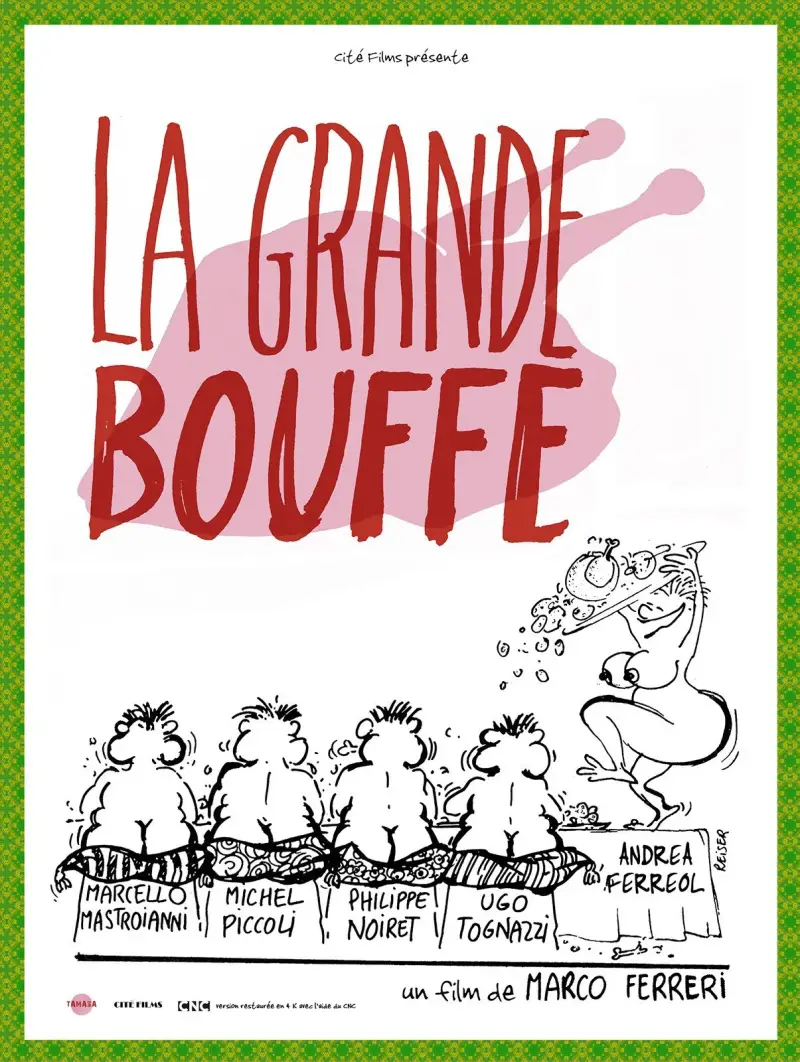
The men are played by Marcello Mastroianni, Michel Piccoli, Philippe Noiret and Ugo Tognazzi. Their characters come from respectable professions and represent different aspects of established bourgeois society. They are successful, educated and materially secure. By conventional standards, they have won the game. Yet their existence has become so empty that they choose to destroy themselves through the very pleasures that were supposed to represent their success.
At first, their elaborate meals resemble a celebration of French gastronomy. Beautiful ingredients, sophisticated cooking, expensive wines, extraordinary quantities of meat, pastries and delicacies. Everything is prepared with care. Everything reflects refinement and privilege. But gradually the feast becomes something else entirely. Their bodies begin to rebel. Digestion turns into physical distress. Pleasure becomes obligation. The men continue eating when they are no longer hungry, when the food no longer brings satisfaction, and eventually when their bodies can no longer tolerate another mouthful.
This is where the comparison with capitalism becomes particularly interesting.
The men in Ferreri’s villa are not merely greedy individuals displaying appalling judgement. They can also be understood as human representations of an economic system that has confused means with ends. Food is essential to life, but when eating becomes the sole purpose of existence, nourishment becomes destruction. Economic production is similarly necessary for a functioning society. We need food, housing, energy, transport, healthcare and technological progress. But what happens when production and consumption cease to be primarily about satisfying human needs and instead become mechanisms for continuously surpassing yesterday’s figures?
Society becomes an enormous dining table where nobody is allowed to admit that they are full.
When La Grande Bouffe premiered at the Cannes Film Festival in 1973, it provoked outrage. Its grotesque bodily humour, sexual excess and deliberate assault on bourgeois respectability offended audiences and critics alike, although it also received the International Critics’ Prize. Ferreri was not simply making a film about overeating. He was attacking the complacency of a consumer society that had begun to confuse material abundance with civilisation itself.
The uncomfortable question is whether his film has become even more relevant during the five decades since its release. In 1973, excessive consumption was still closely associated with the privileges of the Western upper classes. Today, the same logic has spread into almost every aspect of everyday life. The economic system has even developed a remarkable talent for turning our attempts to escape consumption into new things to consume.
The Great Paradox of Growth: Nobody Is Allowed to Leave the Table
One of capitalism’s greatest historical strengths has been its ability to organise resources, encourage innovation and generate material prosperity on a scale that previous generations could scarcely have imagined. It would be intellectually dishonest to deny this. Market economies have helped produce technological breakthroughs, improved living standards and created unprecedented opportunities for millions of people.
But this is precisely where the paradox begins.
A system extraordinarily effective at producing more is considerably less capable of determining when more is actually enough. And once economic success becomes inseparable from continuous expansion, the very idea of sufficiency begins to look like a threat.
Companies are expected to grow. Investors demand returns. Governments promise increasing purchasing power. Stock markets become nervous when sales decline, even in societies where people already possess far more material goods than they need. Consumers are encouraged to replace functioning products with newer versions, upgrade electronic devices that still work perfectly well and regard economic restraint as a symptom of stagnation.
Even sustainability has become a market in which the proposed solution to excessive consumption is frequently to consume something new.
It is almost as though the men in Ferreri’s villa, halfway through their collective suicide, were visited by an economic consultant explaining that their real problem was not the quantity of food but insufficient consumption growth.
However, an important distinction is necessary. Capitalism and consumption are not identical, just as economic growth does not automatically require an equivalent increase in resource consumption. Improvements in productivity, technological efficiency and the intelligent use of materials can create genuine value without proportionate environmental damage. Market economies can also be regulated, taxed and structured in very different ways.
The problem is therefore not that all economic growth is destructive. The problem arises when growth is transformed from a possible consequence of human progress into society’s overriding objective, regardless of what is growing, who benefits and what is being sacrificed.
This becomes particularly visible when considering environmental destruction, resource waste and the concentration of wealth. Profits can be privatised while the consequences of pollution, climate change and social disruption are distributed across society or transferred to future generations. A company may report impressive financial results without paying the full cost of the damage associated with its activities.
The accounting records success while the physical world quietly accumulates losses that never appeared on the balance sheet.
Just as Ferreri’s feast continues while the men’s bodies are deteriorating, an economic system can continue reporting growth while undermining the environmental and social conditions on which its long-term survival depends.
When the Sewage System Can No Longer Handle the Abundance
One of the film’s most grotesque elements concerns the body’s most basic functions. Excessive consumption does not merely produce pleasure. It produces waste, gas, illness and ultimately the literal collapse of the villa’s sanitary system. Ferreri allows bourgeois elegance to drown in the physical consequences of its own excess. The beautiful surroundings, refined food and sophisticated gastronomic rituals can no longer conceal what is happening beneath the surface.
It is an extraordinarily effective image of modern economic civilisation.
For decades, we have organised production and consumption in ways that allow us to enjoy the results without necessarily confronting the consequences. We purchase electronic products without knowing much about the working conditions or mineral extraction behind them. We enjoy inexpensive goods without visiting the factories in which they are manufactured. We fly across continents, order products from the other side of the planet and rely on immense logistical systems capable of delivering almost anything to our doors.
Meanwhile, significant environmental and human costs are moved beyond our immediate field of vision.
The global economy has become remarkably skilled at removing its waste from the dining room.
The difference between Ferreri’s villa and our world is that humanity has no alternative villa into which it can retreat. There is no unlimited external space where emissions, plastic waste, discarded products and depleted natural resources can be deposited without consequences. Eventually, the waste returns through climate disruption, polluted water, biodiversity loss or the economic costs of damaged ecosystems.
What fascinates me is the enormous amount of human energy devoted to maintaining the impression that everything is still functioning normally. We produce new packaging, sustainability reports, environmental commitments, climate strategies and green corporate identities. Some of these initiatives deliver genuine improvements. Others resemble spraying expensive perfume over a sewage system that has already exploded.
The smell may temporarily disappear, but the underlying mechanism continues operating exactly as before.
There is something profoundly disturbing about Ferreri’s dinner guests because they seem to have lost the ability to respond meaningfully to the consequences of their own behaviour. They experience the discomfort, witness the deterioration and understand that what they are doing is destructive.
Yet they continue.
That is perhaps the most recognisable feature of the film. Not its extravagance, but its indifference.
The Modern Human Being as an Economic Digestive System
There is another dimension that makes La Grande Bouffe particularly relevant today. The men are no longer eating because they are hungry. Eating has become their identity, their occupation and their ultimate purpose. Their bodies have turned into instruments serving a process that no longer exists for any reason beyond keeping itself going.
It is worth asking whether something similar is happening to the modern relationship between work, consumption and technology.
We work to earn money, spend that money on consumption and are then expected to continue working to maintain or increase our level of consumption. At the same time, much of our attention has become an economic commodity. Digital platforms compete for our hours, emotions and behaviour. Every click, hesitation and reaction can be analysed and transformed into another potential source of revenue.
We no longer consume only physical products. We consume information, entertainment, identities, conflicts, opinions and endless promises that something better awaits after the next update.
Unlike Ferreri’s dinner guests, we do not even have to be physically present at the table.
We carry it in our pockets.
This is also where artificial intelligence enters the picture. AI has the potential to reduce unnecessary work, improve resource efficiency and make knowledge and sophisticated tools available to far more people. It may enable individuals to accomplish things that previously required large organisations, substantial funding and extensive technical resources.
But the same technology can also accelerate the mechanisms of excessive consumption. More efficient advertising, increasingly personalised persuasion, automated content production and sophisticated recommendation systems could make the digital consumption machinery even more relentless.
We are developing technologies that could liberate us from parts of the economic treadmill, while simultaneously risking their use to make that treadmill run faster.
And perhaps that is one of the great contradictions of our time. Technology continuously promises to save us time, yet many people experience their lives as increasingly crowded, fragmented and demanding. Productivity rises, but the freedom supposedly created by higher productivity does not necessarily reach the individuals whose work and attention make the system possible.
It would nevertheless be too easy to blame capitalism or technology alone. Human psychology plays an essential part. We compare ourselves with others, search for recognition and rapidly become accustomed to improved material circumstances. Yesterday’s luxury becomes today’s ordinary expectation, and tomorrow brings a new desire.
Capitalism has proved exceptionally effective at commercialising these human tendencies, but it did not invent them. The appetite for power, status and abundance is considerably older than the modern market economy.
That is why Ferreri’s film is more than a political attack on capitalism. It is also an uncomfortable examination of our own willingness to participate.
We may despise the dinner party while recognising something of ourselves among the guests.
The Last Supper Has Already Been Served
The truly disturbing aspect of La Grande Bouffe is not that the men die from excessive consumption. It is that they have apparently decided, even before the first meal, that nothing else is worth living for. Their collective suicide is not an accident caused by ignorance of the human body’s limitations. It is a deliberate farewell to a life in which abundance has lost its meaning.
And this is where our economic civilisation deserves to face its most uncomfortable question.
What, exactly, is the ultimate objective?
If we manage to double the global economy, will humanity become twice as happy? If corporate profits continue rising while people experience increasing time pressure, loneliness and economic insecurity, what exactly has improved? If technological progress allows us to produce more with less human labour, why do so many people still feel that they lack enough time to live?
These questions are not arguments for abolishing market economies or romanticising historical alternatives that have often proved both economically inefficient and politically oppressive. They are arguments for distinguishing between the function of an economy and the purpose of human existence.
An economy should reasonably be understood as a tool for creating functioning societies, not as an independent objective to which human life must continually adapt.
Perhaps this is why Ferreri’s film retains such extraordinary power. It illustrates what happens when the ability to consume becomes confused with the ability to live. When everything that once provided pleasure turns into mechanical repetition. When abundance no longer creates freedom but instead becomes another form of imprisonment.
There is, of course, one crucial difference between the film and reality. Ferreri’s four men choose their own fate. The consequences of our contemporary economic system, however, are distributed far from equally. Those who receive the greatest share of material abundance are not necessarily those who pay the highest price.
People with limited resources and comparatively modest consumption may suffer disproportionately from environmental destruction, insecure working conditions and economic crises they did little to create.
This makes the allegory even darker.
In our version of the great feast, some people sit at the elegantly laid table while others work in the kitchen, clean up afterwards or are forced to live surrounded by the waste.
When La Grande Bouffe premiered in 1973, many regarded it as provocative, vulgar and deliberately offensive. It violated established ideas about what cinema should portray and turned the respectable bourgeoisie into the subject of a grotesque joke.
But what could then be dismissed as an absurd exaggeration now also appears as a remarkably perceptive description of a civilisation that knows how to produce almost everything except a widely accepted definition of enough.
Perhaps the most frightening parallel is not even that capitalism might eventually consume itself to death.
It is that capitalism, like the men in Ferreri’s villa, may become so preoccupied with the next serving that it no longer cares whether the sewage system has exploded, the room stinks and the people around the table are beginning to die.
The food simply keeps arriving.
Because growth must continue. Even when the feast has turned into a funeral.

By Chris...
La Grande Bouffe (full Movie)
(1973) with English subs