

It took me many years to understand that a successful life is not necessarily the same as a happy or meaningful one. After decades of major productions, international projects, people, technology, and responsibility, I have begun to discover something that, in many ways, is far more valuable: the freedom to think independently, create on my own terms, and dare to leave behind what has become familiar. When I read about the American author Og Mandino, I recognise something of my own journey. Not in the circumstances of his life, but in the realisation that a person never has to be finished with life.
The Man Who Discovered That Success Is Not Always What We Think
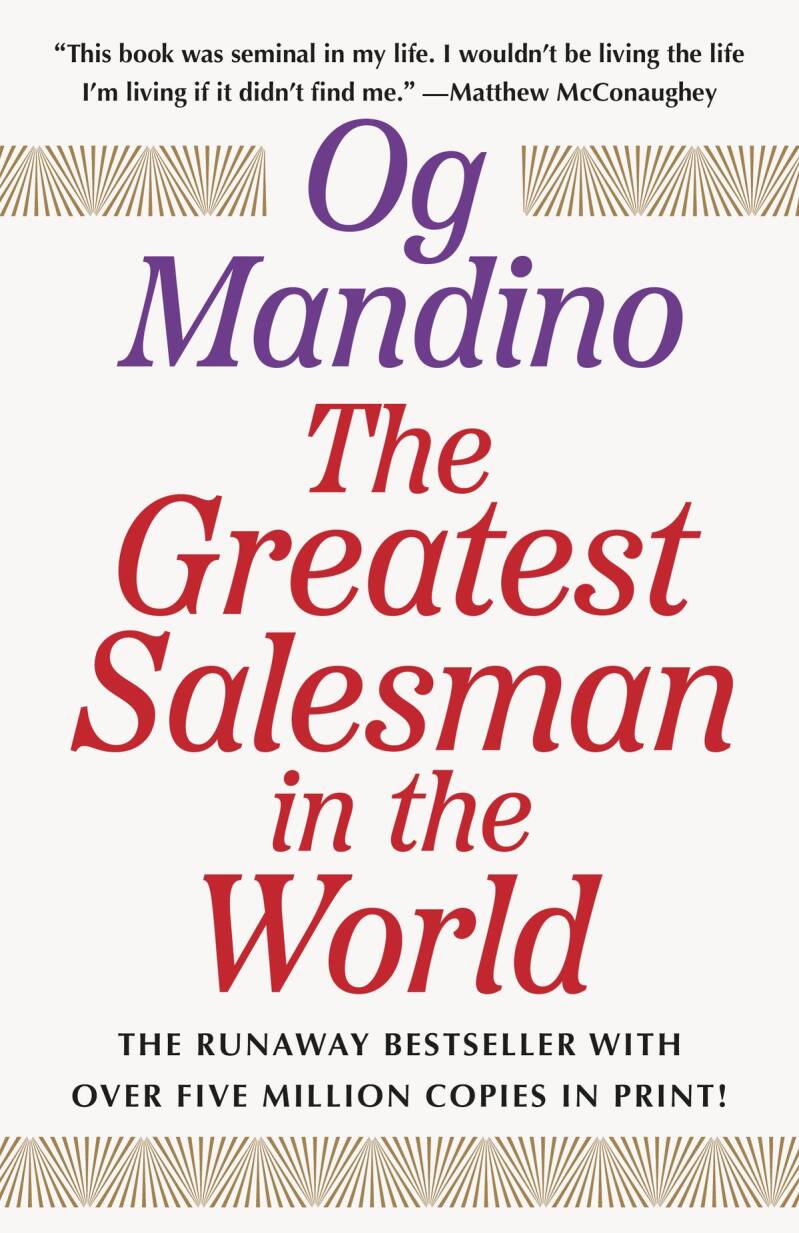
There are people whose ideas we can carry with us through life without necessarily sharing their entire worldview. Og Mandino is one of those people. The American author, who was born in 1923 and died in 1996, became world-famous through his books on personal development, particularly The Greatest Salesman in the World, published in 1968. But behind his sometimes almost provocatively simple messages about perseverance, self-discipline, and human potential lies a life story that makes his thinking considerably more interesting than the usual promises of wealth and success found in motivational literature.
Mandino had served as a bombardier during the Second World War. After the war came difficult years marked by alcohol problems, financial troubles, and a personal life that fell apart. According to his own account of his life, he reached a point where he considered taking his own life. Books, libraries, and his encounter with ideas about personal change became part of his way back. He began working in sales, moved on into the magazine industry, and eventually became an internationally successful author.
It would be wrong to compare his difficulties directly with my own experiences. Our lives have followed completely different paths. But I recognise the more fundamental question that runs through his writing: What happens when a person discovers that the life they have built is no longer the life they want to continue living?
For many years, I worked in film production, concerts, major sporting events, product launches, and complex international projects. It was a world in which much depended on delivering results, solving problems, coordinating people, and making countless different elements work together. It is an environment that can be both stimulating and demanding. One day you are working with creative visions; the next, with technology, logistics, finances, or an entirely unexpected situation that must be resolved immediately.
Those years gave me experiences I would never want to be without. I have met people, encountered cultures, working methods, and situations that probably taught me more than any conventional education could have done. I have also seen how great ambitions sometimes disappear into organisations, administration, prestige, and an almost incomprehensible ability to make simple things complicated.
For a long time, it was natural that my identity was closely connected to what I did for a living. I was the person who organised, produced, coordinated, and made sure things actually got done. It was both my profession and a significant part of how I saw myself.
But over time, another question began to emerge. Did I have to continue being the person my previous experiences had shaped me into, or could I use those experiences to become someone else?
This is where Og Mandino becomes interesting to me.
Leaving a Successful World Without Running Away From It
One of the most liberating realisations in my own life has been understanding the difference between leaving something and running away from something. I have previously described how I finally managed to step outside what I experienced as Sweden's glass bubbles. It was not an escape from my previous life, but a movement towards something else. New experiences, new perspectives, different people, and an opportunity to observe both Sweden and myself from a greater distance.
That does not mean life outside Sweden is automatically better. I have had both good and bad experiences, discovered new possibilities, and at the same time been reminded that human weaknesses and social problems exist everywhere. The difference lies more in perspective. When you leave an environment where almost everything is familiar, you begin to see things that were previously invisible. You discover how much of what we regard as self-evident is really nothing more than habits, cultural assumptions, and social agreements.
I believe the same applies to our personal identities.
We grow into roles, learn what others expect of us, and gradually begin to regard those roles as part of our personalities. We become the project manager, the entrepreneur, the producer, or the specialist. We learn to perform within the boundaries of that identity and may even become highly successful. But that does not mean we must continue playing the same role for the rest of our lives.
Mandino repeatedly returns in his books to the human ability to break old patterns of behaviour. In The Greatest Salesman in the World, he allows his central character to develop through ten scrolls dealing with habits, perseverance, emotions, and the individual's relationship with himself. The story has a religious and moral framework, but its central message is understandable even without that setting: we are shaped by our actions, but we also have the ability to change them.
It is an idea I strongly identify with, although I would like to take it one step further.
For me, change is not simply about developing better habits in order to become more successful. It is also about daring to question what success actually means. Is it really progress to constantly increase turnover, employ more people, acquire larger premises, and take responsibility for increasingly extensive operations? Or is there a point where expansion begins to undermine the very reason we started creating something in the first place?
I have reached a conclusion that differs from the thinking that still dominates much of the business world. I do not need to build another large organisation. I do not need to gather people around me to prove that my ideas have value. Nor do I need to turn every interest into a business model.
I would rather remain curious.
When Experience Meets Technology That Changes the Rules
In recent years, artificial intelligence and digital technology have opened doors I could previously hardly have imagined. Not because technology automatically makes us wiser or more creative, but because it changes the relationship between an idea and its execution.
I have spent a large part of my professional life in a world where almost every major idea required people, equipment, financing, organisation, and extensive planning. Specialists were needed to carry out tasks that you could not perform yourself. That remains true in many fields. But in the digital world, something remarkable is happening.
A person with experience, curiosity, and sufficient determination can now develop prototypes, experiment with applications, create digital services, and test ideas that previously would have required an entire development team. The result does not automatically become professional or ready for the market. Technology makes mistakes, and functioning products still require judgement, testing, and responsibility. But the threshold between imagining something and actually attempting to realise it has been dramatically lowered.
For me, this has become the beginning of a new chapter through PROTO, my European startup project and independent digital creative workshop.
There is something almost ironic about this development. After many years of organising large groups of people to carry out complex projects, I have found my way back to a simpler form of creation. I can sit down with an idea, investigate whether it works, build an initial version, and then decide whether I want to continue. I can experiment without first having to convince a board of directors, gather investors, or employ an organisation.
Sometimes it is a mobile application. Sometimes a digital concept, a visualisation, or an attempt to solve an everyday problem in a new way. Sometimes the experiment develops into something more. Sometimes it turns out that the idea was not particularly good. Even that is a useful result.
The major difference is that I no longer need to regard every unsuccessful experiment as a personal failure. It can simply be knowledge I did not possess before.
Here, there is a clear connection to Mandino's philosophy of perseverance. But where he often described perseverance as the road to success, I increasingly see it as a prerequisite for continued learning. What matters is not winning every time. It is maintaining the ability and the desire to try again.
At the same time, there is a responsibility here that I believe technological optimism sometimes underestimates. The fact that more people can create things does not mean that everything that can be created should also be created. We need critical thinking, an understanding of consequences, and a willingness to question our own ideas. AI can help us produce more, but it cannot take over our human responsibility for why we produce something.
Perhaps it is precisely the combination of old experience and new technology that makes this period of my life so interesting. I am not starting again from zero. I am starting again with everything I have previously learned.
The Second Half of Life Does Not Have to Be a Gradual Withdrawal
There is a conventional understanding of life that I have never really been able to accept. It says that we should educate ourselves in our youth, build our careers during middle age, and then gradually begin winding down our ambitions. As though curiosity, creativity, and the ability to learn new things came with an expiration date.
I see no reason to accept that arrangement.
Of course, our circumstances change with age. We develop different priorities, our bodies change, and things that once seemed important may lose their significance. But that does not mean our intellectual development must come to an end. On the contrary, experience can give us a better understanding of which problems are genuinely worth spending time on.
When I look back on my previous working life, I see more than productions and projects. I see an extensive collection of experiences that has become a kind of personal toolbox. I have seen what happens when people collaborate well, when organisations function badly, when technology breaks down, and when an apparently impossible situation suddenly finds a solution because someone dares to think differently.
All of this accompanies me into digital creation.
I do not need to be the most skilled programmer, the finest designer, or the most advanced AI specialist. My strength lies more in understanding connections, recognising possibilities, and bringing together knowledge from fields that do not normally meet. It is a different kind of competence from that of the traditional specialist, but it can be just as valuable.
Mandino's books have sometimes been criticised for oversimplifying the relationship between determination and success. That is a legitimate criticism. Not everyone has the same financial resources, health, freedom, or social opportunities. Claiming that anyone can achieve absolutely anything through the right attitude would be both naive and unfair.
But we do not need to accept the exaggerations of self-help literature in order to recognise the value of its better ideas.
Human beings possess a certain freedom to act, even when they cannot control every circumstance. And sometimes we make considerably less use of that freedom than we actually could, not because the possibilities are absent, but because we have become too accustomed to thinking about ourselves in a particular way.
I believe many people would benefit from asking themselves which parts of their present lives are the result of their own conscious choices and which parts have simply remained in place because nobody questions them anymore.
That question is not always comfortable. It can lead to the realisation that something we have spent years building no longer gives us the same sense of meaning. But it can also become the beginning of something considerably more interesting than another step up the career ladder.
Finally Owning My Own Time
There is a phrase that has become central to me and my work with PROTO: Work less. Create more. Live full.
It may sound like another slogan that oversimplifies life. But for me, it represents a fairly fundamental change in the way I view work, productivity, and personal freedom.
Working less does not mean doing less or lacking ambition. It means reducing the part of work that consists of unnecessary processes, administration, and expectations that contribute very little real value. Creating more does not necessarily mean producing more things, but freeing up greater space for curiosity, experimentation, and genuinely meaningful work. And living fully means understanding that life is not something that begins once every project has been completed and every obligation fulfilled.
That realisation has developed over a long period of time.
I have experienced both the advantages and disadvantages of a working life where responsibility and performance are central. I know how satisfying it can be to accomplish something that many others regarded as impossible. But I also know that the satisfaction is often temporary. The next project is already waiting, the next problem requires a solution, and the next deadline is approaching.
Eventually, there is a risk of becoming extremely skilled at fulfilling other people's ambitions, or even your own, without continuing to ask why.
These days, I am more attracted by the possibility of deciding for myself what deserves my time.
That does not mean every day is filled with inspiration. I can still become frustrated by technology that refuses to work, ideas that turn out to be weaker than I initially believed, and problems that consume a disproportionate amount of time. But the difference is that I can increasingly choose which problems I want to devote myself to.
That is a freedom I value enormously.
When I return to Og Mandino, it is therefore not his promises of personal success that interest me most. It is his conviction that a person's past does not have to determine their future. I would, however, add something that has become increasingly important to me: we must also have the courage to change our understanding of what that future should contain.
For someone who has spent many years pursuing success, the next step may be to stop chasing it. For someone who has built large organisations, the next great discovery may be the joy of working independently. And for someone who has long defined personal worth through achievement, the real breakthrough may be discovering how much life contains beyond performance.
I do not regard my previous life as something I want to reject or deny. On the contrary, I am grateful for all the experiences that have shaped me, including the less pleasant ones. Without them, I probably would not have the same perspective today. But gratitude for the past does not mean an obligation to continue living in the same way.
Perhaps this is where I feel the strongest connection with Mandino. Not in his views on sales, success, or positive thinking, but in his belief in the possibility of personal renewal.
We never become entirely finished human beings. We change through what we experience, what we learn, and the decisions we make. Sometimes the changes are small and barely noticeable. Sometimes they require us to leave behind something that has been an unquestioned part of our identity for many years.
I have been fortunate enough to live an eventful life filled with unusual experiences. But I do not want those experiences to become merely memories of a time when I was active and creative. I want to use them for something new, while continuing to discover things I do not yet understand.
That is why it feels wrong to describe this period as an ending. To me, it is more like the beginning of a different kind of journey. A journey in which curiosity has more room than prestige, where ideas matter more than organisations, and where I no longer need to prove my worth by constantly doing more.
Perhaps this is one of life's greatest opportunities: as we grow older, we do not simply accumulate experiences; we can also become braver in how we use them.
Og Mandino found a new direction after his life had fallen apart. My own transformation has grown out of different experiences, different decisions, and an increasingly strong desire to live and create on my own terms. They are two very different stories, but they meet around one shared idea.
It is never too late to change your life. But perhaps real freedom comes when you finally understand that you do not have to become somebody else in order to begin living more like yourself.
And that is where I find myself today. Not finished, not all-knowing, and certainly not without new questions. But with a feeling that the most interesting possibilities may still lie ahead.
Work less. Create more. Live full.

By Chris...