

British adventurer Karl Bushby has achieved something that almost defies comprehension. For 28 years, he travelled through jungles, deserts, mountain ranges and across frozen seas, determined to return to his family home in England. He survived situations in which a single mistake could have cost him his life. Yet now, having completed his extraordinary expedition, it is not the geographical obstacles he describes as the most difficult. It is love, family and human relationships. An admission that transforms the story of an astonishing physical achievement into something far more complicated: a story about what it can cost to live entirely on your own terms.
On November 2, 2026, Karl Bushby returned to Hull in northeastern England. Exactly 28 years had passed since he began his expedition from Punta Arenas in southern Chile on November 1, 1998. He had covered approximately 50,000 kilometres, crossed the Bering Strait between Alaska and Russia, travelled through the notorious Darién Gap between Colombia and Panama, and swum across both the Caspian Sea and the English Channel. Thousands of people had helped him along the way. The expedition, which he called The Goliath Expedition, had become one of the most extraordinary adventures of our time.
But in an interview with Global News, conducted shortly after his return to British shores, something interesting happens. When journalist Redmond Shannon asks what has been the hardest part of the journey, Bushby answers that it has been women and personal relationships. He describes two relationships that ended in profound heartbreak and acknowledges that the emotional suffering was far more difficult to endure than the physical and geographical challenges. Suddenly, the story is no longer primarily about what a human being can withstand, but about what a person can lose by never stopping.
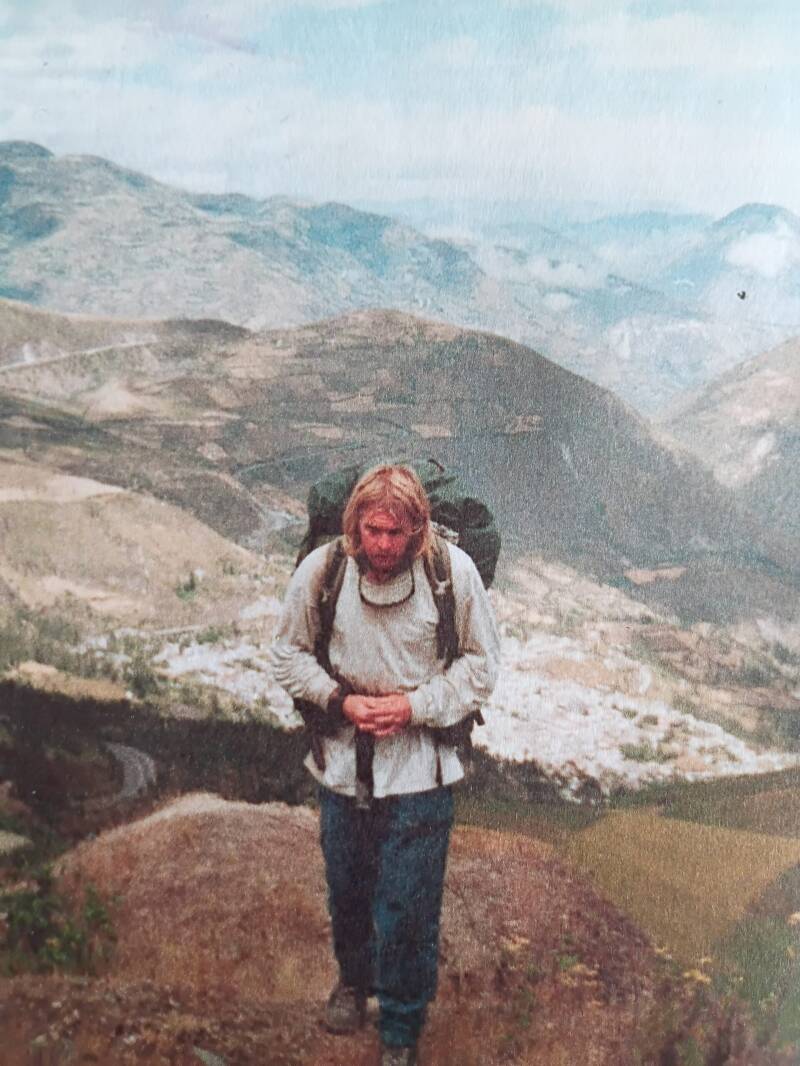
When Love Meets Someone Who Cannot Stay
Even before leaving England, Bushby had anticipated the problem. In his diaries, he wrote that he would probably fall in love during the expedition and that he risked having his heart broken. He understood that the life he had chosen was hardly compatible with a conventional relationship. Yet knowing something intellectually is very different from experiencing its emotional consequences.
In an interview with The Telegraph, Bushby speaks in greater detail about the two significant relationships. The first was with Catalina in Colombia, a relationship that lasted approximately seven years. The second was with Rika, a Japanese woman he met in Mongolia, with whom he had a relationship for three years. According to Bushby, the pandemic contributed to the end of the latter relationship. These were not fleeting encounters along the road, but long-term relationships that must have been central parts of his life for considerable periods.
This is where the fundamental contradiction emerges. Bushby had committed himself to continuing the expedition, regardless of whom he met or what opportunities life presented. Love could have a place in his life, but it could not be allowed to change the overriding objective. The journey came first.
It is easy to admire such consistency when it involves defying weather conditions, borders and physical obstacles. It becomes considerably more difficult when the same principle is applied to people we love.
A relationship can take many forms. Not everyone needs to share a home, a country or even a common daily routine. But most lasting relationships require some degree of mutual adjustment. Two people must be able to influence the direction of their shared lives. If one partner has already decided that a personal mission will always take priority, the space for genuine reciprocity becomes limited.
That does not mean Bushby was wrong to continue, or that the women were wrong when the relationships failed to survive. We do not know enough about their perspectives to draw such conclusions. What we can identify, however, is a structural conflict that is difficult to ignore. He had created a life in which love could exist within the boundaries of the expedition, but the expedition itself could not adapt to love.
That is something quite different from freedom in the ordinary sense. It is a self-imposed commitment to a single objective.
And perhaps that is precisely why his heartbreak was so difficult. A storm eventually passes. A border may reopen. A visa problem can sometimes be resolved. But a lost relationship cannot be repaired with the same tools. Love cannot be conquered through endurance, and another person's decision cannot be overcome simply by refusing to give up.
The Son Who Grew Up While His Father Kept Moving Forward
The most uncomfortable part of Bushby's story, however, is not about his romantic relationships. It concerns his son, Adam.
When Bushby began the expedition in 1998, Adam was eight years old. Today, he is 36 and a parent himself. During those years, his father accomplished something admired around the world, while remaining absent for much of his son's childhood. That does not mean they were entirely disconnected. Adam visited his father in Alaska as a teenager and later accompanied him during part of the expedition. They also maintained regular contact. But occasional visits and conversations cannot replace the shared everyday experiences of a child's upbringing.
In an interview with British GQ, Adam describes the strange experience of having a father whom people either regard as a hero or criticise as selfish. He understands why his father did what he did and does not want to reduce his life choices to a simple moral judgement. At the same time, he acknowledges that his father missed an enormous amount.
It is a nuanced perspective that deserves considerably more attention than the usual heroic headlines.
Bushby himself has begun describing his life project in less flattering terms. In The Telegraph, he characterises his way of living as fundamentally selfish and acknowledges that people who loved him have paid an emotional price. He also explains that, for a long time, he tried to justify his absence through the belief that the expedition would make him a more significant figure in his son's life. Perhaps achieving something extraordinary would make him a more valuable role model.
It is an understandable thought, but it rests on a questionable assumption: that an exceptional personal achievement can compensate for lost time with a child.
A person can be an inspiration to the entire world while simultaneously having been insufficiently present for their own child. Both truths can exist at the same time. One does not cancel out the other.
This is where our tendency to romanticise extreme life choices becomes particularly apparent. We celebrate those who refuse to compromise their dreams. We speak of the courage required to abandon security, follow an inner compass and refuse to let society dictate what life should look like. There is considerable value in that attitude. But we ask far less frequently who has to bear the consequences when someone else decides to live without compromise.
For Adam, his father's expedition was not merely a story of adventure. It was also a reality that shaped his childhood. And unlike his father, he never had the opportunity to choose the arrangement.
This does not make Bushby a bad person, nor does it diminish his achievement. But it reminds us that personal freedom never exists entirely independently of other people's lives.
Two Rules That Turned Freedom into a Prison
Bushby's expedition was built around two self-imposed rules. He could never use transport to advance his position along the expedition route, and he could never return home until he had reached it under his own power. If he had to leave his position to arrange visas, funding or practical matters, he was required to return to exactly the same place before continuing.
The rules gave the project its continuity. Without them, it would have become a series of separate journeys. But they also came to govern almost every significant decision in his life.
This is where the question of freedom becomes particularly interesting. Bushby abandoned a conventional existence to experience the world on his own terms. He did not want to be trapped by predictable routines, traditional career expectations or society's assumptions about how an adult life should be lived. Yet once he had begun the expedition, he created a system that effectively restricted his own options.
He could not simply travel home when he missed his family. He could not easily choose a different life when he fell in love. He could not end the project without violating the principles that defined it.
It is a fascinating contradiction. The man who rejected the limitations of ordinary life ultimately became bound by limitations of his own making.
In the Global News interview, he describes the loneliness, particularly during his journey through Mongolia. He points out that human beings are social creatures and that, historically, we have lived together in groups, depending on one another for survival. Prolonged isolation began to affect him. It was not merely the absence of company, but the absence of people who shared his life over time.
There is an important difference between meeting people and living alongside them. Throughout his expedition, Bushby encountered thousands of strangers and received help from people on several continents. But temporary encounters, however warm and meaningful, cannot always replace the continuity created through family, friendship and everyday closeness.
Someone who is constantly moving can experience an extraordinary sense of human connection while still lacking a place where someone truly knows them.
It is possible that Bushby discovered precisely this distinction along the way. Being able to survive independently is one ability. Being able to live closely with others is another. The former is frequently rewarded with admiration, while the latter rarely attracts attention at all.
Yet perhaps it is the latter that ultimately matters most in determining how we experience our lives.
The World's Longest Journey Home Does Not End at the Front Door
When Bushby returns to Hull, he does not encounter the same family he left behind. His son is now an adult, his granddaughter has reached the age of twelve, and his mother has grown old. His siblings have lived their lives, raised children and built everyday routines in which he has often existed only at a distance.
He acknowledges that family members will, in many respects, have to get to know one another again. It is not simply a matter of resuming contact, but of trying to understand who they have become. He has been transformed by the expedition, but the others have also changed through their own experiences.
Even his homeland is no longer entirely familiar. In the Global News interview, he explains that he must relearn British prices and consumer brands. England almost feels like a foreign country. He also describes a strange sadness as he looks across the water towards the French coast from his hotel window in Dover. Over there lies everything that has been his world for 28 years. What he has struggled for so long to leave behind has simultaneously become the life he knows best.
He has achieved his objective, but in doing so has lost the structure that organised almost half his life.
What happens to a person whose identity has been completely intertwined with a single task for decades? What remains when there is no longer another border to cross, when the road no longer continues, and when there is no expedition to blame when relationships become complicated?
Bushby has spoken about plans for public speaking, documentary filmmaking and work in science education. These activities may provide new objectives and opportunities to use his extraordinary experiences. But none of them automatically replaces the everyday responsibility of creating closeness with people from whom he has lived apart for so long.
Rebuilding a relationship with an adult son requires different qualities from navigating a jungle. It demands sensitivity, humility and the ability to accept that another person carries experiences one does not share. Sometimes, it means listening without defending oneself, compromising without interpreting it as defeat, and accepting that lost time cannot be recovered.
Nor is there any guarantee that relationships can be repaired simply because someone has finally come home.
And perhaps that is what makes the final chapter of Bushby's story so interesting.
We live in an age when personal development, self-realisation and individual freedom are frequently presented as unquestionable ideals. We are encouraged to follow our dreams, break established patterns and refuse to let other people limit our possibilities. There is much that is valuable in this philosophy. Without individuals willing to challenge familiar conventions, the world would be considerably poorer in discoveries, ideas and experiences.
But Bushby's life reminds us that there is also a boundary where self-realisation begins to compete with something equally human: the need to belong.
That boundary does not necessarily look the same for everyone. Some people need great adventures to feel truly alive. Others find the same meaning in lasting relationships, family life or work that rarely attracts public attention. Most of us try, in different ways, to reconcile both dimensions.
Karl Bushby has chosen an unusually extreme path through this contradiction. And it would be far too easy to conclude that he should simply have stayed at home. We do not know that. He has explicitly said that he would not want to discourage his younger self from setting out. The expedition has given him a life that few people can even imagine, and he has returned with a stronger belief in humanity.
But he has also returned with an insight that deserves to be taken at least as seriously as his geographical achievements. The hardest obstacles were not always those marked on a map. They existed between people, between love and conviction, between personal ambition and the needs of others.
He could continue when his body protested. He could wait out political obstacles and search for new routes around seemingly impossible barriers. But he could not decide how other people should feel, how long they should wait or what his absence would mean to them.
For 28 years, the world has seen Karl Bushby as the man who never gave up. It is an achievement worthy of respect. But perhaps his homecoming will teach us something equally important about another form of strength: the ability to recognise that moving forward is not always the answer.
He has demonstrated that it is possible to travel almost 50,000 kilometres around the world with sufficient determination. Now it remains to be seen whether he can also bridge the distances that 28 years have created between himself and the people he loves.
For that journey, there is no map, no fixed timetable and no finishing line where someone is waiting with a certificate.
And perhaps that is precisely why it may turn out to be his most difficult journey of all.

By Chris...