

Two skulls. Two words: LOVE and HOPE. A year when I believed my life might be coming to an end. Today, I live in Bulgaria, with new adventures ahead of me and a powerful desire to live. But I also have a different relationship with death.
I have two skulls tattooed on my hands. Two Sugar Skulls, inspired by the Mexican tradition of Día de los Muertos, the Day of the Dead. One says LOVE, the other HOPE. They are clearly visible, and I never intended to hide them. Sometimes I wonder what people think when they see them. A man approaching 65, with two colourful skulls on his hands. Some probably think they look good. Others may find them strange. But very few know the story behind them.
I had them done when I believed I was going to die.
Not because a doctor had told me my life was over, but because I had lived for so long with the possibility of a serious illness that death had gradually become a very real prospect in my mind. I had started getting used to the idea, and I wanted, in my own way, to honour death before it arrived. There was another reason behind the tattoos, too. I wanted to declare my independence and free myself from expectations I no longer had any desire to meet.
It Started With My Heart. Then Came My Lungs.
I had been experiencing problems with my heart rhythm and was scheduled to undergo a cardiac ablation. That alone was enough to raise questions about my health and my future. Throughout my professional life, I had been used to handling complicated situations, making decisions and solving problems. I had worked with concerts, film productions, international events and projects where keeping a clear head when something unexpected happened was often essential. But when the problem concerns your own body, that experience doesn't help quite as much. Suddenly, other people have the knowledge and the control.

During the preparations for the ablation, doctors discovered dark spots on my lungs.
It was one thing on top of another. First my heart, and now something in my lungs that needed further investigation. What was it? Was it dangerous? Could it be cancer? There were plenty of questions and very few answers. What followed was a long period of examinations, CT scans and medical appointments at Sahlgrenska University Hospital in Gothenburg.
While I was there, I also came into contact with people who were approaching the end of their lives. I sat in the same hospital environment as people who already knew their time was running out, while I was still waiting to find out what those dark spots on my lungs actually meant. That left a deep impression on me. Death was no longer something distant, something you read about in newspapers or heard about when it happened to someone else. It was right there, close enough to touch.
The investigation continued for approximately a year. A year is a long time to live with that kind of uncertainty. Life, of course, continues around you. People go to work, plan holidays, discuss everyday problems and worry about next month. Meanwhile, I was walking around with questions of a much more fundamental nature: How much time did I actually have left?
Eventually, I began getting used to the possibility that my life might end earlier than I had expected. That didn't mean I wanted to die or that I had stopped hoping. But I stopped thinking of death as something that only happened to other people. It had become part of my everyday reality, and it took a considerable psychological toll. Probably more than I understood at the time.
A Tribute to Death – and a Decision About Freedom
It was during that period that I decided to have my hands tattooed.
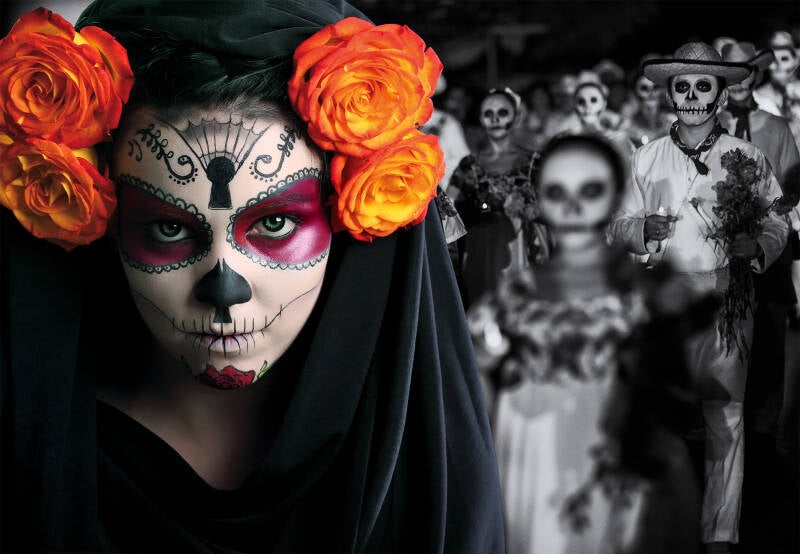
I had become fascinated by Mexican Sugar Skulls, the colourful skulls associated with Día de los Muertos. In that tradition, death is not simply about grief and loss. People remember and honour those who have passed away through colours, flowers, music and love. I was drawn to that way of approaching something we in our part of the world often prefer to keep at a distance.
I wanted to honour death while I was still alive.
So I chose two skulls and the words LOVE and HOPE. Those words felt right, even though I didn't have some carefully developed philosophy behind them at the time. I didn't need one. The tattoos were a personal decision, made during a period when my future was uncertain.
But their placement on my hands was just as important as the designs themselves.
For much of my life, I had heard that people with visible tattoos could have difficulty finding work. You were supposed to look respectable, presentable and preferably not deviate too much from an employer's idea of what an employable person should look like. Tattoos on the hands were long considered something to avoid if you wanted a successful career.
I had grown tired of that way of thinking.
I had been working since I was young, taking responsibility for major productions, solving problems and collaborating with people from different parts of the world. I knew what I was capable of. My experience and competence were hardly going to change because I had two skulls tattooed on my hands.
And, more importantly, I had reached a point where I no longer wanted a conventional job.
That didn't mean I wanted to stop working, creating or being productive. I simply no longer wanted to depend on someone else's approval to do those things. I was tired of the idea that my personality, appearance or life choices should have to conform to the unwritten rules of working life.
If the tattoos made me less attractive to a future employer, that was perfectly fine with me. In fact, it was almost part of the intention.
It may sound like an unusual form of protest, but for me it was something very concrete. I wanted control over my own life. And when I simultaneously believed I might not have much time left, worrying about what some hypothetical future employer might think of my hands seemed rather pointless.
The News Finally Came. But the Happiness Didn't.
After approximately a year, I finally received the news I had been waiting for.
Everything was fine.
I was cleared of the concerns surrounding my lungs. What I had spent so long fearing had not turned out to be the catastrophe I had imagined.
I was going to keep living.
You might expect that I would have been overjoyed. That relief would take over, that life would suddenly feel wonderful and everything would return to normal.
But that wasn't what happened.
Instead, I experienced a strange emptiness. It stayed with me for a long time and was difficult to understand, even for myself.
For an entire year, I had been living with the possibility of dying. I had undergone examinations, waited for results, met people approaching the end of their lives and gradually begun to accept that my own life might be shorter than I had expected. Somewhere during that process, something inside me had changed.
And then, suddenly, the danger was gone.
Of course, that should have been nothing but good news. But the medical results didn't instantly undo what had happened inside my mind. I had mentally prepared myself for an ending that never came, and now I was expected to return to everyday life as though nothing had changed.
But it had.
In my mind, I had almost said goodbye to a life that continued anyway. Now I had my future back, but without the overwhelming happiness that people might imagine should accompany such news.
It took a long time for that emptiness to disappear.
I have thought quite a lot about this since. We talk a great deal about how people react when they receive news of a serious illness. We understand fear, anxiety and grief. But what happens to someone who spends a long time preparing to die, only to discover that they are going to live? How do you return to an ordinary life when you have already begun, mentally, to leave it behind?
I don't have a universal answer. I only know what it was like for me.
And perhaps it was then that I began to understand that I would never quite be the same person again.
Here I Am Now. Bulgaria. New Adventures.
Today, I live in Bulgaria, with Sofia and Bansko as my main bases. A new country, different surroundings and people I would never have met if I had remained in my old life.
I have heard people describe my decision to leave Sweden as running away. I see it exactly the opposite way. I took the opportunity to continue my adventures. I wanted to experience something new, get to know different people and live in another part of Europe. I had spent many years working, travelling and delivering projects. Now I wanted to use my time differently.
Here, I have the city life of Sofia, the mountains around Bansko and an international community of people who have chosen to organise their lives differently from the traditional model. I enjoy that. I have never been particularly interested in standing still, and I see no reason to start now.
I have also discovered a new area of interest. After all those years of physical production, project management, concerts and events, I have increasingly turned my attention towards digital development and artificial intelligence. Through my own initiative, Made by PROTO, I explore ideas and develop digital tools. I want to discover what experience, curiosity and new technology can achieve together.
I don't know where it will lead. Perhaps some ideas will become successful. Others may remain experiments. But what drives me is no longer the next major assignment, the next title or the next job. It is the opportunity to keep creating something that I personally find meaningful.
And I see no reason to stop.
I will soon turn 65. I have more years behind me than ahead of me, at least if life follows anything resembling a normal pattern. That is a fact I don't need to dress up. I have also experienced a great deal already. Travel, relationships, major projects, successes, failures and periods when life turned out nothing like I had expected.
But I am far from finished.
I want to keep discovering new places, meeting people, developing ideas and occasionally doing things that others might find strange. I want to wake up in the morning and still have something to be curious about. Not because every day has to be an adventure, but because I don't want to lose my appetite for life.
At the same time, my relationship with death has changed.
I know it will come one day. It is no longer a thought I need to avoid or push away. That year at Sahlgrenska taught me something about what happens when your own mortality suddenly becomes real. I don't know how I will react when the end actually approaches. Nobody can know that in advance. But I have already confronted the possibility, and I am mentally prepared for the fact that life does not last forever.
That doesn't make me any less interested in living. Quite the opposite.
When I look at my hands today, the two skulls are still there. They were created during one of the most difficult periods of my life. Back then, I thought they would become a tribute to a death that might soon be waiting for me. At the same time, they were a way of declaring myself free from other people's demands and expectations.
Now they have travelled with me to another country and into a new chapter of life.
I don't regret them for a second. I am proud that they are visible, because I know exactly why they are there.
I have no desire to live forever. But I have a powerful desire to truly live for as long as I can.
So here I am. In Bulgaria. Almost 65 years old. With two skulls on my hands, new ideas in my head and more adventures ahead of me.
I tattooed death on my hands because I believed it would soon come for me.
But life had other plans.
I am mentally prepared to die one day. But I still have far too much living left to do to start waiting for it.
LOVE. HOPE.

By Chris...