

A personal reflection on Futuro, six years living aboard a sailboat, and a house made from three silos that I still think about building.
I'm watching an old news report from the late 1960s. A reporter steps into something that looks remarkably like a flying saucer, perched on metal legs a short distance above the ground. Inside, there's a living room, a small kitchen, a sleeping area, a bathroom, and a central fireplace. Everything is compact, carefully considered, and strangely logical. The reporter interviews a representative of the company that imported the house from Finland. He explains that three people can assemble the entire structure in about five days. The sections arrive prefabricated from the factory and essentially just need to be bolted together. I watch the film with a peculiar mixture of fascination and irritation. This was possible almost 60 years ago. So why on earth did we continue building homes in much the same way we always had?

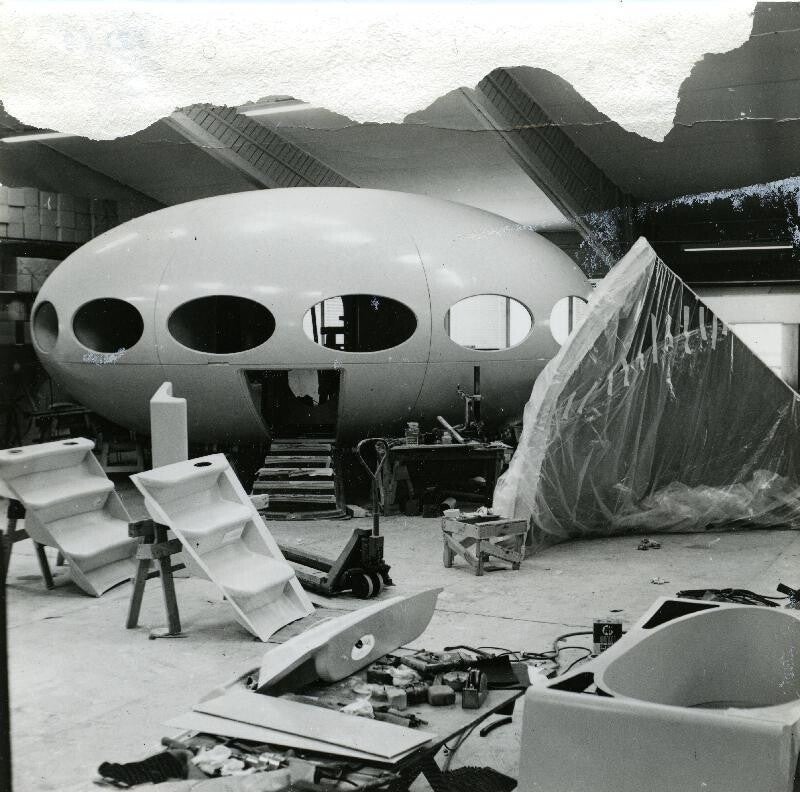
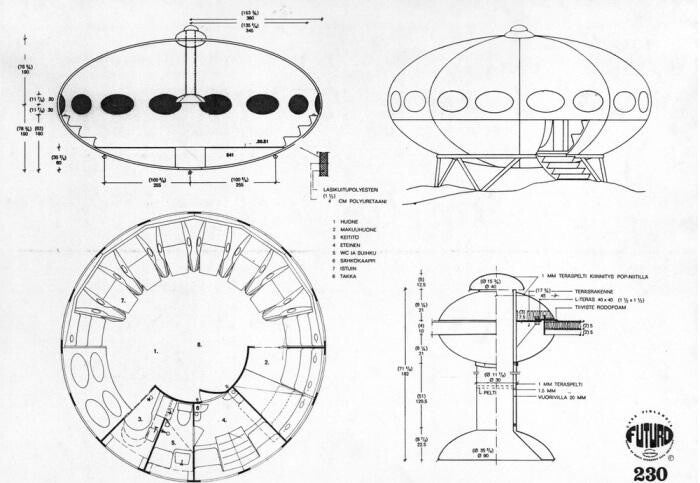
The house is called Futuro, designed in 1968 by Finnish architect Matti Suuronen. Originally conceived as a portable ski cabin, it was intended to be a modern, easily assembled retreat for people wanting to escape the city. With its eight-metre diameter, round windows, fibreglass-reinforced plastic construction, and appearance resembling a spacecraft, it represented a period when the future still seemed capable of becoming radically different from the present. But Futuro never became a commercial success. Fewer than a hundred were manufactured, and today the surviving houses are regarded as collectible pieces of design history. The underlying idea of an industrially manufactured, compact home, however, survived. It is precisely the difference between what succeeded and what disappeared that makes the story so interesting.
For me, the film also awakens memories and thoughts that go far beyond the building itself. I've spent a significant part of my life in environments where space, functionality, technology, and human needs have to work together. And for six years, my home was a 33-foot sailboat.
Six Years Aboard Torus Taught Me What a Home Really Needs
My sailboat was called Torus, a Finnish-built Finfire 33 that also served as my permanent home for six years. Thirty-three feet, roughly ten metres. Not much living space compared with an ordinary apartment, but enough to live a perfectly functional life. On board, I learned something I suspect many people never really have the opportunity to discover: just how little space we actually need when every square centimetre serves a purpose.
On a boat, there's far less room for careless design decisions than in a house. Things have to fit, be usable, remain accessible, and above all, work. The kitchen is small because it has to be, but that doesn't necessarily make it any worse. A sleeping area can be simple and still comfortable. Storage is incorporated wherever space allows. Water, electricity, heating, and ventilation are systems you have to understand and manage. You cannot simply assume that everything comes out of a wall and somehow takes care of itself.
I also learned to distinguish between floor space and quality of life. They are two entirely different things. A larger home can, of course, be wonderful, particularly for a family, but more living space also means more to maintain, heat, repair, finance, and fill with possessions. Aboard Torus, there was a very different relationship between what I owned and what I actually used. Most things had a purpose. Everything else simply couldn't come along. Over time, that limitation began to feel less like a sacrifice and more like freedom.
Naturally, living on a boat has its disadvantages. Dampness, cold, repairs, limited comfort, and the constant relationship with weather and technology. I have no intention of romanticising it. But it was also a life in which I had a very tangible degree of control over my immediate surroundings. I understood how my home worked, what needed doing, and which compromises I was willing to accept. When I eventually returned to more conventional housing, I carried with me an experience that no housing exhibition could ever have given me.
Perhaps that's why I immediately understand the thinking behind Futuro. What I see first isn't a flying saucer. I see an attempt to apply to land the same principles that boatbuilders have applied at sea for generations. You begin with human needs, available space, structural limitations, and the environment in which the structure must function. Then you try to solve the problems with as little waste as possible.
The House I Never Built – Three Silos in the Middle of a Winter Storm
Long before watching this film, I had been thinking about a rather unconventional house of my own. Not a flying saucer, but three vertical silos. I imagined large, prefabricated plastic tubes, approximately three metres in diameter, positioned close together in a triangular arrangement and connected by short tubular passages roughly one metre wide. Something like a small space station, except firmly planted on the ground.
Each silo would contain several levels. At the bottom, a space for technical equipment, installations, and storage. The middle level would accommodate the kitchen and everyday living functions. At the top, a sleeping area. Everything compact, well insulated, and carefully planned. Small circular windows, similar to the portholes on a ship, would provide daylight and views without creating unnecessarily large areas of heat loss. The exterior could be covered with a white, weather-resistant fabric or tarpaulin as part of the structure's visual identity. I pictured a Swedish flag printed on the white surface and a Starlink antenna providing a connection to the outside world.
In my imagination, the house stood somewhere in a harsh northern landscape. It was winter, snow was blowing almost horizontally, and beyond the windows there was little but darkness, forest, and weather. Inside, it was warm. The technology worked. I could cook, work, read, sleep, and live without needing very many square metres.
Perhaps that sounds like a somewhat peculiar dream. To me, it actually makes perfect sense. I've spent much of my life thinking about how people, technology, and practical solutions should work together. It comes down to planning, carefully considered components, reliable connections, and understanding what is genuinely needed. Quite often, the simplest solutions turn out to be the most useful.
With that background, I've sometimes struggled to understand why building a small home has to be treated as such a complicated project, so heavily burdened by tradition. Of course, there are building regulations, fire safety requirements, foundations, insulation, and countless other issues that must be addressed. I'm well aware of that. But these are technical problems, not fundamental reasons why we cannot think differently.
I still believe that a house like this could be built in Sweden, or almost anywhere else in the world, subject to local conditions and regulations. I would buy the large tubes or silo shells ready-made and carry out much of the remaining work myself. Whether it would actually be cheaper than a conventional house remains to be calculated. Three cylinders containing multiple floors, connecting passages, and technical installations present their own engineering challenges. But what attracts me isn't simply the possibility of saving money. It's the idea of creating a home around the life I want to live, rather than adapting my life to a housing model someone else has already decided upon.
When the Future Became Too Expensive and Too Different
Futuro encountered several very real problems. When the oil crisis arrived in 1973, the cost of petroleum-based plastic materials increased dramatically. A structure designed around industrial production in large quantities became considerably less attractive when material costs rose and the anticipated production volumes never materialised. The house was also relatively expensive and so unusual that many people preferred admiring it to actually buying one. Manufacturing licences were sold internationally, but the expected mass production never became a reality.
It's important not to oversimplify the history. We did, in fact, embrace industrially manufactured housing on a considerable scale. In Sweden, in particular, prefabricated timber houses have developed into an established building tradition. But most of these houses retained the basic form of conventional homes. Factories changed the production methods, while the architecture largely continued to follow familiar patterns.
And there are perfectly reasonable explanations for that. Rectangular rooms are easy to furnish. Standard building materials are available almost everywhere. Tradespeople understand familiar construction methods, and someone building a conventional house generally has a better chance of selling it later. A circular house containing specially manufactured components can be considerably more difficult to maintain or modify. Nor is a portable home automatically easy to relocate once ground conditions, utility connections, and regulatory requirements are taken into account.
Still, I cannot help wondering how many interesting ideas never get a genuine opportunity because they don't fit our established expectations. A home is supposed to look a certain way. Preferably, it should have a roof resembling other roofs, walls resembling other walls, and a floor plan that banks, local authorities, and potential future buyers will recognise.
I've encountered similar mechanisms in working life. Something different is often greeted with enthusiasm as long as it remains an idea. But once someone actually wants to implement it, the objections begin. Not necessarily because the idea is bad, but because it challenges the way things are normally done. There is security in what has already been tested, but there is also a danger that we begin treating the familiar as the only conceivable option.
Futuro didn't lose its battle solely because of the oil crisis. It also lost to a market in which unusual products were difficult to finance, manufacture, sell, and accommodate. That doesn't mean the concept was worthless. It means that a technically feasible product doesn't automatically become a commercially viable one.
We Have the Technology Now – But Do We Still Have the Curiosity?
This is where the story becomes particularly interesting to me today. I now live in Bulgaria, with Sofia and Bansko as my main bases, and I spend an increasing amount of my time on digital creation and experiments with artificial intelligence. Through Made by PROTO, I explore what one individual can develop using today's tools without having to build a large organisation around the process.
I have no ambition to return to a life where everything has to expand, become bigger, and involve more people. Quite the opposite. I've become increasingly interested in the reverse. How much can we accomplish with fewer resources, better tools, and more carefully considered solutions? It's a question that applies equally to digital products and physical structures.
When Futuro was introduced, the design process depended on drawing boards, engineers, moulds, and substantial industrial investment. Today, an individual can begin with a simple sketch, develop it in digital design software, explore alternative solutions with AI, 3D-print scale models, and manufacture many of the smaller components using a 3D printer. None of this replaces structural calculations, material testing, or professional engineering expertise, but it fundamentally changes the opportunity to investigate ideas independently before committing large amounts of money.
That doesn't mean a house can magically materialise in an afternoon. Real construction still requires knowledge, work, and responsibility. But the distance between an idea in someone's head and a functional prototype has shrunk dramatically.
I sometimes think about how my own silo house could be developed using these possibilities. Perhaps it would turn out that three silos are a terrible idea. Perhaps the connecting passages would be too complicated, perhaps too much space would be lost to stairs and technical installations, or perhaps the total cost would simply be unreasonable. If so, I want to know. The interesting part isn't defending an old idea at all costs, but having the opportunity to test it properly.
But perhaps some of the solutions would actually work. Perhaps it would be possible to create a small, robust home from standardised components, with modest energy requirements and manageable maintenance costs. A home that doesn't attempt to imitate a conventional house but instead begins with an entirely different understanding of how to live.
I'm about to turn 65. An age when people might expect you to start thinking more about comfort, security, and established routines. Yet I find that my curiosity about alternative solutions has hardly diminished. After six years aboard Torus, I know it's possible to live well in a small space. And after a long working life, I also know that most things can be investigated and a great deal can be built, provided you understand what you're doing and respect the actual limitations.
That doesn't mean everyone should live in a Futuro house, aboard a sailboat, or inside three connected plastic tubes. Different people need different kinds of homes, and a small, vertically arranged living space certainly isn't suitable for everyone. My argument isn't that society chose the wrong housing model. It's that we should have continued developing far more alternatives.
Because when I watch that old film from 1968, what impresses me most isn't actually the technology. It's the confidence of the people who created the house. They didn't regard the conventional home as a final answer. They saw it as something that could be reconsidered, just like an aircraft, a boat, or any other piece of engineering.
Technologically, we have advanced enormously since then. But I sometimes wonder whether we've simultaneously become more cautious in our imagination of the future. We accept that phones, computers, and digital services change at an almost unimaginable pace, while the basic forms of our homes and the ways we organise our lives seem considerably harder to question.
My house made from three silos still exists only as an idea. Perhaps it will never be built. Perhaps one day it will stand somewhere in Sweden, white and peculiar, with small round windows and a Swedish flag on the outside while snow blows past. I don't know.
But after watching the Futuro film, I feel certain of one thing: I'm far from the first person to wonder just how different a home could be.
And I still believe the question is worth asking.
If we could design a functioning house of the future in 1968 that could be assembled in a matter of days, what could we accomplish today if we began questioning not only how we build our homes, but why we build them the way we do?
An Unexpected Update: The Futuro House Is Being Manufactured Again
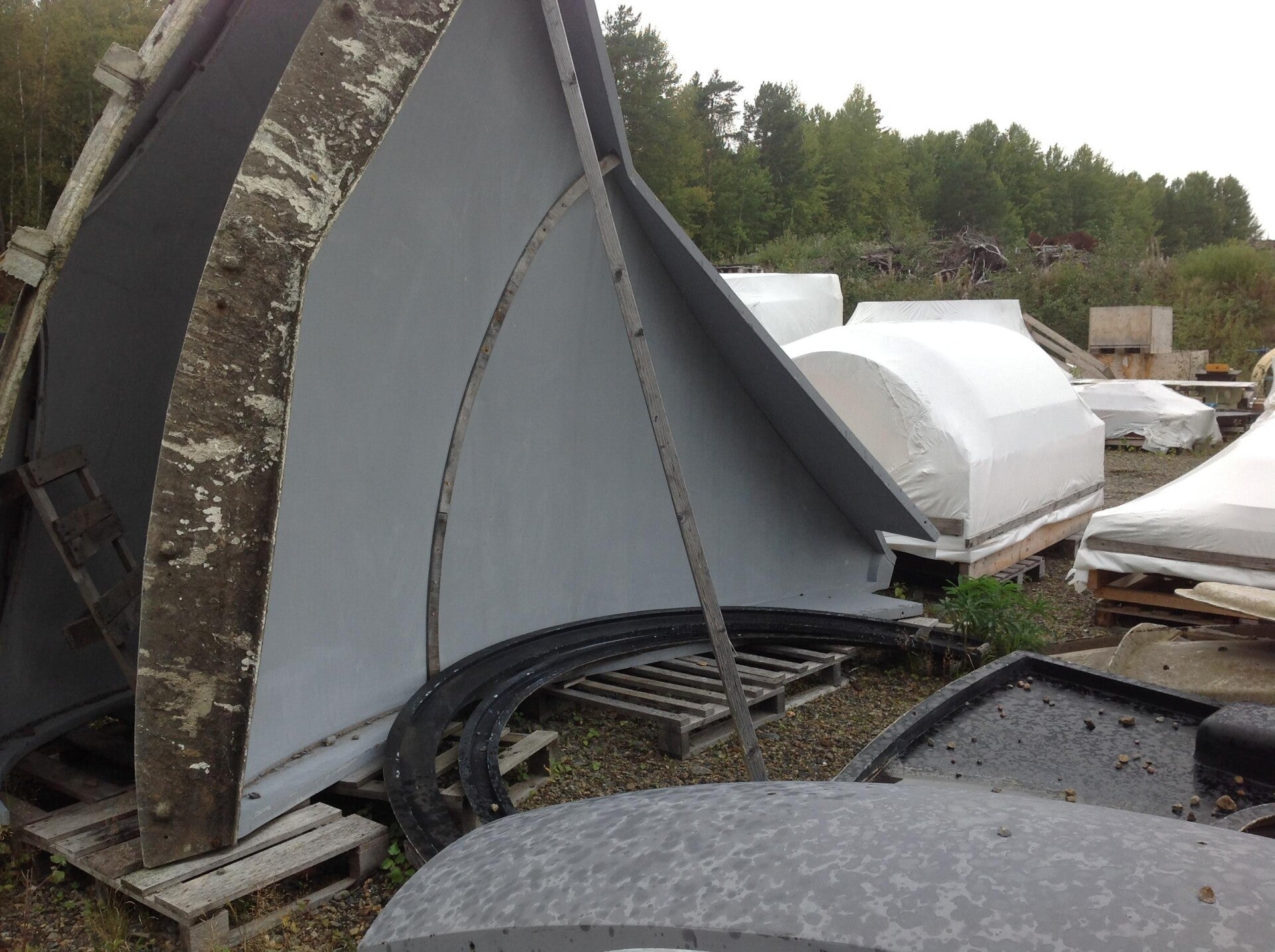
And just when I thought this story belonged entirely to the past, I discovered something remarkable. The original Finnish moulds used to manufacture Futuro houses in the late 1960s were rediscovered in 2024 after spending decades outdoors in Finland. Under the direction of architectural heritage specialist Jan van Dijs, they were carefully restored and returned to production. On June 30, 2026, a newly manufactured Futuro, numbered 21, was completed using the original moulds and production techniques. It was subsequently exhibited at Helsinki Design Week, where it attracted renewed international attention.
Even more interestingly, the project offers a limited number of newly manufactured Futuro houses to order, produced in Finland with authorisation from Matti Suuronen's family. This is not conventional mass production, and the availability of the original moulds is limited. But the opportunity to acquire a newly manufactured, authentic Futuro is real. Almost six decades after its introduction, the house of the future has found its way back into production.
For someone like me, who has spent years thinking about unconventional housing solutions, there is something wonderfully satisfying about that. Perhaps Futuro wasn't simply an idea that arrived too early. Perhaps we are finally beginning to rediscover the possibilities it represented.
More information: The Futuro Project – Original Moulds, Reproduction and Availability

By Chris...
Decades before the tiny house, there was Futuro
Inside a UFO Tiny House:
The Futuro Home Tour
Sources and Further Reading