

Martin Eberhard helped create one of the world's most influential technology companies. Then he lost control of it. In a remarkably candid interview, Tesla's first CEO discusses his conflict with Elon Musk, his skepticism toward artificial intelligence, and why he believes Tesla has begun abandoning its original vision. But his story is also about something far greater: who really owns an idea, what technological revolutions cost, and when a person can genuinely say they have succeeded.
There is something almost surreal about listening to Martin Eberhard. Here is the man who, together with Marc Tarpenning, founded Tesla Motors in 2003, the company that would eventually transform the entire automotive industry's understanding of electricity, batteries, and the future of transportation.
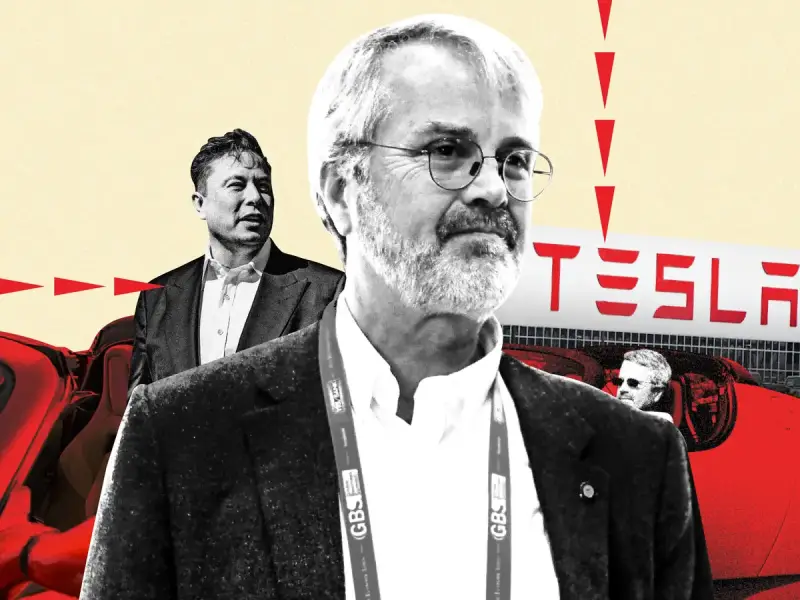
Today, he lives a relatively quiet life, restores old computers, pursues his personal interests, and seems to have little desire to occupy the spotlight. Meanwhile, the company he once started has evolved into a global technology empire, and the man who arrived as an investor the following year has become one of the world's most prominent entrepreneurs. What is remarkable is not that Eberhard has opinions about what happened. What is remarkable is how profoundly his views differ from the vision of the future now associated with Elon Musk.
In an interview lasting just over 50 minutes with YouTube creator Kim Java, published in July 2025, a very different picture of Tesla emerges from the one that usually dominates public discussion. Eberhard is an engineer, entrepreneur, and technological optimist, but also a skeptic. He still believes in electric vehicles and the technological transformation he helped initiate. However, he is highly critical of Tesla's current priorities, autonomous vehicles, and aspects of the artificial intelligence that Musk now considers central to the company's future. It is a fascinating contradiction. A man who once refused to accept established experts' assumptions about what was technically possible is now warning that we may be accepting new technological promises far too uncritically.
History Was Rewritten as the Company Grew
Most people who follow the technology industry know Elon Musk. Far fewer could probably name Martin Eberhard and Marc Tarpenning. Yet these were the two men who founded Tesla Motors in July 2003. Musk joined in 2004 as the largest investor in the company's first financing round and became chairman of the board. Eberhard was the original CEO and led the development of the first Tesla Roadster. Following an escalating conflict, he lost his leadership position in 2007 and subsequently left the company. Musk became CEO in 2008.
It would take until 2009 before a legal dispute between Eberhard and Musk ended in a settlement. Among other things, the outcome recognized five individuals as Tesla's co-founders: Eberhard, Tarpenning, Musk, JB Straubel, and Ian Wright. The formal question of founder status was therefore resolved, but not necessarily the struggle over how history would be told. That is an important distinction. A company can have several founders, but in the public imagination, complicated corporate journeys often become stories about a single extraordinary individual.
Eberhard describes how the idea for Tesla emerged from a personal problem. He wanted to buy a sports car but had begun thinking seriously about climate change, dependence on oil, and energy consumption. He saw little reason to purchase another gasoline-powered vehicle if electricity could offer a better alternative. Together with Tarpenning, he began investigating the possibilities. They already had experience with lithium-ion batteries through their previous company, NuvoMedia, which had developed an early electronic reading device, and realized that the same battery technology could potentially be applied to much larger systems.
The crucial insight was not simply about batteries. It was about understanding how to introduce a new technology into a market that had already decided it would never work. Earlier electric vehicles had often been marketed as inexpensive, slow, and practical alternatives for environmentally conscious consumers. Eberhard wanted to do precisely the opposite. An electric sports car would be fast, attractive, and expensive. It would surprise people and fundamentally change their expectations of what an electric vehicle could be.
This was a carefully considered business strategy. New technologies are often expensive before production can be scaled. By starting with an exclusive product, a company can sell technology to customers willing to pay premium prices while financing the development of more affordable models. Eberhard explains that the original plan already included a sports car, followed by a larger premium vehicle, and eventually cheaper models aimed at a broader market.
It is particularly interesting to revisit Elon Musk's own strategic document from August 2006. In it, he outlines precisely this development and explicitly writes that he is working on the product strategy together with Martin and the rest of the team. The document is an important historical record, but also a reminder that Tesla's original plan was a collaborative effort, not an idea that can reasonably be attributed to one person alone.
At the same time, it would be historically dishonest to diminish Musk's contribution. Financing, industrializing, and expanding a new automotive company is an entirely different challenge from constructing a working prototype. During its early years, Tesla repeatedly faced serious financial and production difficulties. Musk took substantial financial risks and played a central role in the company's survival and expansion. The story does not become more truthful by replacing the heroic narrative surrounding Musk with an equally simplified heroic narrative about Eberhard.
But it raises a question that extends far beyond Tesla. How often do we associate technological breakthroughs with the person who eventually controls the company rather than with those who originally recognized the opportunity and did the pioneering work?
The Engineer Who Doubts the New Technological Revolution
The part of the interview that surprised me most comes when the conversation turns to artificial intelligence. Eberhard explains that he has experimented with ChatGPT and similar systems but has been far from impressed. He describes asking technical questions in fields where he possesses considerable expertise and receiving incorrect answers presented with remarkable confidence. When he pointed out the mistakes, the systems sometimes corrected themselves, only to continue producing flawed reasoning.
This is not a trivial objection. A technology capable of expressing itself convincingly without necessarily being reliable creates an entirely new kind of problem. We humans are accustomed to associating confidence in language with knowledge. When a machine produces a well-structured answer, it can be difficult to determine whether we are witnessing genuine reasoning, a plausible synthesis of information, or something that merely sounds credible.
Eberhard also expresses concern about the use of AI in education. If we delegate the thinking itself to technology, what happens to our own ability to understand and evaluate information? It is a question worth taking seriously, particularly as these systems become increasingly capable of performing tasks that once required independent human effort.
But this is also where I believe Eberhard's argument has a weakness. He evaluates a new technology based on a limited number of personal experiences and sometimes appears to draw broader conclusions than the evidence justifies. That does not mean his criticism is wrong. The problem is that generative AI can be extremely useful even when it is not sufficiently reliable to make independent decisions. There is a fundamental difference between using AI as a tool within a controlled working process and uncritically handing responsibility over to the system.
I recognize this reasoning from several previous technological transitions. When personal computers began spreading, their practical usefulness was questioned. When the internet emerged, many of its possibilities were dismissed as exaggerated or even meaningless. That certainly does not mean every new technology will automatically succeed, but it illustrates the danger of judging a developing technology solely by its present limitations.
There is also a certain historical irony in hearing precisely Eberhard express this skepticism. He tells the story of how engineers at Volkswagen studied the Tesla Roadster's technical specifications and concluded that the car could not possibly achieve the performance Tesla claimed. When Eberhard offered to let them test-drive his own car, they were reportedly uninterested. Their calculations had already demonstrated that it should not work.
It is a wonderful illustration of the difference between reality and established assumptions. But the lesson works in both directions. AI enthusiasts must not confuse impressive demonstrations with proven reliability. Skeptics must not confuse today's limitations with proof of tomorrow's impossibilities.
Perhaps Eberhard's most important objection to AI concerns something else entirely: fraud and manipulation. He warns of a future in which distinguishing a real human being from a digital imitation becomes almost impossible. A voice on the telephone, a face on a screen, or a video message from someone we know can be manipulated using technology that becomes increasingly convincing. This is no longer a question of whether a language model provides the correct answer to a technical problem. It concerns the foundations of trust between human beings.
This is where technological possibilities collide with their social consequences. We do not have to oppose artificial intelligence to recognize that it creates problems requiring new methods of verification, accountability, and protection.
Tesla Built the Car That Would Change the World – But What Happened Next?
Eberhard's criticism of today's Tesla is perhaps clearest when he discusses autonomous vehicles and the company's changing priorities. The original vision was to make electric cars desirable and eventually affordable for a much larger part of the population. The first Roadster was never intended to be the final product. It was a way of persuading an entire industry to think differently.
That is why he is disappointed that Tesla has moved away from developing an entirely new, genuinely inexpensive electric car and instead placed increasing emphasis on robotaxis, autonomous driving, and humanoid robots. He sees no obvious social benefit in replacing the driver with a computer system if the result is still large numbers of cars occupying already congested cities. It is an interesting objection because it goes beyond the question of safety. It challenges the assumption that tomorrow's transportation problems must necessarily be solved through even more technologically advanced private cars.
He also prefers Waymo's use of multiple sensor technologies to Tesla's more exclusively camera-based approach. And he is particularly critical of systems in which humans are expected to monitor automated driving and intervene when the software suddenly encounters a problem it cannot handle.
This objection is firmly rooted in human behavior. Someone who spends long periods monitoring a system that works almost perfectly risks losing concentration. Expecting that same person to intervene immediately and correctly in a situation the system itself could not resolve creates an exceptionally difficult division of responsibility.
At the same time, Eberhard's skepticism must be weighed against actual research. A study published by the American Insurance Institute for Highway Safety in July 2026 found that Waymo's driverless vehicles, in the American cities examined, were involved in 68 percent fewer crashes per distance traveled than human drivers when the comparison was restricted to crashes that would normally be reported to police. The researchers emphasized that the findings applied to limited operating environments and that improved monitoring would be necessary as autonomous systems expanded.
This does not mean Eberhard is wrong about Tesla. It means we must distinguish between autonomous driving as a technological principle and the specific methods different companies use to develop it. Successful autonomous operation under controlled conditions does not prove that every technical approach is equally safe.
Still, I think his criticism exposes something much larger. Tesla has evolved from a company determined to transform the automotive industry's energy consumption into an organization that also wants to define the future of AI, robotics, and automated transportation. This may be a natural extension of the company's technological expertise. But it does not automatically follow that every new technological field becomes more meaningful simply because it is associated with an already successful brand.
There is a difference between developing technology because it solves an identified problem and developing technology because the possibility itself is spectacular.
Losing Your Company – and Still Winning Back Your Life
What stays with me after watching the interview is not primarily the discussion about batteries, autonomous vehicles, or AI. It is Eberhard's relationship with his own history.
He describes how he gradually lost control of Tesla after bringing in outside capital. He openly admits that he was not particularly skilled at negotiating with investors and that he surrendered too much ownership and influence. He also talks about mistakes in recruitment and how certain key employees could exploit their importance during critical development phases to demand higher compensation and larger ownership stakes.
It is unusual to hear an entrepreneur with his background discuss his own shortcomings so openly. Many company founders tend to present their lives as an uninterrupted series of deliberate strategic decisions, where even failures become necessary steps toward eventual success. Eberhard appears willing to accept that he made mistakes and that some of them had consequences that could never be reversed.
At the same time, there is an unmistakable sadness about not receiving full recognition for what he contributed. He tells the story of the special Roadster he owns, one of the earliest examples in the company's Founders Series. According to Eberhard, his and Tarpenning's signatures were missing from the commemorative plaque eventually delivered with the car, even though their signatures were originally supposed to appear on it. To an outsider, that might seem like a minor detail. To him, it represents something much greater.
It is about who gets to belong to history.
I find something deeply human in this. We all want recognition for what we have actually accomplished, particularly when our work has had consequences far beyond our own lives. Money can compensate for lost ownership. It cannot necessarily compensate for the feeling that someone else has taken control of the story behind something you created.
But Eberhard also seems to have achieved something many entrepreneurs never reach. He has accepted that the company can continue without him. He still owns a small portion of his original Tesla shares, but acknowledges that he sold most of them earlier than would ultimately have been financially advantageous. Yet he does not seem especially troubled by it.
Near the end of the interview, he is asked to choose what matters most: money, respect, or power. He chooses respect. He also explains that there really is such a thing as having enough money.
I keep coming back to that answer because it runs directly against much of the entrepreneurial culture that has developed around Silicon Valley. Success is frequently measured in company valuations, funding rounds, expansion rates, and personal fortunes. Building something small and then deciding that it is enough is rarely presented as a particularly interesting ambition. Deliberately choosing not to expand can almost be interpreted as a failure.
But why?
Perhaps one of the more revealing aspects of Eberhard's story is that technological achievement and personal ambition do not necessarily follow the same trajectory. Creating an extraordinary company does not automatically mean wanting to spend the rest of your life managing it. Nor does leaving a successful enterprise necessarily mean abandoning the ideas, curiosity, or principles that inspired its creation.
There is also a difficult lesson here about ownership. An entrepreneur may develop the original concept, assemble the first team, overcome fundamental technical obstacles, and establish a functioning business, only to discover that control ultimately belongs to those who command the capital. That is neither unusual nor necessarily unjust in itself. Investors take risks, companies require financing, and ownership structures evolve. But the consequences can be enormous when the people who created the original vision no longer have the authority to influence its direction.
Eberhard's experience illustrates why the relationship between creativity, ownership, and power deserves more attention in discussions about entrepreneurship. We celebrate those who raise the most money and build the largest organizations, yet rarely question whether growth itself remains consistent with the original purpose. We admire founders who refuse to surrender control, but seldom acknowledge the personal cost of spending decades defending it. Somewhere between creating a successful enterprise and becoming permanently responsible for its expansion, the freedom that originally attracted someone to entrepreneurship can quietly disappear.
Martin Eberhard changed the automotive industry, but lost control of the company he helped establish. Elon Musk subsequently developed Tesla into something far larger than its original founders could have anticipated. Both realities can exist at the same time.
What makes the interview so fascinating is that Eberhard does not come across as someone who wants his former life back. Rather, he wants his place in history to be acknowledged so that he can continue living the life he has chosen.
And perhaps that is where the real question lies. Not who won Tesla, who became the richest, or who gets to define the future of transportation. But why we so often assume that the person who builds the biggest company must also be the person who has achieved the greatest success.
It is possible to create something that changes the world without having to control the world yourself.
And it is possible to leave a company behind without abandoning your curiosity, your desire to create, or your belief in the future.

By Chris...