

On 5 November 2026, two people were launched into the air from a 360-metre industrial chimney in Trbovlje, Slovenia. Not as the result of an accident, but by a specially constructed, 60-metre-long catapult. Spanish skydiver Dani Román accelerated from a standstill to 180 kilometres per hour in 2.15 seconds and continued upwards until he had reached 100.36 metres above his starting point. Later, he and Frenchman Frédéric Fugen carried out a simultaneous launch that set another Guinness World Record. Both landed by parachute. All of this is spectacular enough to make international news. Yet, for me, it is not the height, the speed, or even the obvious risk-taking that makes this project most interesting. It is the entrepreneurship behind it.
At some point, someone must have been sitting around with an idea that sounded almost ridiculous: What if we built a machine capable of shooting people straight up out of a chimney? The normal reaction would have been to laugh, discuss the costs, mention safety regulations, and move on. Here, the reaction was different. The group began investigating what would have to be true for the idea to work. That is a crucial distinction. Imagination is the ability to picture something that does not exist. Entrepreneurship begins when someone decides to find out whether it can be created.

The First Investment Was Stubbornness
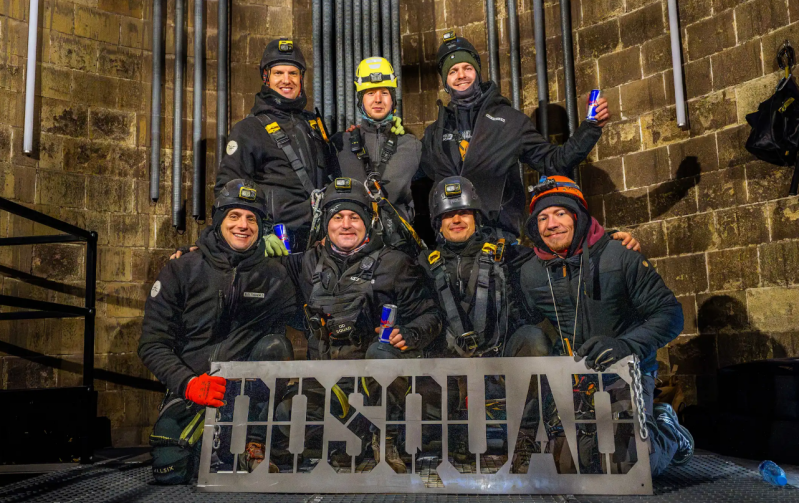
The Slovenian team DD Squad, whose roots lie in the acrobatics group Dunking Devils, had not simply stumbled upon a lucky idea. The project evolved over approximately two and a half years. Smaller constructions and a succession of experiments came before the final machine. In the videos, we follow the progression from drawings and horizontal tests to the almost unbelievable task of installing the structure high inside the chimney. What initially looks like madness is broken down into a series of technical questions: Can the springs deliver the necessary force? Can the trolley withstand the speed? Will the brakes work? How do you anchor a structure inside an old chimney? And what happens if a test fails when filming is only days away?
This is precisely what I find so interesting. The ultimate idea is enormous, but the development method is surprisingly down to earth. They do not start by building everything and hoping for the best. They divide the problem into smaller parts, test one thing at a time, and use the answers to justify taking the next step. In one of the films, they first construct a horizontal test track, allowing them to study the system's behaviour without simultaneously dealing with the consequences of being hundreds of metres above the ground. The load is increased gradually, using weights rather than people. It remains an extreme project, but the underlying working principle is the same as in serious product development: reduce uncertainty before making the next major decision.
We often speak of entrepreneurs as people who dare to take a chance. It makes courage sound like their most important asset. Yet this project shows that their real strength lies in combining courage, knowledge, and a stubborn willingness to test assumptions. Wanting something that others consider impossible is not enough. You must also endure the thousand rather uninteresting problems separating a fascinating thought from a working result. An entrepreneur cannot be only a visionary. Sooner or later, somebody has to work out how to fasten the bolt.
A Machine Nobody Needs — Yet One That Creates Value
From a traditional business perspective, this project is almost provocative. Who needs a 60-metre human catapult? How large could the customer base possibly be? How many of these machines could you sell? They are reasonable questions, but they risk missing the point entirely. The catapult does not have to be the product being sold. Instead, it can serve as proof of a capability that others want to associate with, commission, or finance.
This is entrepreneurship in a different form from the classic story of identifying a customer problem and building a scalable solution. DD Squad creates an extraordinary achievement, a technical story, and images that people want to see. In the process, potential value is created for several participants at once. Red Bull gets extreme, visually compelling content that closely matches its brand identity. Prada Linea Rossa participates as a partner, supplying the athletes with technical clothing and equipment. The professional skydivers gain another chapter in their careers. The Slovenian team demonstrates its abilities to an international audience. And an old industrial chimney becomes the setting for something the world suddenly has a reason to notice.
This does not mean we know whether the project was profitable. The financial agreements have not been publicly disclosed in the sources I have seen. A record-breaking stunt may be extraordinarily expensive to produce, and viral attention is not the same as business success. What the project does demonstrate, however, is how an original initiative can bring together several different interests without initially resembling a conventional product. In that sense, the catapult matters less than the ability to organise and deliver something that very few others could accomplish.
That is a business asset which is difficult to copy. In principle, the machine's components can be described and analysed. The accumulated experience, creative judgement, network, collaborations, and trust, however, have to be built over time. That is where a value resides which cannot be seen in the record books.
Behind Those Two Seconds Lie Thousands of Hours
The most revealing part of the longer film is not the launch itself but everything that comes before it. The team must haul materials and tools up an enormous chimney, establish working platforms, install winches, anchor steel structures, and assemble a custom-built machine in an environment plainly never intended for such a purpose. Progress is slow. People become exhausted. The weather and the schedule put the group under pressure. According to the team's own account, during the intensive construction period they worked six days a week, around fourteen hours a day, and on one occasion even spent the night high up on the chimney.
There is something almost refreshing about seeing this side of the story. The romantic image of the entrepreneur often revolves around the grand vision, the rapid breakthrough, and the decisive pitch to an investor. Here, instead, we see dirty hands, heavy materials, miscalculations, sweat, and a relentless search for solutions. The extraordinary outcome consists of an almost comically large number of ordinary tasks. Someone has to manufacture the parts. Someone has to make sure they fit together. Someone has to discover what does not work before a human being is placed inside the capsule.
At the same time, there is good reason not to romanticise the danger. The fact that a project succeeds does not automatically mean everything done along the way was wise, or that another group ought to attempt the same thing. Working at extreme heights, handling powerful springs, and launching human beings all demand technical controls that enthusiasm cannot replace. That is why there is such an important distinction between creative madness and irresponsible risk-taking. What is genuinely impressive is not simply that someone is willing to take risks, but that a team can identify, reduce, and manage those risks as far as possible.
There is another, less flattering entrepreneurial lesson here. Working fourteen hours a day, six days a week, may lead to an extraordinary achievement, but it is hardly a way of life everyone should aspire to. Admiring the result does not mean wanting to copy the working conditions. A creative enterprise should ultimately also be judged by the kind of life it allows the people behind it to live.
When the Journey Itself Becomes Part of the Product
One particularly intelligent aspect of DD Squad's work is the way the construction process becomes a story in its own right. They could have shown only the completed jumps: a few dramatic camera angles, two records, and a collection of logos. Instead, the audience follows the development, the frustration, the tests, and the people working behind the scenes. The machine is a main character, but the process is the plot.
This changes what the project can produce. A prototype generates technical knowledge, but a documented prototype can also arouse the audience's curiosity and build confidence among potential partners. A failed test does not have to be a wasted step; presented thoughtfully, it can show how the team thinks and solves problems. A lengthy development process becomes not only an expense but also material for a series of films and a stronger professional reputation. There is no automatic monetary value to place on this, but it is difficult to ignore the opportunity.
This connects to a broader change in entrepreneurship. Creators do not always have to separate the act of developing something from the act of communicating what they know. Someone who can show how an idea takes shape, why certain approaches are abandoned, and which obstacles are overcome can begin building a relationship with the outside world before the finished product even exists. That is just as relevant to digital tools as it is to spectacular mechanical constructions. One business builds in steel, another perhaps in code and AI, but both can make their working methods understandable and thereby create interest in the outcome.
I recognise something of this in the thinking behind Made by PROTO, even though the scale and objectives are entirely different. For me, the point of creating new digital tools is not to produce the greatest possible number of projects or build an organisation that constantly demands more time. I want to be able to follow ideas, test them, create useful prototypes, and decide for myself which deserve further development. It is particularly interesting when technology can help people facing genuine needs. Where DD Squad aims to create an extraordinary physical experience, an independent digital creator might try to make an everyday problem less difficult. These are different goals, but the underlying drive to turn thought into functioning reality is recognisable.
The Ability to Think the Unthinkable Must Be Matched by the Ability to Choose
Perhaps that is why this project captures my attention so strongly. We live in an age when it is easier than ever to present ideas as fully formed visions. AI can generate concept images, drawings, texts, code, and presentations in minutes. Yet the distance between a convincing visualisation and something that actually works can still be enormous. DD Squad has made that journey visible. They have not merely described a sensational future. They have built, tested, and accomplished something concrete in the real world.
At the same time, being capable of carrying something out does not mean that every idea should be pursued. It takes judgement to choose which projects deserve months or years of your life. This is where I see a distinction between entrepreneurship as a constant pursuit of ever-greater achievements and entrepreneurship as an opportunity to shape your own existence. One path can lead to enormous collaborations and world-record attempts. The other can lead to small, independent products and a freer life. Both can be creative. Both can generate value. But success has to be measured against what you are actually trying to achieve.
When I watch those people being propelled out of the chimney, I find myself thinking less about the courage required to sit inside the capsule than about the courage required to take the original idea seriously. The first launch was visible to the world for only a few seconds. The decision to investigate the seemingly impossible, together with all the work that followed, lasted two and a half years.
They set two Guinness World Records. But what impresses me most is that they took an idea which barely sounded plausible even as a joke and made it real. It is an unusually clear example of what creative entrepreneurship can actually mean.

By Chris...
"We Built World's Biggest Human Catapult to Launch Red Bull Skydivers"