

We have built a society in which people are expected to spend most of their lives working, building careers, being productive, and preferably taking pride in their job titles. But what happens when more and more people begin questioning the entire arrangement? When artificial intelligence transforms the labour market, traditional career paths begin to disappear, and people discover that their identities may not need to be tied to their jobs at all? The British podcast Work Is Weird Now raises questions far bigger than what the office of the future might look like. I believe this could be one of the most important conversations we can have right now. And no, it's not because I happen to appear in one of its episodes.
What If It's the World of Work That's Become Weird – Not the People?
There is an almost endless supply of podcasts telling us how to become more successful at work. How to improve our efficiency, develop our leadership skills, build our personal brands, earn more money, and find the next step in our careers. The world of work is presented as an established structure to which we are expected to adapt. If we are unhappy, lose motivation, or begin questioning what on earth we are doing, it is usually we who are expected to change. We should retrain, discover our passion, find another employer, or learn to manage stress. The system itself remains largely unquestioned.
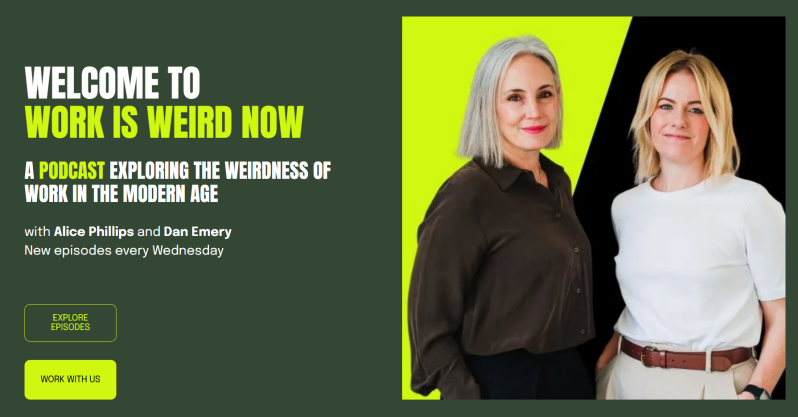
That is why I became interested in Work Is Weird Now, a British podcast hosted by Alice Phillips and Dan Emery. The title sounds almost like something someone might say over a cup of coffee after another particularly strange day at work. But behind that seemingly simple observation lies a much bigger question: What happens when the assumptions that have shaped our working lives for generations no longer reflect reality?
The podcast describes itself as a place for people who have reached a mid-career impasse, are questioning their previous choices, looking for inspiration, or simply wondering what on earth is going on. It is a modest but remarkably accurate description of something I suspect affects far more people than we realise.
Because what happens when you have done everything you were supposed to do? You have educated yourself, worked hard, taken responsibility, accumulated experience, and perhaps reached a position that others would consider successful, only to discover that you are no longer particularly interested in continuing along the same path.
We have developed a fairly sophisticated vocabulary for describing the beginning of a career. We talk about ambition, opportunities, development, and dreams for the future. We even have a language for the end, when retirement approaches and people are expected to withdraw from working life. Yet we have surprisingly few natural ways of describing that moment when someone simply no longer wants to continue along the road they have spent decades building.
It does not necessarily involve burnout, failure, or some dramatic midlife crisis. Sometimes it simply means that you have changed. That what once mattered no longer seems particularly important.
And why should that be strange?
When You Discover the Career Ladder Is Leaning Against the Wrong Wall
When I began working in the 1970s, there was still a relatively clear idea of what adult life was supposed to look like. You got an education, learned a trade, found employment, and organised the rest of your life around it. If you were ambitious, you could move up. If you were loyal, you could hopefully expect some security. Work was not merely a means of earning a living. It was also a way of becoming somebody.
Of course, that reality never applied equally to everyone. Social class, gender, education, and economic circumstances determined what opportunities people actually had. But the model was powerful enough to shape several generations' ideas about success.
Today, parts of that structure are beginning to crack.
Work Is Weird Now has explored what happens when the traditional career ladder no longer works, whether organisational hierarchies have made people too dependent, whether work should be organised around projects rather than fixed working hours, and what happens to our ambitions as traditional patterns of family life change. In another episode, the podcast asks how we should prepare our children for the future of work.
What interests me is not that the podcast claims to have all the answers. Quite the opposite. It is the questions themselves that make it valuable. They do not assume that today's working world is some kind of natural law.
I think about the many organisations I have worked with during decades of international productions, concerts, events, and complex projects. I have seen extraordinary people achieve almost impossible things through cooperation, technical expertise, and the ability to improvise. But I have also experienced organisations where hierarchies, territorial thinking, and outdated working methods made even the simplest improvements remarkably difficult.
On one occasion, I suggested using QR codes to organise and monitor the management of portable toilets. Hardly rocket science. Just a practical way of using existing technology to improve information, logistics, and operational control. I was told I was ten years ahead of my time.
I still laugh about that.
But there is something rather revealing about the story. We humans often find it easier to accept new technology than new ways of organising our work. We can invest enormous amounts of money in digital systems while continuing to think according to organisational models developed for an entirely different world.
Perhaps the real challenge is not developing better technology, but changing our assumptions about what work is supposed to be.
AI Could Change Far More Than Our Jobs
This is where the podcast's perspective becomes particularly relevant. We are living through a technological transformation that is seriously challenging the relationship between people, skills, and organisations.
Almost every discussion about artificial intelligence still revolves around productivity. How much faster can we work? How many tasks can be automated? How many employees will companies need in the future? Which professions will disappear, and which new ones will emerge?
These are important questions, but they generally begin with the same assumption: the objective is still to produce more with fewer resources.
I wonder whether we are missing something much bigger.
For the first time, an individual with relatively limited financial resources can access tools that previously required entire teams of specialists. Programming, analysis, translation, research, design, and technical development have become accessible in ways that would have been difficult to imagine only a few years ago.
I can see it happening in my own life. At 65, I have started developing digital tools and applications using AI. Not because I have suddenly become a programmer in the traditional sense, but because technology has made it possible to turn experience, ideas, and problem-solving into working prototypes. After a long career in an entirely different industry, I can suddenly explore fields that were previously beyond my practical reach.
That does not mean AI replaces specialist knowledge or makes complex development effortless. It means the distance between an idea and its practical implementation has become shorter.
At the same time, there is a darker side. Companies can use exactly the same technology to reduce their workforces, monitor employees, and squeeze even more productivity out of fewer people. Technology that could give individuals greater independence could just as easily create new forms of dependency and economic insecurity.
There is therefore nothing automatically liberating about AI.
The question is who the technology is primarily supposed to serve.
Should we use it to make people even more efficient within the same old systems, or should we use it to create opportunities for people to organise their own lives, creativity, and livelihoods?
I believe this is one of the most underestimated social questions of our time.
Six Years on a Sailboat and a Life That Never Followed the Career Map
There is, incidentally, a personal detail to this story. I happen to appear in an episode of Work Is Weird Now as part of its What Now? mini-series. Alice and Dan introduce me as a Swedish production professional who was living a nomadic life back in the 1990s, long before anyone started talking about digital nomads. They describe my six years living aboard a sailboat, with just four square metres of floor space and a working life that followed me wherever the boat happened to be.
The episode is called What if where you live matters more than what you do? and revolves around a simple but potentially radical question: Why should we always choose where we live based on where we work, instead of trying to create a working life that fits the life we actually want to live?
Naturally, it was a pleasure to be part of the conversation. But that is not why I believe this podcast matters. My story is simply one example of the much larger transformation Alice and Dan are trying to understand.
I have been working since I was a teenager. I have been involved in international productions, worked with major artists, managed complicated logistics, and carried responsibility for projects where many people depended on everything functioning properly. I have also got up before dawn to clean public toilets in Gothenburg, Sweden. I know what it feels like to carry responsibility, to be in demand, to lose your footing, and to have to start again.
For several years, I lived aboard a sailboat. It was not some romantic holiday with a laptop and a beautiful sunset. It was a way of life, complete with practical problems, limitations, freedom, and uncertainty. But it also taught me something important: security does not always have to mean permanent walls, possessions, and a predictable existence.
Today, I live in Bulgaria and have increasingly chosen to leave my previous professional world behind. The experience remains, and I use it every day. But I no longer want to be defined by my old job titles.
It is a strange feeling to discover how strongly the people around you sometimes cling to your former identity. If you have spent thirty years working in a particular industry, people expect you to continue being that person. You remain the experienced producer, project manager, or specialist, even when you yourself have become interested in something completely different.
I want to develop ideas, write, experiment with AI, and create digital tools that might be useful to other people. This is not a continuation of my old career. It is something new that has grown out of it.
And perhaps this is precisely where Work Is Weird Now touches on something important.
We frequently talk about lifelong learning, but far less often about a person's right to lifelong change. We encourage people to retrain so they can remain useful in the labour market. Yet we seem less comfortable with people who want to use their experience for something entirely different from what the labour market expects of them.
Why should curiosity have an expiry date?
A New World of Work Must Also Include Those Who Cannot Choose
At the same time, it would be far too easy to romanticise the freedom offered by new technology, project-based work, and digital nomadism.
I know from personal experience that independence can also involve financial uncertainty, loneliness, and the constant responsibility of providing for yourself. Not everyone wants to live that way. More importantly, not everyone has the opportunity to choose.
A care worker, bus driver, factory employee, or single parent cannot necessarily switch to a creative, project-based lifestyle with geographical freedom. Many people need predictable incomes, secure employment, and functioning social safety nets. That is not a lack of imagination or ambition. Those are real material circumstances.
That is why the conversation about the future of work must involve more than individual freedom and inspiring lifestyle choices. It must also address who actually gains access to the new opportunities, who carries the risks, and how we avoid creating a labour market in which a privileged group enjoys greater independence while others pay the price.
This is also where I see an opportunity for Work Is Weird Now to develop its conversations further. By continuing to challenge our assumptions about work while also examining the economic and social structures that determine what choices people actually have, the podcast could become an important part of a much larger debate.
Because telling people to follow their dreams is not enough if they lack the means to do so.
We need a society in which more people have a genuine opportunity to change direction, regardless of age, background, or financial circumstances.
Perhaps It's Time to Ask a Completely Different Question
I do not know whether Work Is Weird Now will become one of the year's most widely recognised podcasts. There is no reason to pretend that its wider influence has already been established. But I believe Alice Phillips and Dan Emery have found a subject whose importance reaches far beyond the number of people listening.
Ultimately, it is about how we see human beings.
For a very long time, we have organised our societies around the assumption that work is not only necessary for our survival but also central to our value as individuals. We introduce ourselves through our professions. We ask children what they want to be when they grow up, as though they are not already somebody. We congratulate people when they receive a promotion and ask unemployed people what they intend to do about their situation.
We have turned work into a kind of measuring stick for human existence.
But what if we are entering a period in which that measuring stick gradually begins to lose its significance?
Not because people will no longer need to work. Not because AI is suddenly going to provide everyone with an income. But because the relationship between work, identity, and meaning is beginning to change.
I have started to suspect that the most interesting revolution will not be about how many tasks technology can take over, but about what we humans will do with the opportunity to think differently.
Perhaps we will need entirely new ways of organising work. Perhaps it will become more common for people to pursue several different activities throughout their lives, or for experience and expertise to be used in contexts that do not fit traditional professional categories. Perhaps we will also need to reconsider things that are currently regarded as unproductive: time for reflection, creativity, community, and curiosity without an immediate financial objective.
And perhaps we need to stop treating people who want to change their lives after 50, 60, or 70 as exceptions to some unwritten rule.
I have spent most of my life making things work. Now I want to spend more time exploring what might work differently.
There is a considerable difference.
There is one question I believe deserves to be asked far more often, not only in podcasts about working life but also in politics, education, and discussions about the future of society:
Why do we continue organising human life around work when technology is giving us increasingly powerful opportunities to start organising work around human life?
Perhaps that is why Work Is Weird Now feels so relevant right now.
Not because it offers yet another model for becoming more successful in our careers, but because it dares to explore whether our careers need to be the centre of our lives at all.
And at the age of 65, I happen to think this is an excellent time to start asking that question.

By Chris...
Listen to Work Is Weird Now
YouTube channel:
https://www.youtube.com/@WorkisWeirdNowPodcast
Official website:
https://www.workisweirdnowpod.com/
My episode – What if where you live matters more than what you do?
https://www.youtube.com/watch?v=BKNw80BKWjw&t=74s
Spotify:
https://open.spotify.com/show/52L9LE3vWloJREDzsvTWdu
Apple Podcasts:
https://podcasts.apple.com/us/podcast/work-is-weird-now/id1794194721