

There is something fascinating about watching people experiment without really knowing where the experiment will take them. I recently watched a video in which a group of people combined an inflatable boat with electric propulsion and a hydrofoil. They assembled components, adjusted the weight distribution, improvised seating arrangements and headed out onto the water. They laughed at their creation, discovered its limitations and tried again. Suddenly, they had a vessel with entirely different characteristics from the original boat.
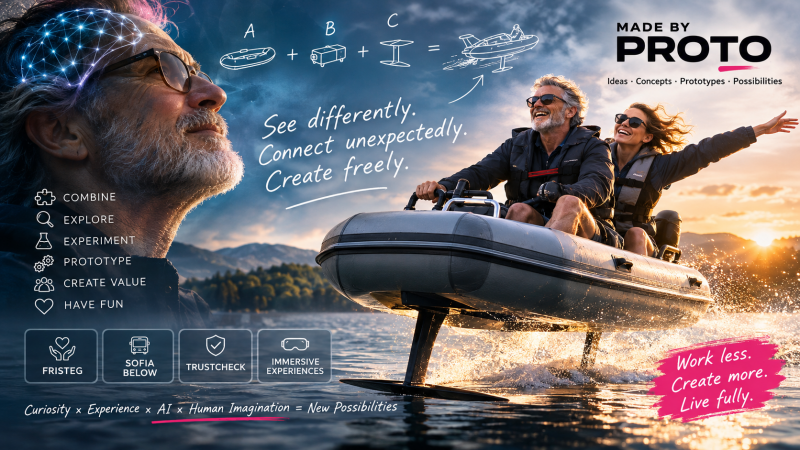
It was not the boat itself that captured my attention. It was the mindset. I recognised something of myself in their approach to technology, in their willingness to explore what happens when you bring together things that may never have been intended to work together. Where others see a finished product, I often see a component of something that does not yet exist. My mind has worked this way for much of my life, and only in recent years have I begun to understand how fundamental this characteristic is to my creative identity.
Does Something Always Have to Be What It Is?
We live in a world where almost everything has been given a definition. Products have their designated purposes, people have their professional titles, and organisations have their areas of responsibility. We are educated to understand how things work, but perhaps not always encouraged to question why they must work in that particular way. Definitions help us navigate a complex reality, but they can also become intellectual limitations.
In psychology, there is a concept known as functional fixedness: the human tendency to perceive an object primarily through its established purpose. It is an understandable characteristic, but also an interesting starting point for understanding creativity. What happens when we free ourselves from the original definition? When we stop viewing a product simply as a product and instead see it as a collection of functions that could be applied in entirely different contexts?
An electric motor does not care what kind of structure it powers. A camera does not necessarily have to be used to create photographs. A mobile phone does not have to function primarily as a communication device. We are the ones who have decided which contexts these technologies belong to. The same components, combined differently, can create entirely different forms of value.
I believe that many of tomorrow's innovations will emerge precisely in this space. Not necessarily through spectacular technological breakthroughs, but through people who look at existing possibilities from new perspectives. Innovation does not always require a new invention. Sometimes, it simply requires a new thought about something that already exists.
Experience Is a Library of Possibilities
For many years, I worked in film production, concerts, major events and complex international projects. These were environments where reality rarely adapted itself to the original plan and where the ability to combine people, technology, logistics and resources was often essential to the outcome. It was about solving problems with whatever was available, sometimes under considerable pressure. There was not always an opportunity to order the perfect solution. You had to create it yourself.
Today, I realise that over the years I have accumulated something that could almost be described as a mental library. It contains technical solutions, human behaviour, organisational models, practical experiences, successes and failures. Whenever I encounter a new technology or a social problem, I often find myself unconsciously searching for connections within that library. Something I learned thirty years ago can suddenly become relevant to the development of a digital service today.
That is also why I increasingly identify myself as an Idea Generalist. I have no ambition to become the leading specialist in every individual field. What interests me is what happens between those fields, where different forms of knowledge meet and established boundaries begin to dissolve.
Specialists are indispensable, but we also need people who move between their different worlds. People who ask questions that may appear naive to someone who has spent an entire professional life within a single discipline. Sometimes, it is precisely that seemingly naive question that opens a new door.
There is a particular value in being able to recognise the potential of knowledge without necessarily possessing every technical skill required to apply it. Understanding how different forms of expertise can complement one another is itself a competence. In a world increasingly dominated by specialisation, the ability to connect knowledge across disciplines deserves greater recognition.
When Artificial Intelligence Meets Human Imagination
For me, the truly transformative aspect of artificial intelligence is not necessarily how quickly it can produce text, images or software code. It is how the technology changes an individual's ability to explore their own thoughts. In the past, I could have an idea, understand its potential functionality and even imagine how it might be constructed, but the journey towards a working prototype often required expertise and financial resources that I did not personally have access to.
Today, the situation is different. I can begin exploring an idea in the morning, visualise it, discuss its technical requirements and, in some cases, have an initial digital prototype by the same evening. It will probably contain flaws. It may require professional scrutiny, specialist expertise and considerable further development. But it exists. Something that previously existed only in my mind has acquired a form that other people can understand, question and evaluate.
This does not mean that artificial intelligence has made me more creative. Rather, it has enabled me to translate more of my existing creativity into practical reality. That distinction matters. I have no desire to outsource my thinking to artificial intelligence. I want to use artificial intelligence to extend the reach of my own thinking.
I also believe there is a largely unexplored potential among people with extensive professional and life experience. People who may never have written a line of code, who do not identify themselves as technological innovators, but who have spent decades accumulating knowledge about how the world actually works. What happens when these individuals suddenly gain access to tools that allow them to create digital solutions to problems they have personally encountered?
I find that development at least as interesting as the technological race between the world's largest technology companies. Innovation may increasingly emerge from individuals who have spent their lives outside the technology industry but who possess something equally valuable: a deep understanding of reality.
Made by PROTO – A Place for Ideas Yet to Take Shape
It is from this way of thinking that Made by PROTO has emerged. Not from an ambition to build a traditional technology company with employees, investors and ever-increasing revenue targets. I want to create an independent digital idea lab where I have the freedom to move between different disciplines, investigate possibilities and develop concepts without first having to justify every thought economically.
FRISTEG is an example of how experiences of financial hardship can be combined with digital guidance to lower the barriers to accessing help. SOFIA BELOW explores what happens when public transport data is combined with digital cartography and augmented reality. TRUSTCHECK investigates how knowledge of digital fraud can be transformed into an accessible decision-support tool. Another concept explores the possibility of combining immersive film technology, sound and sensory experiences to allow seriously ill children to experience parts of the world they are currently unable to visit.
At first glance, these projects appear to have very little in common. Yet they originate from the same creative process. I observe, question, connect, reconsider and attempt to give a thought a physical or digital form. Afterwards, I must be prepared to investigate whether it actually works. Sometimes it does. Sometimes I discover that my original assumption was wrong. The latter is equally valuable, provided I am willing to accept the result.
Social value is central to Made by PROTO, but there must also be room for playfulness. Not every experiment needs to solve a major societal problem. Not every idea needs to become a product. The seemingly pointless little inflatable boat in the video reminds me of something that is easily lost when innovation is reduced to financial performance indicators: the human pleasure of discovering something you did not previously know was possible.
Curiosity should be allowed to precede the business plan. Experimentation should precede conclusions. A prototype should be allowed to exist before anyone decides whether it needs an organisation around it.
The Freedom to Create Without Building an Empire
At the age of 65, I have little desire to build an organisation that subsequently demands all my time and attention. I have spent enough years coordinating complex operations to understand what that entails. My ambition today is different. I want to follow my curiosity, create something, investigate its value and then decide for myself whether to continue developing it or allow someone else to take it further.
An idea does not have to remain mine for me to feel satisfaction in having created it. Perhaps that is one of the greatest freedoms of being an independent creator: not having to own the entire future of everything you create.
We live in a business culture where success is frequently measured through expansion, revenue, headcount and market dominance. Growth is often treated as an objective in itself rather than a means of achieving something meaningful. I increasingly question whether that model is appropriate for everyone, particularly when emerging technologies are making it possible for individuals to accomplish things that previously required entire organisations.
What if success could also mean creating something genuinely useful without sacrificing your independence? What if an idea could make a difference without becoming the foundation of a corporate empire? What if the freedom to move on to the next idea were considered an achievement rather than a missed commercial opportunity?
I do not know which ideas I will be working on a year from now. Nor do I feel any particular need to know. The next idea may emerge while watching an inflatable boat, reading a newspaper article, talking to another person or discovering a technological function that someone originally developed for an entirely different purpose.
I have no intention of abandoning my curiosity simply because I have reached an age at which society expects me to slow down. On the contrary, I now have access to creative possibilities that I could barely have imagined only a few years ago.
Made by PROTO is not defined by the technology I use, the applications I develop or the individual projects I pursue. It is defined by the way I look at the world.
I do not just see what things are.
I see what they could become.
That is the intellectual and creative foundation of Made by PROTO.
SEE DIFFERENTLY. CONNECT UNEXPECTEDLY. CREATE FREELY.
Work less. Create more. Live fully.
MADE BY PROTO
Ideas · Concepts · Prototypes · Possibilities

By Chris...