

Rick Beato’s interview with Mick Jagger is considerably more than a conversation about The Rolling Stones and the history of rock music. It is a fascinating lesson in creativity, technological evolution, collaboration and intellectual flexibility. Above all, we encounter a man who, after more than six decades in the music industry, still considers himself someone with things left to learn.
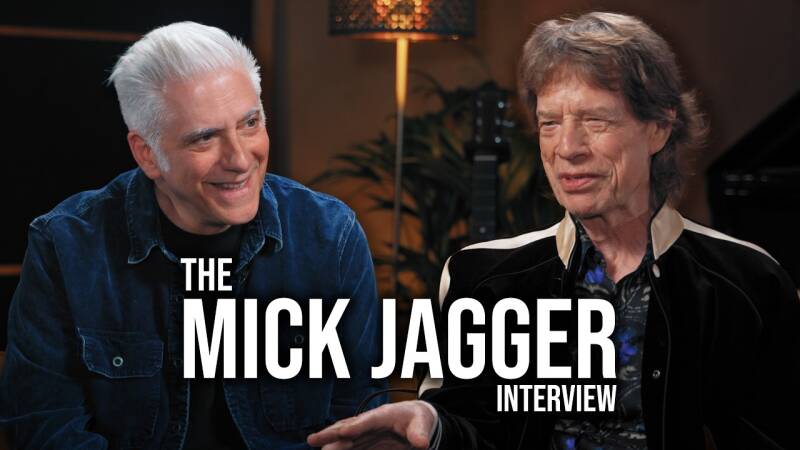
There is something particularly fascinating about listening to Mick Jagger when he is not standing in front of 70,000 people, playing the role of perhaps the world's most iconic rock singer or defending his own legacy. When music producer and YouTube personality Rick Beato sits down with him for an extended conversation, a different person emerges. A curious, humorous, self-critical and technologically minded creator with an almost disarmingly modest attitude towards his own achievements. Perhaps that is where the real charm lies. Behind the almost superhuman stage persona is someone who still wonders how a guitar riff could be improved, how a rhythm might be changed or why a vocal melody suddenly works in an entirely different way from what he originally intended.
Beato opens the interview by explaining that Goats Head Soup was the first record he bought with his own money at the age of eleven. He describes Angie as perhaps his favourite song of all time. A perfect composition. Jagger accepts the compliment, but when Beato asks him what he would consider a perfect song outside The Rolling Stones, he immediately questions the very notion of perfection. The tone for the rest of the conversation is already established. Jagger appears considerably more interested in how music is created than in turning it into a monument.
When Experience Does Not Become a Prison
One of the things that fascinates me most is Jagger’s relationship with his own history. He has every reason to romanticise the analogue recording techniques of the 1960s and 1970s, yet he does not. Instead, he describes the practical limitations, how microphones had to be positioned, how musicians were balanced against one another and how changing a string arrangement could require an entire orchestra to amend its sheet music by hand. It demanded both careful preparation and considerable craftsmanship.
When he discusses working with arranger Paul Buckmaster, we also encounter a young Mick Jagger who lacked formal musical training but had a clear understanding of what he wanted to achieve. He could not necessarily explain his ideas using the language of music theory, but he could listen, evaluate, communicate and learn from people who mastered other parts of the process.
This is an underestimated form of competence. The ability to recognise quality without personally mastering every technical detail. The ability to articulate a vision and then, together with others, transform it into reality.
Having spent many years working in concerts, live events and other creative productions myself, I recognise this. The most interesting creative individuals are not always those who possess the greatest expertise in one particular field. They are often people who understand the relationships between different areas of expertise and have the ability to make something emerge from their intersection.
In that respect, Jagger is as much a creative producer as he is a singer.
The Greatness of Allowing Someone Else to Be Better
When the conversation turns to his collaboration with Keith Richards, the interview becomes particularly interesting. Beato asks how Jagger reacts when he has written a guitar riff himself and Richards subsequently comes up with something different. Jagger explains that, naturally, he hopes Keith will come up with something better.
While working on Mr. Charm, Jagger had developed his own guitar riff, but Richards created a different musical phrase for the verse which, according to Jagger, improved both the song and its rhythmic character. There is no obvious ego in the story. What matters is what happens to the music.
An even clearer example emerges later in the interview. Jagger explains how he had developed an incomplete demo that he had never played to the other musicians. During a lull in the studio, he started playing a single chord. The others gradually joined in. Steve Jordan began playing drums, keyboards entered the arrangement, and Ronnie Wood developed a musical transition that Jagger considered better than the one he had already written himself. He therefore kept Ronnie's version without even mentioning that he had one of his own.
It is an almost perfect illustration of what creative collaboration can be when it works at its best. An idea does not need to be defended simply because it belongs to you. Nor does it need to be realised exactly as you originally imagined it. Its value lies in what it can become.
How many ideas have been lost because people were more interested in defending their ownership than improving the final result? How many organisations have built entire cultures around individuals who struggle to accept that someone else might have a better solution?
Being able to abandon your own idea in favour of a better one is not a sign of creative weakness. It is a form of creative maturity.
From Magnetic Tape to the Digital World
Perhaps the most surprising aspect of the interview is Jagger’s remarkably uncomplicated relationship with technological progress. He belongs to a generation that has experienced the transition from a very limited number of analogue recording tracks to today's digital production environments, where music can be edited, transformed and assembled with a precision that was previously unimaginable.
Many musicians and music lovers regard this development with a degree of suspicion. Analogue technology is associated with authenticity, while digital technology is sometimes portrayed as a loss of human expression. Jagger does not appear particularly interested in that opposition.
Technology has been used in the recording studio since recording studios were invented.
An apparently obvious observation, yet one with considerably greater implications than it might initially suggest. Recorded music has always been the result of an interaction between human creativity and technological possibilities. The microphone, the amplifier, the mixing console, magnetic tape and digital audio processing represent different stages of the same evolution.
Jagger also explains how, during the production of Blue & Lonesome, around 2016, he was already using remote mixing. He could be in France while others were working in a studio in Los Angeles, listen to the results, provide feedback and return once the changes had been made.
For me, the parallel with today's discussion about artificial intelligence is obvious. Although the interview is not about AI, Jagger's attitude towards creative tools is equally relevant in that context. New technology transforms our working methods and opens possibilities that did not previously exist. It does not remove the need for judgement, experience or artistic integrity. It can, however, change who has the opportunity to bring their ideas to life.
Human creativity does not necessarily reside in the tool itself. It resides in the decisions we make when using it.
Curiosity as a Creative Driving Force
When Jagger describes his travels to Brazil and his encounters with Brazilian percussion culture, it becomes clear how much of his creativity is built upon the ability to discover connections between seemingly different worlds. Twenty or so people playing different percussion instruments collectively create rhythmic structures that evolve almost imperceptibly. It is a musical experience quite different from traditional British rock music.
Sympathy for the Devil is a brilliant example. Jagger had written the lyrics and chords, but the song did not originally have the samba character that would later become such a central part of its identity. Through experimentation in the studio, it evolved. Jagger believes the idea came from Keith Richards and that their experiences in Brazil may have contributed, although he is careful to acknowledge that he cannot remember precisely how it happened.
At its core, this is combinatorial creativity. Discovering something in one context and recognising that it could serve an entirely different purpose in another. Allowing experiences, cultures, technologies and forms of expression to meet in places where they would not ordinarily encounter one another.
The same principle emerges when Jagger discusses his harmonica playing and how blues musicians borrowed musical phrases from saxophonists. One instrument inspires another. A technique moves between different forms of expression. Something new emerges from something that already exists.
Creativity does not necessarily mean inventing something out of nothing. Often, it is about recognising a possibility in something that others already have in front of them.
A Rock Star Who Still Has Things Left to Do
Mick Jagger was born in 1943. At the age of 83, he is still sitting there discussing guitar tunings, recording techniques, song structures, rhythms and new musical ideas. He explains how he uses his mobile phone to capture melodies that emerge in the middle of the night, and how a song he has sung in the same way across several recording sessions can suddenly change because he questions his own approach.
When Rick Beato asks towards the end of the interview whether there will be more Rolling Stones tours, Jagger replies that he would like to do more and feels ready, although none had been booked at the time of the interview.
There is something liberating about this, particularly in a society that likes to divide human lives into distinct phases and expects ambition, creativity and curiosity to diminish with age.
I increasingly struggle to accept the notion that experience belongs to the past. Experience is raw material for the future. Its real value emerges when it is combined with new knowledge, new tools and a willingness to continue exploring the world.
Rick Beato could have produced yet another interview about the great moments in rock history, legendary tours and old scandals. Instead, he gives us a conversation about the act of creation itself. He allows one of the world's most successful rock musicians to talk about craftsmanship, uncertainty, experimentation and the joy of still being able to discover something new.
And perhaps that is precisely where Mick Jagger's real charm lies. Not in his stage persona, his fame or his ability to seduce an audience, but in his seemingly inexhaustible interest in what is still possible.
Call me Mr Charm!

By Chris...
Watch the Interview
The Mick Jagger Interview – By Rick Beato