

Deep in the heart of the Eastern Rhodope Mountains, far from Bulgaria’s bustling cities and tourist crowds, lies a place shrouded in myth and geological wonder — the "Mysterious Stone Face of Nenkovo"
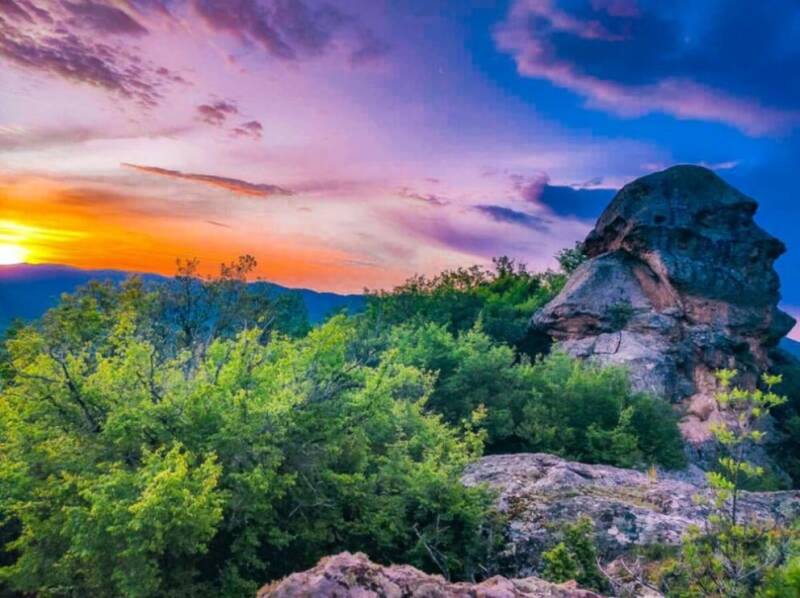
Standing silent and watchful over the rugged hills near Mount Bezdiven, this enigmatic rock formation has fascinated explorers, scientists, and spiritual seekers alike. Rising more than 250 meters above the sacred site of Kalpak Kaya, the face appears to gaze eternally toward the rising sun, its expression etched in time — serene, solemn, and hauntingly human.
A Hidden Path Through Forgotten Villages
The journey to this ancient guardian begins in the small village of Nenkovo, located in the Kardzhali region. From the remnants of old water pumps, a narrow trail winds through overgrown meadows and the ghostly remains of Hayrenlar, an abandoned hamlet where time itself seems to have stopped. Crumbling stone houses, encroached by vegetation, whisper of lives once lived in harmony with the mountains. As hikers continue upward, the air grows thinner and purer, filled with the scent of pine and wild thyme. Then, suddenly, between the trees, the massive rock formation reveals itself — a colossal stone visage emerging from the mountain, oriented perfectly toward the east.
This orientation is no coincidence. Whether shaped by nature’s patience or ancient human hands, the face’s alignment with the sunrise evokes deep symbolic meaning. In many Thracian and pre-Christian cultures, the east was sacred — the direction of rebirth, light, and divine awakening. It is said that when the first morning rays strike the eyes of the stone, they seem to glimmer for a brief moment, as if the mountain itself opens its gaze to greet the new day.
A Geological Miracle or an Ancient Monument?
Scientists remain divided on the origins of the Nenkovo stone face.
Geologists attribute it to natural erosion, the slow artistry of wind, rain, and frost carving the soft volcanic rock over millennia. The Rhodope Mountains are, after all, a canvas of geological wonder — filled with strange formations, from mushroom-shaped pillars to towering rock sanctuaries like Perperikon and Tatul.
Yet others — archaeologists, local historians, and mystics — see something far more deliberate. They argue that the face bears too much symmetry and expression to be mere coincidence. Could ancient Thracians, known for their sun worship and monumental sanctuaries, have intentionally sculpted it? If so, this would place it among the oldest surviving rock carvings in Europe, potentially predating the pyramids.
The Cave Beneath: A Portal to the Past
Below the stone face lies a dark opening — a cave that deepens the site’s mystery. Measuring roughly five meters in height and 26 meters in depth, it resembles another famous Rhodope site: the “Utroba” (Womb) Cave in Tangardak Kaya. That cave, shaped like the inside of a human womb, was discovered to align with sunlight on specific days of the year, creating a symbolic ritual of “rebirth.” Could the cave beneath the Nenkovo face hold a similar significance?
Local legends suggest so. According to one tale, the cave was once a sacred place where Thracian priests conducted ceremonies to honor the sun god Sabazios. Another story tells of shepherds who once heard strange chanting from within the rock and saw light emanating from the cave’s depths. Some claim that the face and cave together represent Mother Earth — her visage above ground, her womb below — forming a cosmic connection between earth, sky, and humanity.
Land of Spirits and Ancient Beliefs
The Rhodope Mountains are steeped in myth. This is the land of Orpheus, the legendary musician whose songs could charm even the stones. It is also the realm of Dionysus, god of ecstasy and transformation. Every valley seems to carry echoes of ancient rituals — fire dances, sun cults, and nature worship — practiced long before Christianity reached these lands.
For centuries, villagers have viewed the stone face as a protector. They call it “The Guardian of the Rhodopes,” believing it watches over travelers and livestock. Some even say that in times of danger or war, a mysterious mist rises from the mountain to conceal it from invaders — as if the spirit of the land itself intervenes.
Anthropologists studying the region often speak of the “sacred geography” of the Rhodopes: a landscape where every rock, cave, and spring carries spiritual meaning. The Nenkovo face fits perfectly into this pattern, embodying the human desire to find — or create — divine presence in nature.
Nature’s Hand in the Sculptor’s Work
Even if one believes the face to be purely natural, the artistry of the elements is undeniable. The forehead, nose, and chin form a striking profile, with features shaped by millennia of erosion, freeze-thaw cycles, and mineral layering. The rock’s reddish hue glows at dawn, then fades into cool grey by afternoon, mirroring the mood of the day. It’s as though the mountain breathes — alive, ever-changing.
Geologists point out that the volcanic tuff common in the Eastern Rhodopes is particularly prone to forming such “pareidolic” structures — shapes that resemble familiar forms, like faces or animals. But in this case, the resemblance is so uncanny that it continues to blur the line between coincidence and creation.
A Pilgrimage for the Soul
Reaching the stone face is not easy, and perhaps that’s part of its magic. The path winds upward for several kilometers, demanding both physical effort and mental stillness. Along the way, hikers encounter fragments of forgotten worlds — traces of Thracian altars, stone cairns, and shepherd shelters. Every step feels like a journey back in time.
When travelers finally stand before the great rock, the experience is often described as spiritual rather than touristic. The silence is profound. The vast panorama stretches endlessly, and the “eyes” of the stone seem to gaze into eternity. Many visitors report a sense of calm, even reverence — as though standing in the presence of something sacred that defies rational explanation.
Photographers love the site for its play of light and shadow, especially at sunrise and sunset. At those moments, the stone’s contours sharpen, and the human likeness becomes undeniable. Some call it “the Bulgarian Sphinx,” though unlike its Egyptian counterpart, this guardian offers no riddles — only reflection.
Echoes of the Past, Lessons for the Future
In an era dominated by digital distractions, the Mysterious Stone Face reminds us of the dialogue between humanity and nature. Long before skyscrapers and smartphones, people looked to mountains for wisdom. They saw in them faces, forms, and spirits — symbols of their connection to the earth. Whether the Nenkovo face is man-made or natural, its significance lies in this very act of recognition: the human impulse to find meaning in stone.
Modern researchers studying cultural landscapes argue that such sites are crucial for understanding how ancient societies viewed their world. They represent early forms of environmental consciousness — seeing nature not as a resource to exploit, but as a living entity to honor. The Rhodopes, with their countless sanctuaries and megaliths, are a living museum of that worldview.
Preserving the Mystery
Today, local conservationists and cultural organizations are campaigning to protect the Nenkovo Stone Face from uncontrolled tourism. While the site remains relatively unknown compared to Perperikon or Tatul, growing interest on social media has begun to attract adventurers. Without proper management, the delicate balance of this natural monument — both ecological and spiritual — could be threatened.
There are plans to include the area in regional eco-tourism routes promoting sustainable exploration of the Rhodopes. Guides emphasize respect for the environment: no littering, no carving on rocks, and no loud music. “This is not a selfie spot,” one local ranger says. “It’s a place to listen — to the wind, the birds, and maybe to your own thoughts.”
An Invitation to Wonder
For travelers seeking more than beaches or ski resorts, the Mysterious Stone Face offers a different kind of experience — one of introspection and awe. Standing before it, you are reminded that nature still holds secrets untouched by time, waiting for those willing to walk the extra mile.
As the sun rises over Mount Bezdiven, light touches the stone’s brow, and for a fleeting moment, it seems to come alive. You might find yourself thinking: If mountains could speak, what stories would they tell?
Perhaps they already do — in the silent language of stone.
Practical Information for Visitors
-
Location: Near the village of Nenkovo, Kardzhali Province, Eastern Rhodope Mountains, Bulgaria
-
Elevation: Approximately 1,140 meters above sea level
-
Access: Start from the old water pumps in Nenkovo, pass through the abandoned hamlet of Hayrenlar, and continue toward Mount Bezdiven
-
Difficulty: Moderate; suitable for experienced hikers or guided tours
-
Best time to visit: Spring or early autumn, when the path is dry and visibility is clear
Conclusion
Whether sculpted by ancient believers or the patient hands of nature, the Stone Face of the Rhodopes stands as a symbol of our shared quest for meaning. It bridges eras — from prehistoric rituals to modern curiosity — reminding us that mystery still exists in the world.
In an age when everything can be explained, uploaded, or digitized, the silent watcher of Nenkovo remains defiantly enigmatic, whispering across centuries:
“Not everything that looks human is made by humans — and not every mystery needs to be solved.”

By Bo...
Add comment
Comments