

“I ran around in my boxers chasing baboons, but they got away – and everyone was filming me,” laughs Ivo Oreshkov
Ivo Oreshkov, the maestro behind the camera whose lens has captured not one or two wedding couples, is a passionate adventurer, blessed with the knack of being in the right place at the right time.
A few days ago, Craig the elephant – an emblem of Kenya and the oldest elephant in the world – passed away at the age of 54. Just three months earlier, Ivo had managed to photograph him.
“Craig was famous for being the oldest elephant on the planet. He was also renowned for having the largest tusks – each weighing around 45 kg. He was born in 1972. Unfortunately, he died of old age on January 3, 2026, shortly after turning 54.
I had the honour of seeing this giant alive three months ago, during a safari in Amboseli National Park, Kenya, where I was with a group of friends – adventurers and photographers. Unfortunately, we didn’t manage to see him up close. When the local guide told us that Craig had gone out for a walk and that we might be able to see him, we headed towards the indicated spot. And then we saw him walking in the distance, but sadly he wasn’t coming in our direction. Since we were not allowed to leave the road boundaries with the jeep, we had to photograph him from afar. Thanks to the long telephoto lens I was armed with, I managed to take a few shots of him. But they didn’t turn out the way I would have liked if I had photographed him from close range. At the time, I had no idea that this would be both my first and my last encounter with this legend. That’s why I’m content even with these shots I took of him, because just three months later he was gone forever,” Ivo recounts.

Ivo Oreshkov
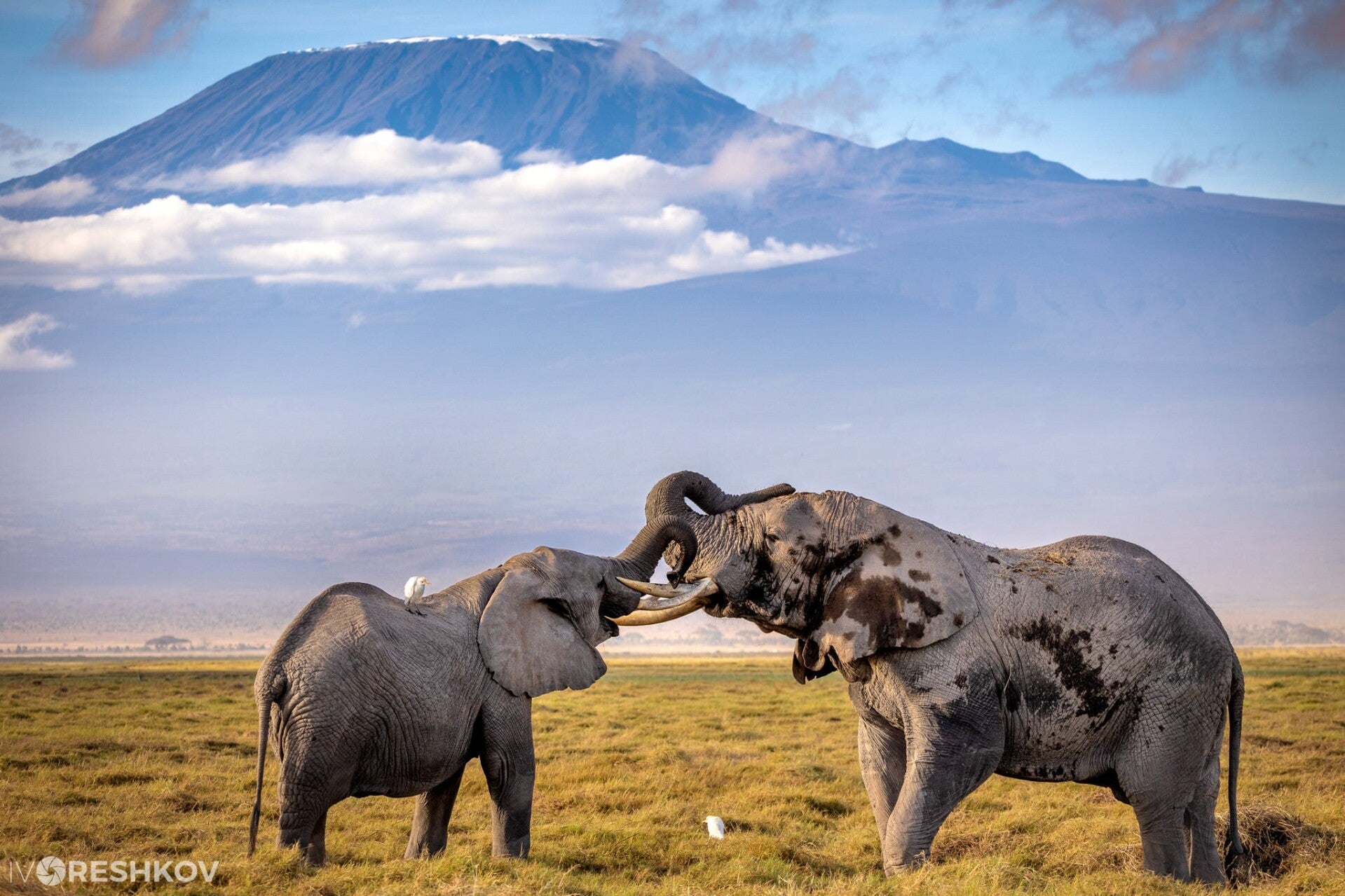
He also posted on Facebook an attractive shot, again of elephants, titled “A Blessing from the Son.”
“It’s more of a poetic title than a realistic one. As far as I understand, male elephants live in the herd with their mothers and females until they reach maturity. After that, they separate, and fathers have no relationship with their offspring. The herd is led by an elderly female (a matriarch) and consists of females and calves.
In this case, we were looking to photograph elephants against the backdrop of Mount Kilimanjaro. And we came across these two males – one big and one small – playing with their trunks. They practically put on a whole show for us against the snowy Kilimanjaro. It was truly magical! That’s how I captured these images,” Oreshkov explains.
For years, he has been part of a group that travels to impressive places around the world, off the mainstream path, where nature and people are fascinating and each has their own story.
“We were in Kenya on a photo safari with a group from Bulgaria. It’s a photography group I’ve travelled with to many places around the world – Morocco, Vietnam, Myanmar, Thailand, Namibia. Through our journeys together, we’ve become good friends and always have a lot of fun.
We landed in Kenya’s capital, Nairobi. Since travelling at night is forbidden there, we waited several hours at the airport until dawn, when the jeeps came to pick us up. Then we headed to the kingdom of elephants – Amboseli Park at the foot of Mount Kilimanjaro. After that, we visited Lake Naivasha, Lake Nakuru, and finished in the Maasai Mara reserve.
Most of the time we were in the jeeps. The parks are enormous, so we covered a lot of ground – sometimes from sunrise to sunset. Honestly, seeing interesting animals and situations involving them is largely a matter of luck. Giraffes, zebras, antelopes and the like are everywhere. But cats, for example, are harder to find. The hardest to spot is the leopard. It mostly stays in trees, which makes it more difficult to see. The good thing, however, is that the local jeep drivers keep in touch via radio. When there’s an interesting animal somewhere, they inform each other.
That’s how we got to the leopard. The huge cat, however, was sleeping in the tree canopy and was completely invisible for photography. Hanging on the branches below it was a killed antelope. Everything suggested the cat had just eaten and gone to take a nap. Bad luck for us. But we were persistent and ready for anything for a great shot. We stayed by the tree for a full four hours, waiting for the beauty to get hungry and get up to eat. In fact, even if we had wanted to leave, we couldn’t – around 50 jeeps had gathered around the tree and we were stuck in a massive ‘traffic jam’. But in the end, our patience was rewarded. The leopard stood up, walked majestically along the branches, paused to pose for a few photos, then jumped onto the dead antelope and started feeding. During this few-minute spectacle, we got our shots.
It was similar with the lions. Most of the ones we saw were sleeping in the bushes. They hunt at night and nap during the day in the shade of some thicket. That makes them extremely unphotogenic at those moments. You can barely see them, they don’t look good, and the light isn’t good for photos either. A lousy situation!
So we came across an entire sleeping pride, consisting mainly of lionesses with larger cubs. We stood there, watching the sleeping cats, wondering whether it was worth wasting time on them or whether we should go look for something more interesting to photograph. The good thing was that this happened shortly before sunset. Suddenly, the lifeless lions stirred and began to rise one by one from their ‘beds’ and gather together. Huge yawns followed, lots of cuddling – it was a full-blown spectacle. It lasted only a few minutes, after which they headed towards the sunset, probably for an upcoming hunt. But that was the moment when I took several great shots, in one of which I captured three lions yawning simultaneously,” Ivo describes the extraordinary world there.
He is quick to add that the other “interesting cat” – the fastest animal, the cheetah – unlike leopards and lions, hunts during the day. It relies on surprise and the high speed it can reach to catch its prey.
They saw a cheetah stalking warthogs – familiar to us from The Lion King through the character Pumbaa. The graceful cat used their jeeps as cover to surprise the pigs, which had mingled with a herd of zebras.
“She charged at them, but unfortunately didn’t manage to catch anything. And since cheetahs exhaust themselves after reaching high speeds and need rest to ‘recharge their batteries’, our beautiful hero retreated. But we had already taken our shots and were satisfied with the situation,” the photographer recounts.
They hardly visited cities. They were told it wasn’t particularly safe. Kenya is home to various tribes and peoples, the most famous of whom are the Maasai.
“These are the people who wear colourful, blanket-like garments and are known for jumping high. We visited a Maasai village. Of course, the people there have long since become part of the civilised world. And although they showed us aspects of Maasai life and culture, we learned that most of them are Christians. Overall, Kenya is a Protestant country and the Christian faith is dominant. One of the Maasai men curiously examined my tattoo, which features a verse from the Bible, and really liked it. Also, most of them had TikTok accounts. At the camp where we stayed near Maasai Mara, at night we were guarded by a Maasai armed with a spear and a flashlight, standing in the bushes. He was mainly protecting us from hyenas, which usually cause trouble. Meanwhile, zebras grazed peacefully around our rooms at night. It was very funny how one evening my wife, Emilia, texted me that she was going to bed and would lock the door because she was afraid of the guard. I laughed a lot and replied that he was there to protect her, not scare her. At another camp, at Lake Naivasha, one of the local staff members was named John Maina. And since our group was mostly from Plovdiv, I won’t even tell you how many tips that man got just because of his name. There was a lot of laughter!” Ivo says.
Another funny incident from the journey happened at the camp by Lake Nakuru, when a staff member told them to keep their door closed because baboons – large monkeys – enter the rooms.
“But my wife understood that we should close the door because bugs come in. The climax was when I was standing in the room in my boxers and suddenly saw three huge baboons sprinting past. I grabbed my camera and ran after them. They were faster than me, though, and disappeared into the bushes before I could photograph them. Meanwhile, our entire group was laughing at me and filming me running around in my underwear with a camera and a huge 600 mm lens after the monkeys. But what can you do – art requires sacrifices! And Minko, our guide, hearing female giggling outside his room, was 100% convinced it was laughing hyenas. He was truly amazed when he realised it wasn’t hyenas, but us,” Ivo recounts with amusement. His work can be seen at www.oreshkov.bg.
Wedding photography is his profession, and he has been practising it enthusiastically for 17 years.
“I love my job! Through it, I capture people’s love and emotions. And my photographs turn into memories for them, which over time become like an open door to the past. Every time they peek through it, they see those emotions and that love again. Photography for me is a hobby through which I have fun as a creator. I love to travel, and I love to photograph! And by combining the two, I experience an inner fulfilment that makes me truly rich,” Ivo shares.

By Bo...


Add comment
Comments