


At the water’s edge in Hawaii, people gather in quiet reflection. Waves lap gently against the shore, the sun rises slowly, and the silence carries echoes of history. Eighty-four years have passed since Japanese aircraft bombed Pearl Harbor on December 7, 1941—a morning that forever altered the balance of global power and propelled the United States into World War II. This year, the ceremony feels different. Not because the memory has faded, but because those who carried it in their own bodies are almost gone.
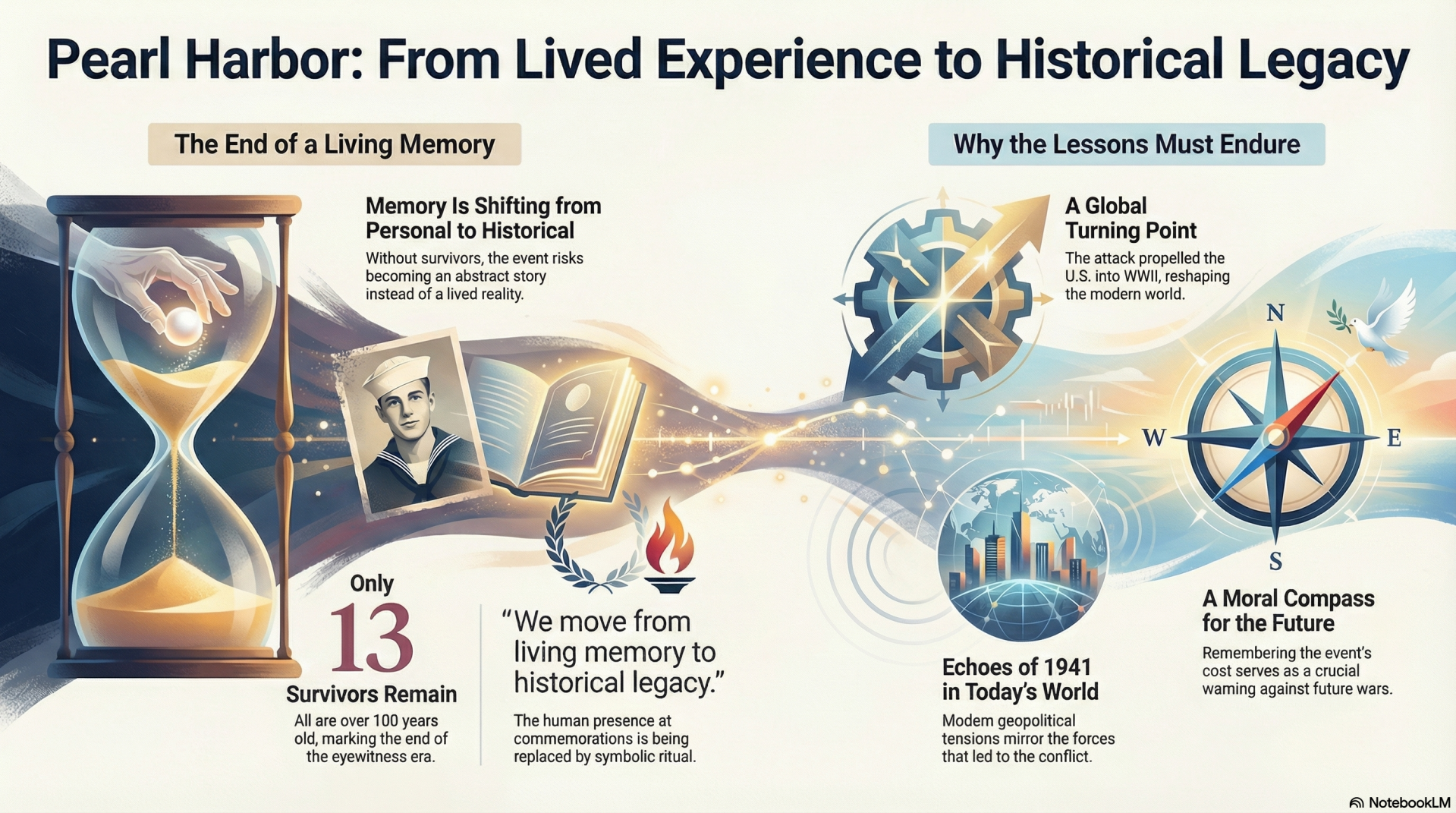
Of the thousands who survived the attack, only thirteen are still alive today. All are over 100 years old. For decades, they have served as living bridges between past and present—men who stood there, who heard the explosions, who watched their comrades die. Their ability to make the journey to Hawaii has become increasingly limited. Soon, no eyewitnesses will remain to stand at the memorial. And when that happens, our relationship to this event will inevitably change.
The Morning That Changed the World
The attack on Pearl Harbor was not merely a military strike. It was a geopolitical shock that shook an entire civilization. In just a few hours, more than 2,300 American servicemen were killed, much of the Pacific Fleet was crippled, and the American illusion of security within its borders was shattered.
Until then, the United States had sought to remain outside the war raging in Europe. Pearl Harbor made neutrality impossible. The following day, President Franklin D. Roosevelt delivered his now-famous address, calling December 7 “a date which will live in infamy.” This was not rhetoric—it was reality.
With America’s entry into the war, the global dynamic shifted dramatically. U.S. industrial power, technological capacity, and military resources would become decisive in determining the war’s outcome. Without Pearl Harbor, the world map as we know it today would likely look very different.
From Local Tragedy to Global Turning Point
It is easy to view Pearl Harbor solely as an American tragedy—and it was. But its significance is global. The attack pulled a major power into an already raging conflict and accelerated its transformation into a truly world-encompassing war.
What followed were the Battle of Midway, the island-hopping campaign across the Pacific, the atomic bombings of Hiroshima and Nagasaki, and finally Japan’s surrender. At the same time, the foundations of the postwar world were laid: the rise of the United States as a global hegemon, the creation of the United Nations, the onset of the Cold War, and the security architecture that continues to shape our era.
Pearl Harbor marked the beginning of America’s role as a global power with worldwide reach—a role still debated, criticized, and questioned today.
Memory That Bound Generations Together
For decades, surviving veterans have played a central role in the commemorations. Their presence made history tangible. Reading statistics in a book is one thing; standing beside someone who lived through the explosions is something entirely different.
Their stories have not only been about war and death, but also about camaraderie, fear, responsibility, and lifelong scars. Many have spoken of how the sound of explosions stayed with them for decades, how the smell of burning metal never truly left.
As these voices fade, something profound changes. We move from living memory to historical legacy—from human presence to symbolic ritual.
When History Risks Becoming Abstract
When the last survivors can no longer attend, a void emerges. The risk is that Pearl Harbor becomes just a point on a timeline, a chapter in a textbook, a historical reference without emotional depth.
This is where our responsibility as a generation begins. Memory must be carried forward in new ways—through education, storytelling, documentation, and reflection. If history loses its human dimension, it is doomed to be repeated.
Pearl Harbor is not only about military strategy or geopolitics. It is a warning of what happens when diplomacy collapses, when misunderstandings deepen, and when power games replace dialogue.
The World Today – Echoes of 1941
Eighty-four years later, we once again live in a time of rising tensions. Major powers are positioning themselves militarily, and conflicts in Europe, the Middle East, and Asia are driven by the same underlying forces as then: fear, nationalism, economic interests, and technological competition.
What differs today is the speed. An attack can now be digital, economic, or informational—yet its consequences can be just as devastating. Pearl Harbor reminds us how quickly the world can tip into chaos when red lines are crossed.
There are also parallels in human response. Shock. Anger. Calls for action. History shows that these reactions are understandable—but potentially dangerous if not tempered by reflection.
A Commemoration as Moral Compass
The Pearl Harbor ceremony is more than a tribute to the fallen. It functions as a moral compass. It asks uncomfortable yet essential questions that still matter today: How do we prevent future wars? How do we protect civilians? When is military response necessary—and when does it represent failure?
When the last eyewitnesses can no longer answer with their lived experience, the burden of asking and answering these questions falls to us.
A Responsibility That Must Not Fade
The story of Pearl Harbor endures not to glorify war, but to remind us of its cost. Each name engraved on the memorial wall represents a life that never grew old, never saw the postwar world take shape.
That only thirteen survivors remain is not merely a marker of time’s passage—it is a wake-up call. Soon, there will be no one left who can say, “I was there.” At that point, it is our words, our actions, and our commitment to memory that will determine whether the lessons endure.
Conclusion: Between Then and Now
Pearl Harbor is an event that tied together the threads of history in a way few others have. It connects personal tragedy with global consequence. It shows how a single morning can change the world—and how the memory of that morning can guide the future.
As thousands gather once again by the water in Hawaii, perhaps without the physical presence of the veterans, we face a choice: to let history remain static—or to carry it forward with the same seriousness as those who lived it.
In the end, remembering Pearl Harbor is not about the past. It is about who we are today—and who we choose to be tomorrow.

By Chris...
Remembering Pearl Harbor 84 Years Later.
Pearl Harbor Stories & Scenes: December 7 marks 84 years since Japan’s surprise attack on US Navy ships in Hawaii. A look back through the archives and stories from veterans, as we remember those lost in the attack. This video includes stories from our stations in Portland and St. Louis.
Add comment
Comments