

As a Swede, I grew up with a natural trust in institutions. Banks do not collapse overnight. Elections lead to real change. Politicians who fail step aside, at least from the center of power. History is confronted, responsibility is taken, and society moves forward.
Following developments in Bulgaria today—an EU member state for nearly two decades—I realize how fragile these assumptions can be. People are once again on the streets. Not because the state has gone bankrupt, but because trust has. And the deeper reason is that history here was never truly settled.
This is what I want to try to explain to fellow Europeans.

This Is Not About Left or Right
First, an important clarification: this is not an ideological conflict between left and right, socialism and liberalism, East and West. It is about something more fundamental—the continuity of power, and what happens when a country never fully breaks with a destructive system.
One of the clearest examples is Rumen Gechev.
For many Europeans, the name means nothing. For Bulgarians, it evokes memories of hunger, bank collapses, and a winter that still haunts the collective memory.
When the State Collapsed – 1997
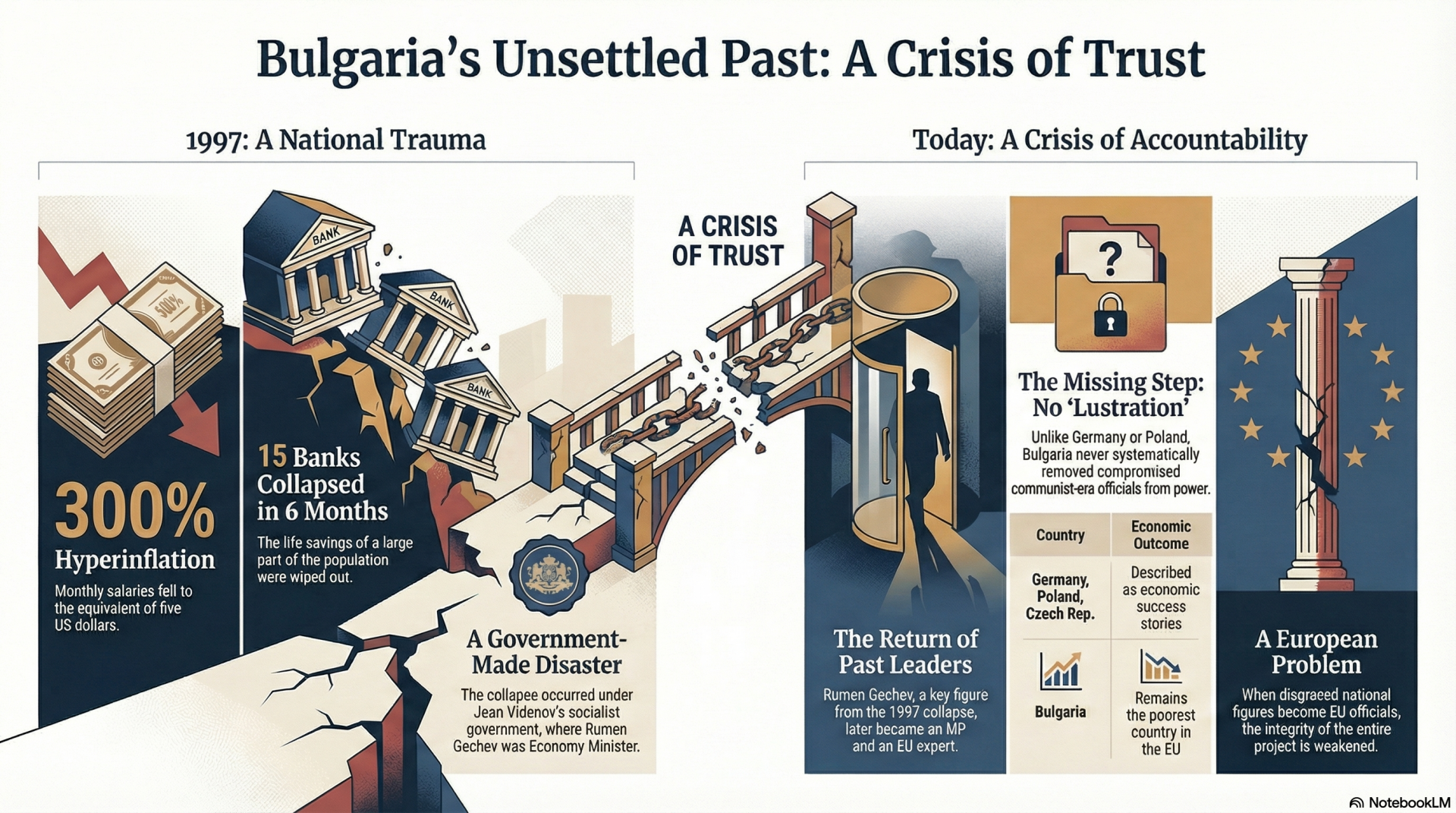
Rumen Gechev was Deputy Prime Minister and Minister of Economy in Jean Videnov’s socialist government, the administration that drove Bulgaria into total economic collapse in 1997.
This was not a recession. It was hyperinflation—around 300 percent. Salaries fell to the equivalent of five US dollars per month. Fifteen banks collapsed within six months, wiping out the savings of large parts of the population. Shops were empty. Bread was scarce. A grain crisis paralyzed the country.
For someone from Sweden, this is almost unimaginable. For Bulgarians, it is lived memory.
In any functioning democratic system, the politicians responsible would have permanently left public life—not necessarily for legal reasons, but out of moral necessity.
That did not happen.
The Return – Step by Step
Rumen Gechev did not disappear from public life. He returned.
First as a professor of economics at UNSS, educating future economists—despite his role in one of the worst economic disasters in modern Bulgarian history. Later, he returned as a member of parliament for the Bulgarian Socialist Party (BSP), frequently lecturing from the parliamentary rostrum about stability and responsibility.
And finally—this is crucial for Europeans to understand—he became an expert at the European Commission in Brussels, paid in euros, despite having publicly opposed Bulgaria’s entry into the eurozone and even taking part in legal efforts to block it.
From a Western European perspective, this sounds absurd.
But that is precisely the point.
Hypocrisy as a System
This is not a personal contradiction. It is a systemic pattern that has characterized parts of Bulgaria’s political elite since the fall of communism.
Throughout the transition years, loud anti-EU, anti-NATO, and anti-US rhetoric was common. At the same time, children were sent to study in New York, not Moscow. Politicians drove German cars, not Soviet ones. They bought property in the United States, not in Russia. Publicly, they demanded Russian Covid vaccines—privately, they inoculated themselves with American ones.
In much of Western Europe, this would be seen as corruption. In Bulgaria, it became normalized.
The Crucial Difference: Lustration
There is an essential historical distinction that Europeans must understand.
Countries such as Germany, the Czech Republic, and Poland carried out forms of lustration after the fall of communism—systematic efforts to remove deeply embedded communist-era officials from political and institutional power.
Bulgaria did not.
As a result, the same people, the same networks, and the same informal loyalties survived—now wearing suits instead of uniforms.
Thirty-six years after the fall of the Berlin Wall, the consequences are clear:
-
Germany is Europe’s economic engine
-
The Czech Republic has enjoyed stable, long-term growth
-
Poland is often described as an economic success story
-
Bulgaria remains the poorest country in the EU
This is not a coincidence.
A Message to Europe’s Younger Generation
When I see young people protesting in Bulgaria today, one thing is clear: many of them were not born in 1997. They do not remember the banks collapsing, salaries evaporating, or empty shop shelves.
So this must be said clearly.
Under the Videnov–Gechev government, people’s savings were destroyed—while the debts of the so-called Komsomol credit millionaires were quietly erased. These individuals used non-repayable bank loans to buy state assets for almost nothing during privatization, laying the foundations of today’s oligarchic system.
When the situation became unbearable, the entire country took to the streets. Barricades were erected. Parliament was blockaded and occupied. The socialist government fell. Bulgaria chose a new direction—toward NATO and the EU.
There was real hope then.
Why the Protests Have Returned
So why is Bulgaria back on the streets 28 years later?
Not because of bankruptcy.
But because of the continuity of corruption.
When Europeans ask why Bulgaria has struggled to “catch up,” this is the answer: because the past was never closed. Because those who bore responsibility for collapse were never forced to step aside.
A European Responsibility
This is not only Bulgaria’s problem. It is a European problem.
The European Union is built on trust—trust in institutions, rules, and accountability. When the same individuals who once helped ruin their own country can quietly move between national parliaments and EU institutions without consequence, the integrity of the entire project is weakened.
After 28 years, Bulgaria is back on the streets.
Not because history repeats itself by accident—
but because it was never truly confronted.

By Chris...
Add comment
Comments