

It took time before the realization landed. Not because reality changed overnight, but because it was slowly normalized. In Sweden, protest has become something strange: a political property.
Something owned by the left. Something historically associated with strikes, demonstrations, trade unions, and red flags. And perhaps that is exactly where the problem begins.
Because the moment protest became ideologically branded, large parts of the population stopped using it.
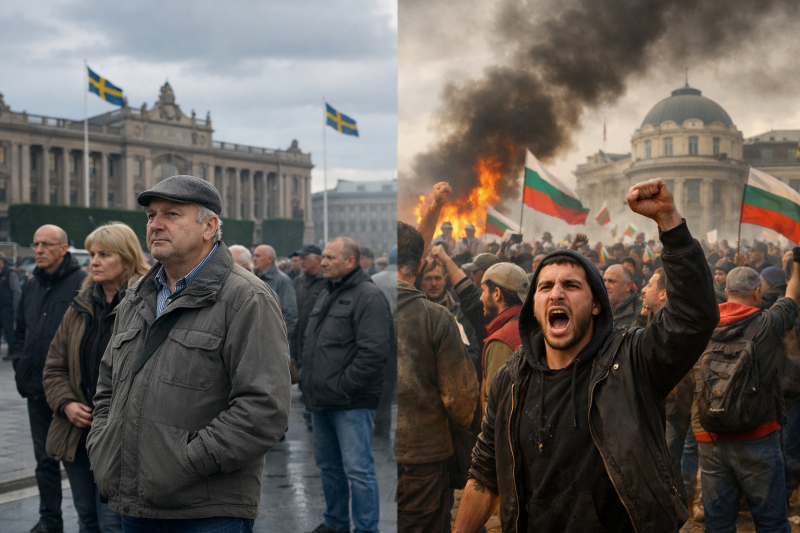
The Strike as Identity – Not a Tool
Historically, protest and strikes in Sweden were closely tied to the labor movement. That made sense. It was necessary. Industrialization created extreme power imbalances, and collective action was the only way forward. But somewhere along the way, something peculiar happened: protest stopped being a civic tool and became a political identity.
Protesting became something you are, not something you do.
The result? A strange silence from everyone else.
Today, it seems as if only those left of center have the “right” to protest. Everyone else is expected to keep quiet, keep working, pay more—and say thank you.
The Swede Who Accepts Everything – With a Clenched Fist in His Pocket
The modern Swede does not protest openly. The Swede grumbles. At the kitchen table. During coffee breaks. In comment sections—anonymously. But rarely with their body. Rarely with their voice. Rarely in public.
It is as if the entire country has slipped into a kind of democratic coma.
Taxes rise. Conditions worsen. Pensions are hollowed out. Welfare systems are dismantled. The unemployed are tightened until they disappear from the statistics. Older people are pushed out of the labor market. Young people are saddled with debt before they have even lived.
And yet:
– “Well… that’s just how it is.”
– “You should be grateful you have a job.”
– “It’s worse in other countries.”
This is where the Swede delivers their famous “thank you”—even while being kicked.
When the System No Longer Works – but Everyone Pretends It Does
What is truly provocative is not individual cutbacks. It is that the entire system clearly no longer works, yet it is defended by politicians from the far left to the far right.
The ideologies differ in rhetoric—but not in outcome.
Everyone talks about responsibility. Everyone talks about necessary reforms. Everyone blames someone else. And at the same time, we see politicians who:
-
Secure their own pensions
-
Move seamlessly between positions
-
Receive top jobs after failures
-
Never personally face consequences
This is where something uncomfortably familiar begins to emerge.
Wait… Where Have We Seen This Before?
Suddenly, it no longer feels so “Swedish.”
Suddenly, the pattern begins to resemble something else.
Bulgaria.
A country where people for decades have lived with politicians who change colors but never behavior. Where the system officially changed—but in practice continued to benefit the same layer. Where people eventually stopped staying silent.
The difference?
They go out into the streets.
Bulgaria: When Protest Is Not Ideology – but Survival
In Bulgaria, people do not protest because they are left or right. They protest because there is nothing left to lose.
Pensioners. Students. Small business owners. Ordinary people. They know the system does not work—and they say it out loud.
The Swede looks at this and often thinks:
“What chaos. Good thing we don’t have it like that.”
But the question is:
Is it really better to stay silent while being slowly ground down?
The Swedish Illusion: Order, but No Justice
Sweden still has order. Forms. Apps. Receipts. Authorities that respond—sometimes. Everything looks proper on the surface.
But beneath that surface, the same thing is happening as in the countries we like to compare ourselves away from:
-
Systems take on a life of their own
-
People are reduced to case numbers
-
Responsibility is always collective—never personal
-
Failure does not lead to resignation, but reassignment
The only difference is that Sweden is better at packaging it neatly.
When Protest Died – Accountability Died with It
When protest became something “the left does,” the rest of the population abdicated from its democratic right—and duty—to speak up.
That created a vacuum.
And in that vacuum grew a political class that no longer fears the people.
Because what happens when no one protests?
Nothing.
To Protest Is Not to Be Left-Wing – It Is to Be a Citizen
This is where a mental reset is needed.
Protesting is not extreme.
Protesting is not left-wing.
Protesting is not about tearing society down.
It is about saying:
“This no longer works.”
And that should be the most Swedish act of all.
The Real Danger: Normalized Resignation
The most dangerous state in a society is not anger. It is apathy.
When people stop believing their voice matters. When they adapt to decline as if it were the weather. When they accept less—year after year.
That is when systems truly break.
Not with a bang.
But with a yawn.
Perhaps That Is Why Bulgaria Unsettles Us
Because in Bulgaria we do not see chaos.
We see a mirror of what happens when people no longer accept.
And perhaps that is why Swedish media often looks away. Because it raises an uncomfortable question:
Why don’t we protest?
Conclusion: The Swede Is Not Kind – the Swede Is Silent
It is time to stop romanticizing Swedish silence as maturity or responsibility.
Sometimes silence is not dignity.
Sometimes it is just fear of standing out.
Or worse—fear of being labeled “wrong.”
But democracy requires more than voting every four years. It requires presence. Friction. Resistance.
Otherwise, protest will always be someone else’s job.
And then—sooner or later—Sweden will wake up.
The question is:
How much must be lost before that happens?

By Chris...
Add comment
Comments