

And Our Nordic Neighbours Are Watching in Disbelief
There comes a moment when a society crosses an invisible line.
When mistakes, bad timing, or misfortune can no longer be used as excuses.
When politics is no longer poorly executed — but deliberately destructive.
Sweden has crossed that line.
What is now happening to unemployment insurance, activity support, and the very view of unemployment is not reform. Nor is it a marginal ideological difference.
It is a systematic dehumanisation of people who are already in vulnerable positions.
And yes — the choice of words is deliberate:
It is a genocide of the Swedish welfare state.
Not with bullets.
Not with camps.
But with spreadsheets, percentages, and a language that makes suffering administratively acceptable.

When Unemployment Rises — The Unemployed Are Punished
Sweden currently has an unemployment rate of 8.9 percent. Around half a million people are without work.
This is happening during a recession driven by global factors: inflation, interest rates, war, and energy prices.
In this situation, the government decides to:
-
cut unemployment benefits
-
reduce compensation every hundred days
-
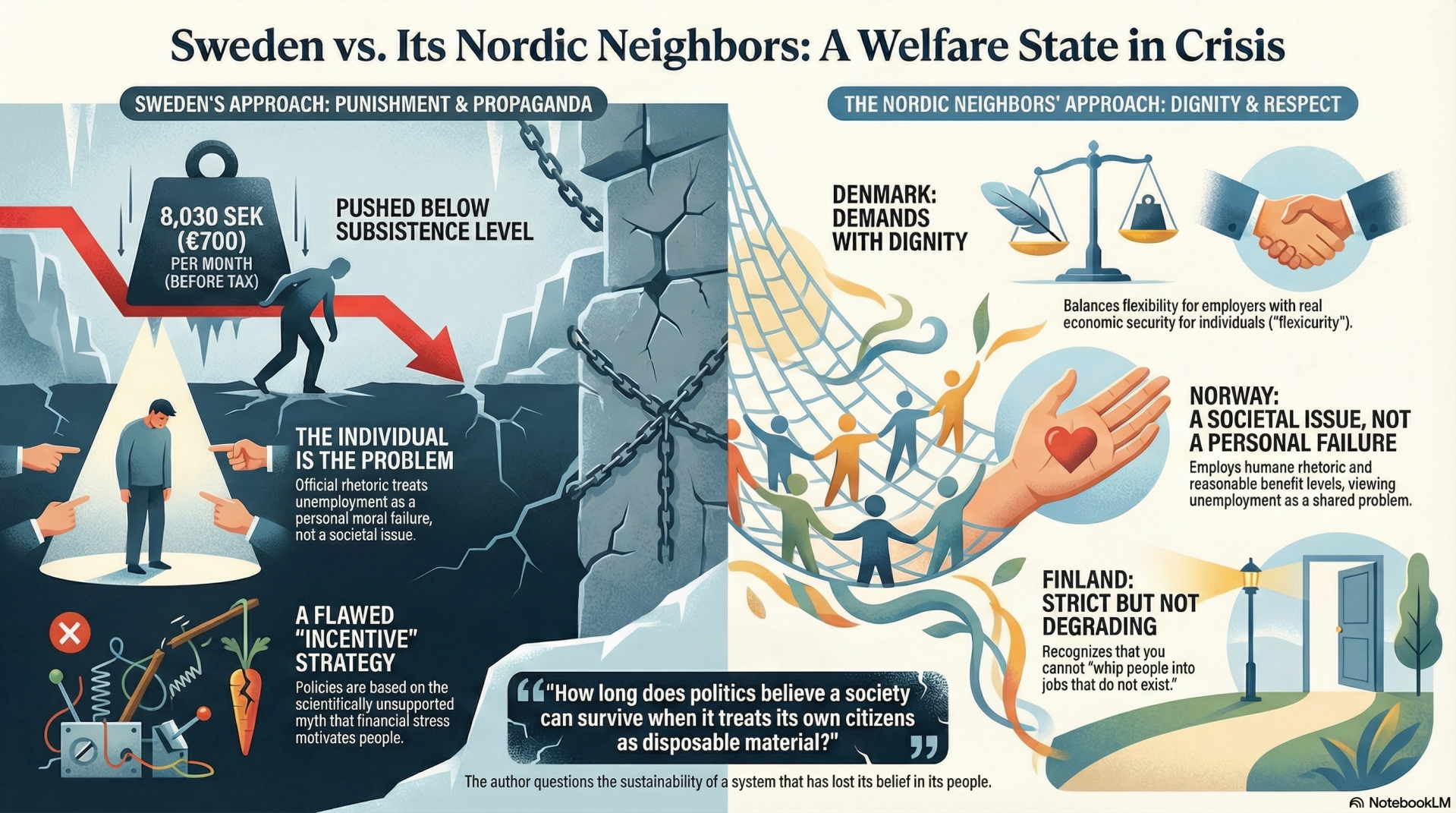
push people down to 8,030 SEK per month before tax
This is not economic policy.
It is punishment.
And this is where Sweden begins to stand out — not as a role model, but as a warning.
Denmark: Demands — but Also Dignity
In Denmark, high demands are placed on the unemployed. There is no doubt about that.
But the difference is crucial:
The Danish model does not punish people economically down to below subsistence level.
-
Unemployment benefits are set at a level people can actually live on
-
Transition and retraining systems are real
-
Labour market policy is built on flexicurity: flexibility for employers — security for individuals
Danish politicians do not say the unemployed are passive.
They say the labour market must function.
In Sweden, we say the opposite:
“The individual is the problem.”
Norway: Oil Money — but Also Respect
Norway has resources, yes.
But that does not explain everything.
Norway has chosen to view unemployment as:
-
a societal problem
-
not a moral failure
Benefit levels are higher. Time limits are strict — but reasonable.
And above all:
The rhetoric is humane.
No Norwegian minister would say on national media that it is “unreasonable to live on benefits” — while knowing that people are applying for hundreds of jobs without a single response.
In Sweden, it is said — without anyone even blushing.
Finland: Crisis-Hardened — but Not Cynical
Finland has experienced:
-
financial crises
-
unemployment
-
structural problems
Yet it has never gone as far as Sweden’s cold, moralistic harshness.
Finnish labour market policy is strict — but not degrading.
They have understood something Sweden has forgotten:
You cannot whip people into jobs that do not exist.
Sweden: Where Security Has Become a Dirty Word
Sweden has gone furthest in the Nordic region in:
-
moralising unemployment
-
casting suspicion on security
-
calling compensation “passivisation”
Labour Market Minister Johan Britz says that people previously could “live without supporting themselves.”
This is a remarkable statement in a country where:
-
unemployment insurance is contribution-based
-
people have paid into the system for decades
-
benefits had already been severely eroded
This is not analysis.
It is propaganda.
The Myth of Motivation — and the Lie of Incentives
The entire reform is built on one assumption:
If people receive less money, they will try harder.
That assumption has no scientific support.
Research shows repeatedly that:
-
financial stress impairs decision-making
-
mental ill-health increases
-
the ability to transition back to work decreases
Johan Britz himself states that long-term unemployment is linked to suicide.
Yet he chooses a reform that deliberately increases stress.
This is not ignorance.
It is ideological indifference to human consequences.
Older Workers: From Asset to Burden — Overnight
Especially revealing is the view of older unemployed people.
People over 60:
-
are denied jobs
-
are systematically discriminated against
-
are expected to take on new debt via student loans
-
to possibly work a few more years
In Denmark and Finland, there are specific transition solutions for older workers.
In Sweden, there is one message:
“Take anything — or starve.”
When the State Abdicates — and Municipalities Are Left to Clean Up
When unemployment benefits run out.
When activity support bottoms out.
When the individual breaks.
The state says:
The municipalities have the ultimate responsibility.
This is not accountability.
It is cowardice.
People are moved from one system to another — without solving anything.
At the same time, billions continue to be poured into:
-
failed IT projects
-
consultancy procurements
-
political prestige projects
No minister survives on 8,030 SEK per month.
The Real System Failure — That No One Wants to Admit
The system failure is not unemployment.
The system failure is:
-
a closed labour market
-
experience being treated as a liability
-
politics refusing to take responsibility
-
Sweden breaking the Nordic social contract
Our neighbours look at Sweden and ask:
“What happened to you?”
A Country That Has Stopped Believing in Its People
When politicians begin to speak of citizens as something to be corrected rather than supported, the social contract is broken.
Sweden was once the country that:
-
invested in people
-
saw security as strength
-
built trust
Now we are the country that:
-
pushes people down until they break
-
calls it responsibility
-
and wonders why trust is collapsing
This is no longer something that merely “grates.”
These are open wounds.
And the real question is not whether it is reasonable to live on benefits.
The real question is:
How long does politics believe a society can survive when it treats its own citizens as disposable material?

By Chris...
It Is Time to Do What You Have Never Done Before
Sweden was not built on silence.
It was built by people who once said no.
No to child labor.
No to starvation wages.
No to worn-out bodies being discarded when they were no longer profitable.
The Swedish welfare state was not born in a conference room.
It was born in public squares, in strikes, in loud disagreement.
And now—while it is being dismantled piece by piece—we remain silent.
It is time to do what you have never done before.
Take to the squares. Protest.
Not for a political party.
Not for left or right.
But for yourselves.
For those without work.
For those who soon will be.
For those who have worked for forty years and are suddenly treated as a problem.
This is not about benefits.
This is about dignity.
“But Swedes Don’t Protest”
No.
And that is exactly why this is happening.
In Denmark, people take to the streets when security is threatened.
In Finland, unions and civil society mobilize before systems collapse.
In Norway, politicians know there is a line—and that crossing it has consequences.
In Sweden, those in power have grown used to something dangerous:
a population that clenches its fists in its pockets and pays anyway.
They count on your silence.
They budget for your resignation.
This Is Not Radical — It Is Necessary
Protesting is not extreme.
It is democratic.
What is extreme is:
-
pushing people below subsistence levels
-
acknowledging suicide risks while tightening the system
-
demanding “responsibility” without taking any themselves
When politics stops listening, it must be made to hear.
Do Not Wait for Permission
No one will give you the green light.
No minister will say, “Now it’s okay to be angry.”
That is why public squares exist.
Squares are where:
-
power cannot scroll past
-
decision-makers cannot hide behind press releases
-
people meet each other eye to eye
That is where societies wake up.
This Is the Moment
When people are forced to survive on €8,030 a year? (Note: originally SEK/month; adjust if needed)
When older unemployed people are pushed into debt to “create incentives”?
When security has become a dirty word?
If not now — when?
If not for this — what will it take for you to stand up?
Take to the Squares. Raise Your Voice. Be Seen.
Not in comment sections.
Not at the kitchen table.
Not in silent bitterness.
But openly. Clearly. Together.
Sweden changed once because people refused to accept injustice as “necessary.”
It is time again.
Because no society dies from protest.
But many die from silence.
Take to the squares. Protest.
Add comment
Comments