

It doesn’t begin in a studio.
It begins with irritation.
Late 1960s.
The Rolling Stones are one of the biggest bands in the world — and still trapped. Trapped by booking schedules. Trapped by sterile studios. Trapped by clocks ticking money instead of creativity. Mick Jagger wants to write at home. Keith Richards wants to play when the feeling strikes. Charlie Watts wants calm and concentration.
But the industry doesn’t work that way.
So Ian Stewart — the band’s invisible backbone, road manager, pianist, and organizer — asks a question that sounds almost naive:
Why does the studio have to stay still?
That question would change how rock music was recorded forever.

A Studio on Wheels
In 1968, a truck rolls onto the British roads.
On the outside, it looks unremarkable.
On the inside, it is revolutionary.
The Rolling Stones Mobile Studio is born.
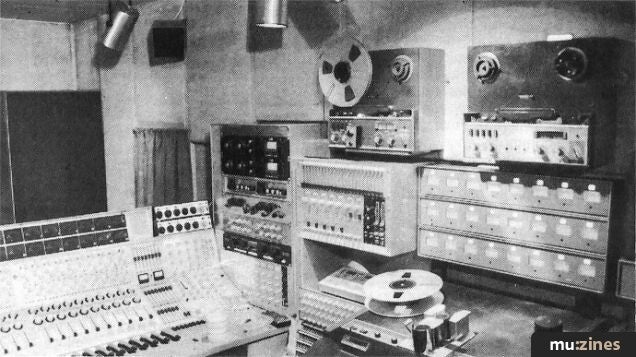
Built into a DAF truck and equipped with a Helios mixing console, tape machines, and everything needed for professional recording — but with one decisive difference: the studio goes where the music is.
To a country estate.
To a castle.
To a barn.
To a casino.
To a concert stage.
Suddenly, it’s no longer the musicians adapting to the studio — the studio adapts to the musicians.
It sounds obvious today.
Back then, it was a direct challenge to the system.
Stargroves – Where Freedom Begins
The Rolling Stones use the studio first themselves.
Mick Jagger’s country estate, Stargroves, becomes the testing ground.
Cables are pulled through windows.
Microphones are placed in rooms never meant for music.
The control room sits parked outside the house.
The results can be heard on Sticky Fingers.
These aren’t just songs.
They have space. Air. Dirt. Presence.
The studio doesn’t just capture sound — it captures place.
Word spreads fast.
Led Zeppelin and the House That Sang
Led Zeppelin hear what the Stones have done.
Jimmy Page understands immediately.
The band rents a remote building in Wales: Headley Grange.
An old workhouse. Stone walls. Echoes. Stairwells. Rooms that sing.
The Mobile Studio parks outside.
John Bonham records drums in a stairwell.
Microphones capture the building as much as the удар.
No acoustic treatment.
No studio walls.
The result becomes Led Zeppelin IV.
When “When the Levee Breaks” thunders from the speakers, it’s not just Bonham you hear — it’s the entire house.
This could never have happened in a traditional studio.
Montreux – When Fire Became Music
December 1971.
Deep Purple arrive in Montreux, Switzerland, to record their new album.
The Rolling Stones Mobile Studio is parked at the Montreux Casino.
Frank Zappa is playing a concert.
A member of the audience fires a flare.
The casino catches fire.
Flames spread.
Smoke hangs thick over Lake Geneva.
The Mobile Studio is evacuated at the last moment.
Deep Purple watch their recording location burn to the ground.
And someone says:
“Smoke on the water…”
The Mobile Studio survives the fire.
Deep Purple record Machine Head in a nearby hotel — still using the Stones’ studio.
The song becomes immortal.
The studio becomes part of rock mythology.
The Who – Precision in Motion
The Who use the Mobile Studio for Who’s Next.
Pete Townshend’s demos collide with the band’s raw power.
Synths, loops, drums.
Everything recorded without losing edge or energy.
Here, the Mobile Studio shows its second face:
It isn’t just chaotic and free.
It is precise.
The Helios console delivers a sound still chased by producers today — warm, aggressive, present.
Exile on Main St. – A Masterpiece of Chaos
In 1971, the Rolling Stones flee Britain for tax reasons.
They end up in the south of France.
In a villa called Nellcôte.
The basement becomes the studio.
The heat is oppressive.
Electrical wiring is improvised.
Musicians come and go at all hours.
The Mobile Studio waits outside.
Exile on Main St. is recorded in organized chaos.
Blues, soul, rock’n’roll — all at once.
The sound is dark, murky, alive.
It sounds like a place.
Because it is a place.
More Voices, More Worlds
Throughout the 1970s and 80s, the Rolling Stones Mobile Studio becomes a tool for the entire rock world.
Fleetwood Mac record parts of Penguin and Mystery to Me.
Bad Company make Run with the Pack.
Bob Marley & The Wailers record live performances.
Dire Straits capture concerts.
Iron Maiden record Live After Death.
What they all share:
Music that breathes.
Not polished.
Not sterile.
But human.
When the World Changes
By the 1980s, recording technology shifts.
Digital studios emerge.
Budgets return to fixed rooms.
The Mobile Studio begins to feel old-fashioned.
But it is far too important to scrap.
In 1985, it is sold.
Used by new bands.
New genres.
Punk, alternative rock, underground.
Eventually, it ends up in Canada.
Restored.
Preserved.
Today, the Rolling Stones Mobile Studio stands at the National Music Centre in Calgary — fully operational. A living time capsule.
More Than Technology
The Rolling Stones Mobile Studio was never just a truck filled with equipment.
It was a statement.
A rejection of time cards.
A rejection of perfection.
An embrace of place, feel, and presence.
It taught a generation of musicians that:
-
the room is an instrument
-
limitations fuel creativity
-
control is not always the answer
And perhaps most importantly:
Music does not have to be confined.
The Legacy Today
Every time a band records in a house.
Every time someone drags recording gear into a barn, a garage, a mountain.
Every time feeling is chosen over perfection.
You hear the echo of the Rolling Stones Mobile Studio.
It didn’t just roll across roads.
It rolled across boundaries.
And it left tracks still audible today —
on vinyl, in digital files, in stories that refuse to fade.

By Chris...
Rolling Stones' Mobile Recording Truck | Inside Tour
A Calgary museum has acquired a mobile recording studio built for The Rolling Stones and used by rock titans ranging from The Who to Bob Marley.
https://www.studiobell.ca/rolling-stones-mobile-studio
https://en.wikipedia.org/wiki/Rolling_Stones_Mobile_Studio

Add comment
Comments