

When leaders, NATO, and religion speak over the heads of the people –
and Europe begins to push back!
No ordinary person in the EU asked for war.
No one in Ukraine asked for their cities to become front lines.
No one in Palestine asked to live with sirens, ruins, and permanent fear.
No one asked for everyday life to be turned into a survival project.
This is a brutal, simple truth — and at the same time the most avoided one in our political age.
Yet we continue to live in a reality where war is normalized, protests are demonized, and suffering is reduced to statistics. Where politicians speak of “necessary sacrifices,” military alliances of “security,” and religious power structures of “righteous struggle.”
But it is never their children sleeping in shelters.
Never their homes being destroyed.
Never their lives put on hold.
It is the lives of ordinary people — decided by others.

War Is Never the People’s Project
War does not begin at the kitchen table.
It is not born in preschools, clinics, workshops, or offices. Ordinary people want the same things everywhere: safety, meaning, work, stability, and a future they can plan for.
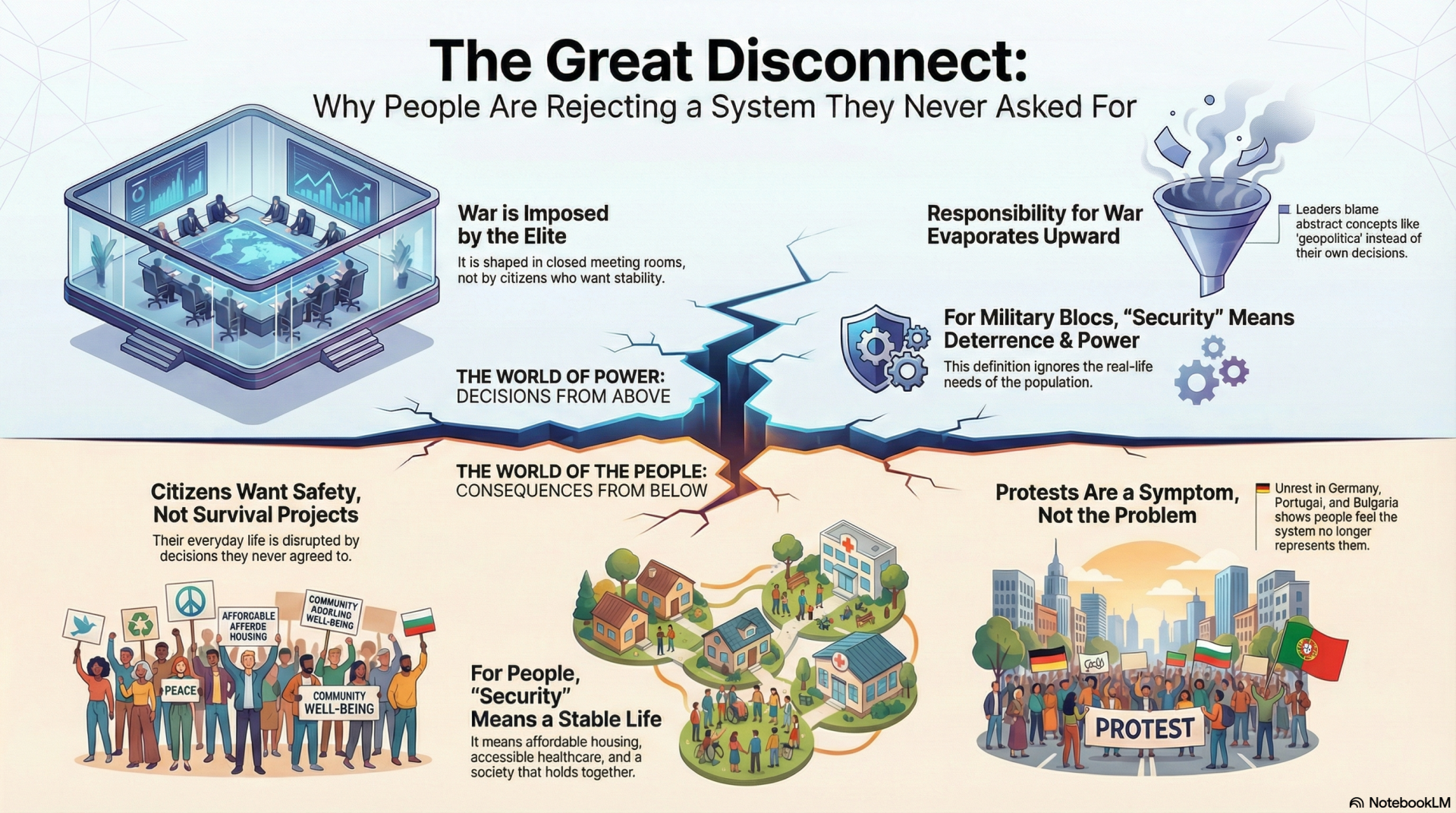
War is not created from below. It is imposed from above.
It is shaped in:
-
closed meeting rooms
-
strategies written by people who never carry the consequences themselves
-
doctrines where “risk” means numbers, not lives
And when power needs legitimacy, it speaks of “the will of the people,” “national security,” or “our values.”
But the people were never asked.
Leadership’s Convenient Absence of Responsibility
When politics fails economically, socially, or structurally, responsibility is quickly assigned downward: the individual, the unemployed, the “unproductive,” the citizen who “should have tried harder.”
But when war breaks out, responsibility evaporates.
Suddenly it is:
-
history
-
geopolitics
-
“the security situation”
-
“there was no alternative”
This is one of the great lies of our time.
Leaders always have choices.
They can choose diplomacy over escalation.
They can choose dialogue over sanction spirals that punish civilian populations.
They can choose long-term stability over short-term power positioning.
When they do not, it is not fate. It is a decision.
NATO Is Not the Voice of the People
This must be stated plainly:
NATO is not the voice of the people.
NATO is a military power bloc — a top-down system where decisions are made by governments, general staffs, and security apparatuses, far removed from everyday citizens. Ordinary people in NATO countries have never meaningfully voted on:
-
proxy wars and strategic escalation
-
troop deployments and military doctrines
-
what is actually considered “necessary” in military logic
Parliaments are often informed after the fact. Citizens are expected to accept the consequences.
The fundamental gap lies in the meaning of the word security.
For people, security means:
-
being able to afford housing
-
electricity without panic
-
healthcare when needed
-
a society that holds together
For military blocs, security means:
-
deterrence
-
capacity
-
strategic zones
-
balance of power
Two languages. Two realities. And when they no longer meet, the result is always the same: people pay the price without having had a mandate.
Religion as Fuel for Absolutism
Faith itself is not the problem. Power is.
When politics fails, when compromise becomes difficult, when arguments run out, the sacred is invoked. Conflicts cease to be political and become “moral,” no longer negotiable but eternal.
When something is done “in God’s name,” dialogue often ends.
If the opponent is no longer seen as human but as wrong, impure, or evil, there is no space left for nuance.
Religion, when hijacked by power, makes conflicts:
-
sacred
-
inevitable
-
impossible to compromise
And when compromise becomes impossible, only violence or submission remains. This is the exact mechanism that has driven humanity into catastrophe time and again.
Protests Are Not the Problem — They Are the Symptom
No one protests because it is fun. Protest is almost always the last resort. It costs safety, livelihoods, and sometimes lives.
Protests arise when:
-
systems stop listening
-
elections feel hollow
-
decisions are already made
-
life becomes too narrow
And now we see it clearly: people across countries are beginning, slowly but unmistakably, to react.
Bulgaria, Portugal, Germany — Different Countries, the Same Feeling
Bulgaria: When Protest Becomes Normal
In Bulgaria, protest has become a recurring condition. Not because people enjoy conflict, but because many feel the system is captured by elites and networks that survive every government.
Governments fall, but perceived power remains.
When people vote repeatedly without seeing real change, democracy begins to resemble a ritual rather than a tool.
And when the ritual fails, the street remains.
Portugal: When the Middle Class Starts to Crack
Portugal’s reaction is often quieter — but equally dangerous for the system.
Here, pressure comes from people who normally sustain stability.
Housing is unattainable. Wages lag behind costs. Young adults see their futures shrinking.
When the middle class stops believing that “things will work out,” the foundation begins to shake.
Germany: When Stability Erodes
Germany is the signal many do not want to read.
A country built on order, institutional trust, and social contracts is showing cracks. Protests there are not primarily about extremism — they are about lost direction.
When even Europe’s most system-loyal population begins to question legitimacy, it is not the people who have radicalized. It is the system that has lost its anchor.
The Common Denominator: A Crisis of Legitimacy
The differences are real, but the pattern is shared:
“This is no longer built for us.”
People experience:
-
decisions made far away
-
responsibility never moving upward
-
crises used as excuses for permanent decline
-
a political language that no longer connects to daily life
This cannot be solved with better messaging. This is not a PR problem. It is a legitimacy crisis.
The Most Dangerous Reduction: People as “Collectives”
To justify decisions, power speaks of people as blocks and masses: “the public,” “the voters,” “the population.”
But people do not live as collectives. They live as individuals.
The person who cannot afford to heat their home is not an “inflation effect.”
The person who lost a family member in war is not a “security consequence.”
The person protesting is not a “threat.”
They are saying:
I want to live. I want a future. I want to be represented.
This Is No Longer Acceptable
This is not 1968.
Not 1989.
Not an ideological uprising.
What is emerging now is far more dangerous to power:
ordinary people who no longer believe the story.
When words like “necessary,” “responsible,” and “for the greater good” ring hollow.
When people are told endlessly to endure — while systems never answer upward.
That is when something shifts. Slowly. Heavily. Irreversibly.
A Breaking Point — and Two Paths Forward
If politics continues to:
-
make decisive choices without mandate
-
hide behind NATO and “security” to silence criticism
-
allow religious absolutism to lock conflicts in place
-
place the burden on people while responsibility floats nowhere
then reactions will not fade. They will deepen.
But another path exists.
To reconnect politics with real lives.
To reduce the distance between decisions and consequences.
To demand accountability upward — not moral sermons downward.
Because the most uncomfortable conclusion is also the clearest:
It is not the people who have become restless.
It is power that has become disconnected.
And now — in Bulgaria, Portugal, Germany, and beyond — people are beginning to say so.
Not because they want chaos.
But because this is no longer acceptable.

By Chris...
Add comment
Comments