

Europe’s green industrial strategy is approaching a dangerous inflection point. What began as a necessary response to climate change is increasingly morphing into a high-stakes experiment in state-led risk-taking — one where governments assume exposure levels that private capital deliberately avoids.
Projects such as Stegra (formerly H2 Green Steel) and Northvolt have come to symbolise this approach. They are frequently described as indispensable to Europe’s climate ambitions and industrial sovereignty. Yet beneath the rhetoric lies an uncomfortable reality: public institutions are underwriting technological, market and execution risks that remain largely unproven at scale.
This is not merely a question of individual corporate failures. It is about the structure of incentives now embedded in green industrial policy.
When Policy Ambition Substitutes for Market Validation
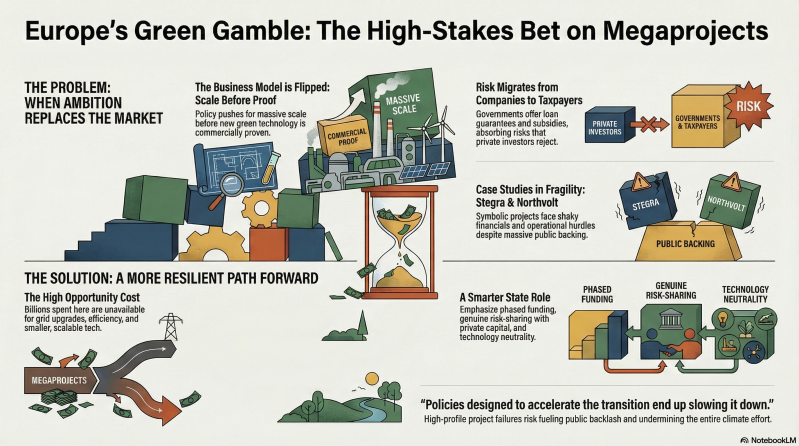
In functioning market systems, scale follows proof. Technologies demonstrate commercial viability before attracting capital-intensive expansion. In Europe’s green megaprojects, that sequence has often been reversed.
Governments have stepped in early with:
-
loan guarantees,
-
direct subsidies,
-
preferential energy pricing,
-
publicly funded infrastructure,
-
and political backing that implicitly signals “too strategic to fail”.
This support is often justified by urgency — climate timelines do not permit gradualism. But urgency is not a substitute for validation. When scale precedes proof, policy ambition begins to replace market discipline, and risk migrates silently from balance sheets to taxpayers.
Private investors recognise this asymmetry. Their participation is frequently conditional, layered, or time-limited. The state, by contrast, has no natural exit.
Stegra and the Fragility of Grand Narratives
Stegra’s promise — fossil-free steel at industrial scale — fits perfectly with Europe’s decarbonisation narrative. Steel is hard to abate, politically salient, and symbolically central to industrial identity.
Yet the economic fundamentals remain precarious:
-
production costs hinge on sustained access to low-cost electricity,
-
hydrogen-based steelmaking remains capital-intensive and operationally complex,
-
margins depend on customers paying a “green premium” in globally competitive markets.
Recent reports that Stegra’s multi-billion financing plan has faltered should not be read as a surprise. They are a reminder that narratives do not generate cash flow.
When projects of this scale wobble, the risk is no longer corporate. It becomes systemic — financial, political and reputational.
Northvolt and the Limits of Strategic Optimism
Northvolt was framed as Europe’s answer to Asian battery dominance. Strategic autonomy, job creation and climate alignment made it politically irresistible.
Yet persistent operational challenges, escalating capital requirements and delayed milestones have highlighted a familiar problem: industrial learning curves cannot be legislated into existence.
Continued public backing, even as execution risks mount, reflects a deeper issue. Once a project becomes symbolic, withdrawing support becomes politically costly — regardless of economic logic. At that point, sunk-cost bias replaces evaluation.
Climate Policy Cannot Ignore Opportunity Cost
Perhaps the least discussed dimension of this strategy is opportunity cost.
Every billion committed to a high-risk flagship project is capital unavailable for:
-
grid reinforcement and resilience,
-
energy efficiency in existing industries,
-
modular and scalable technologies,
-
small and medium-sized enterprises with faster deployment cycles,
-
workforce skills and applied research.
Climate transition is not only about scale; it is about capital efficiency. Megaprojects absorb attention, talent and funding while delivering uncertain returns — both financial and environmental.
A Political Economy of Herd Behaviour
Europe’s green megaproject boom is also driven by institutional psychology. Regional governments compete for prestige investments. National leaders seek legacy projects. Public agencies are incentivised to support “transformational” initiatives rather than incremental ones.
In such environments, dissent is costly. Skepticism is framed as obstruction. Risk assessment is softened by moral framing.
The result is a classic herd dynamic — amplified by climate urgency and geopolitical anxiety.
Rethinking the State’s Role
This is not an argument against public involvement in climate transition. The scale of the challenge demands it.
But the state is a poor substitute for market selection.
A more resilient approach would emphasise:
-
phased funding tied to verifiable milestones,
-
genuine risk-sharing with private capital,
-
technology neutrality where possible,
-
explicit exit conditions for public support,
-
and transparency around failure as well as success.
Green industrial policy should create conditions for innovation — not attempt to predetermine winners.
The Risk of Undermining the Transition Itself
If Europe’s green megaprojects fail at scale, the consequences will extend far beyond balance sheets. Public trust in climate policy is fragile. High-profile collapses risk fuelling political backlash and scepticism toward decarbonisation as a whole.
That would be the ultimate paradox: policies designed to accelerate the transition end up slowing it down.
Climate ambition is necessary.
Industrial realism is essential.
Without the latter, the former risks becoming fiscally reckless — and politically unsustainable.

By Chris...
Add comment
Comments