


There are moments in a country’s political life that leave a mark. Not because they are ceremonial, but because they reveal something fundamental: how power truly views the people. Bulgaria is living through such a moment right now.
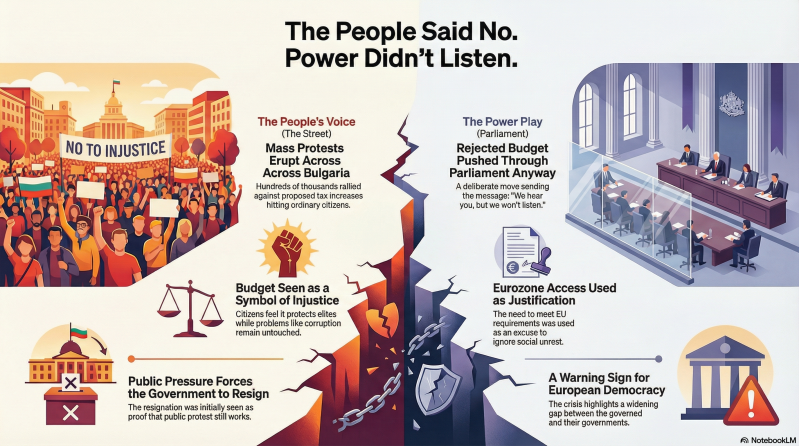
Hundreds of thousands of people have taken to the streets. In Sofia, Plovdiv, Varna, and smaller towns across the country. The protests have been massive, persistent, and unmistakably clear. The message was simple: no to the 2026 budget proposal, no to tax increases that hit ordinary citizens, no to a system perceived as protecting elites while ordinary people are asked to shoulder the burden.
The pressure became so strong that the government resigned.
And yet—just days later—the same political forces attempted to push through the very same 2026 budget in parliament.
Not by mistake.
Not because of a misunderstanding.
But as a deliberate political move.
This is where something breaks.
A Democratic Moment – and a Democratic Breakdown
In theory, democracy works like this: the people express their will, politicians listen, adjust course, and rebuild trust. Protests are not a threat to democracy—they are democracy in its rawest form.
But when a government falls due to public opposition and the same budget proposal is brought back anyway, a very different message is sent:
“We hear you—but we are not going to listen.”
That is a dangerous moment. Not just for Bulgaria, but for the broader European idea of representative democracy.
According to Novinite, the ruling coalition attempted once again to place the controversial 2026 budget on the parliamentary agenda despite the government’s resignation. The opposition reacted immediately, calling for new protests and denouncing the move as an open insult to the will of the people.
What Is the Budget Really About?
Formally, the 2026 budget is about fiscal discipline, taxes, and EU alignment ahead of Bulgaria’s planned entry into the eurozone. But in reality, the protests are about something far deeper.
For many Bulgarians, this budget represents:
-
yet another situation where ordinary people are told to “take responsibility”
-
while structural problems, corruption, and inefficiency remain untouched
-
where money is quickly found for security structures and political priorities, but slowly—or never—for healthcare, education, and social safety nets
This is why the budget is not seen as technical. It is symbolic.
The Government Resigned – but the System Remains
Prime Minister Rosen Zhelyazkov’s resignation was initially seen as a victory. Proof that public pressure can still work. But the attempt to push the budget through anyway exposed an uncomfortable truth:
Governments may resign—but the logic of power often stays exactly the same.
This is a pattern many Bulgarians recognize all too well since the 1990s. Governments fall, new ones appear, but decisions continue in the same direction. For many young people—especially Gen Z, who have been unusually active in these protests—this fuels deep cynicism: Why vote? Why engage? Decisions seem to be made above our heads anyway.
It is no coincidence that Bulgaria has held seven parliamentary elections in four years. This is not political vitality—it is a crisis of legitimacy.
Parliament Versus the Street
When the budget was brought back onto the parliamentary agenda, it created a visible clash between two worlds:
-
The street, where people express fear, frustration, and anger about their future
-
Parliament, where procedures, technicalities, and shifting majorities are used to continue as if nothing happened
When these two worlds drift apart, a dangerous vacuum appears. This is where populism thrives. This is where conspiracy theories take hold. And this is where democracy slowly loses its soul.
That is why the opposition called for renewed protests almost immediately—not primarily against the budget itself, but against the process and the arrogance of attempting to override such a clear public rejection.
The Eurozone as an Excuse
One recurring argument from those in power is that Bulgaria “must” pass the budget in order to meet eurozone requirements for 2026. Fiscal stability matters—no one disputes that. But when eurozone accession becomes an excuse to ignore social unrest, it turns into a political weapon rather than a shared national goal.
Many Bulgarians recognize this pattern from previous EU-related reforms:
-
changes that look good on paper
-
implemented without public consent
-
with the costs pushed downward onto those least able to absorb them
It is not the euro itself that people are rejecting—but how it is being used.
“What Happens in Bulgaria, Stays in Bulgaria”
There is a saying often used half-jokingly, half-seriously:
“What happens in Bulgaria, stays in Bulgaria.”
But that is no longer true.
At a time when Europe is struggling with democratic fatigue, declining voter turnout, and growing distrust in institutions, Bulgaria is not an outlier—it is a warning sign.
When a government resigns after mass protests and the same policies are pursued anyway, this is not merely a domestic issue. It is a symptom of a wider European problem: the widening gap between those who govern and those who are governed.
What Happens Next?
After today’s events, the budget vote was temporarily withdrawn. Instead, parliament discussed extending the 2025 budget until a new political solution is reached. This creates breathing space—but not resolution.
The question is no longer simply which budget Bulgaria will have in 2026. The real questions are:
-
Who the budget is for
-
Who pays the price
-
And whether public opposition still carries real political weight
If political power continues to treat protests as a nuisance rather than a message, the next wave of public anger may be stronger—and less peaceful.
A Crossroads for Bulgaria – and for Europe
Bulgaria now stands at a crossroads. Either:
-
this moment becomes an opportunity for genuine reflection
-
for renewed dialogue between institutions and citizens
-
for an acknowledgment that legitimacy cannot be retroactively imposed
Or the country continues down the familiar path: technocratic decisions, political exhaustion, and a growing distance between parliament and the people.
The second path is easier.
The first is necessary.
And perhaps that is precisely why it is so difficult.

By Chris...
Political clash erupted in Bulgaria’s parliament during budget debates!
A heated parliamentary debate over the budget escalated into physical violence amid sharp accusations between governing and opposition parties.
Add comment
Comments