

A global reflection on power, language — and why Scientology suddenly feels like an uncomfortably accurate analogy
There is a feeling that can no longer be pinned to a specific place. It surfaces in Europe, North America, Latin America, and Asia alike. It appears in conversations between people who otherwise share neither ideology nor background. A quiet but persistent realization:
The systems that govern us have begun to live lives of their own.
This is not primarily about what decisions are made, but how. Not about left or right, but about mentality. And somewhere in this global unease, an unexpected comparison emerges — one that initially sounds provocative, yet proves disturbingly precise when examined more closely:
Scientology.
Not as an insult. Not as satire.
But as structure.

Why Scientology?
Scientology is not interesting because of what it believes, but because of how it operates — how language, hierarchy, loyalty, and criticism are handled; how the system protects itself by defining reality on its own terms.
And this is where the parallel appears.
In large global institutions — where European Union in Brussels often becomes the symbol, though it is far from alone — we see the same foundational patterns:
-
a closed internal language
-
a moral self-image
-
an inner circle with interpretive authority
-
and a growing inability to absorb criticism without pathologizing it
This is not a conspiracy. It is classic organizational psychology.
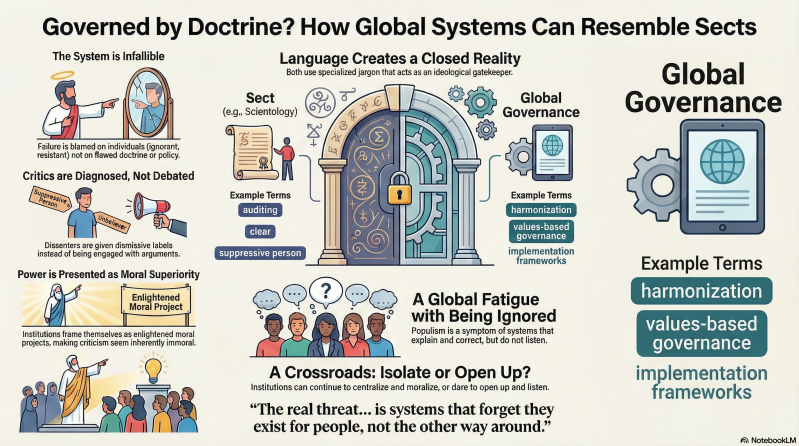
Language that creates reality
Scientology has its own vocabulary:
-
auditing
-
clear
-
suppressive person
-
the bridge
The words sound technical, almost clinical. They signal rationality and structure. But they serve a crucial function: they can only be fully understood from inside the system.
The same is true in global governance environments:
-
harmonization
-
values-based governance
-
implementation frameworks
-
the “right direction”
-
“necessary measures”
This language is not neutral. It acts as a gatekeeper. Accept the words, and you accept the worldview. Question the language, and you are no longer challenging a decision — you are challenging the legitimacy of the system itself.
And then you quickly become the problem.
The system cannot be wrong — only people can
In Scientology, doctrine never fails. If something goes wrong, the fault lies with the individual:
-
you didn’t understand
-
you weren’t ready
-
you carry internal blockages
The same logic increasingly shapes global decision-making structures.
When reforms fail, when societies react negatively, when citizens protest or vote “incorrectly,” the conclusion is rarely:
“We might have been wrong.”
Instead, we hear:
-
resistance to change
-
fear
-
ignorance
-
misinformation
The system is always on the right side of history. Reality is what lags behind.
This is one of the clearest sect-like traits: infallibility.
Moral superiority
Scientology does not see itself as one belief among many, but as a higher level of awareness — a place where one “understands more.”
Likewise, many global institutions have begun to present themselves not merely as administrative bodies, but as moral projects. They represent the enlightened, the rational, the necessary.
The problem arises when this self-image makes criticism impossible.
How do you criticize something that claims to embody the good?
How do you dissent without being framed as immoral?
When power speaks in the language of morality, democratic friction disappears. Dialogue is replaced by preaching.
Inner circles and sealed knowledge
Scientology is strictly hierarchical. The higher you rise, the more you are assumed to “see.” Transparency is not a right — it is something you earn.
Global governance structures increasingly mirror this:
-
expert panels
-
working groups
-
closed-door meetings
-
technocratic processes
Ordinary citizens are assumed to lack:
-
the full picture
-
the competence
-
the maturity
Therefore decisions are made above their heads — for their own good.
This is not malice. It is paternalism. And paternalism is always a sign of power that has lost downward contact.
Critics become diagnoses
Scientology uses the term Suppressive Person — a label that renders criticism irrelevant by defining the critic as harmful.
Modern global discourse uses different words, but the function is the same:
-
populist
-
extremist
-
conspiracy theorist
-
threat to the system
When criticism is met with labels instead of arguments, dialogue has already ended. It is no longer a debate — it is a character assessment.
And systems that behave this way become self-sealing.
Responsibility dissolves into structure
In both sects and large bureaucracies, responsibility is hard to locate.
Decisions are collective.
Processes belong to no one.
Consequences are dispersed.
When something goes wrong, there is always a ready-made phrase:
-
it was complex
-
it reflected the knowledge available at the time
-
it was a collective assessment
But for those who live with the outcome — unemployment, insecurity, eroded trust — such formulations are meaningless. What remains is powerlessness.
Global fatigue
This has produced a global fatigue. Not with democracy. Not with cooperation. But with being governed by systems that do not listen.
People are tired of being:
-
explained to
-
corrected
-
ignored
And when the relationship between the governed and those who govern breaks down, the vacuum is quickly filled by forces that at least pretend to listen.
Populism is not the cause — it is the symptom.
History is full of warnings
History shows that civilizations rarely fall because they are evil, but because they become self-satisfied.
Rome did not collapse overnight.
The Soviet Union did not fall from lack of control.
They stopped listening before they fell.
When language becomes more important than reality.
When the center no longer hears the periphery.
When the system becomes sacred.
Not about tearing down — but opening up
This reflection is not an attack on international cooperation. Quite the opposite. It is a defense of it.
Cooperation that cannot correct itself will not survive. Institutions that cannot tolerate criticism lose legitimacy. Systems that begin to resemble belief structures become dangerous — not because they are evil, but because they are convinced of their own goodness.
Scientology is an extreme mirror. But mirrors are not meant to flatter. They are meant to reveal what would otherwise remain unseen.
A crossroads
We are not facing collapse. We are facing a choice.
Either global institutions continue to:
-
centralize
-
moralize
-
isolate themselves
Or they dare to:
-
open their language
-
take criticism seriously
-
step down from the podium
The real threat to Europe — and to the world — is not external forces. It is systems that forget they exist for people, not the other way around.
And when someone says, “This is starting to feel like a sect,” it is not an attack.
It is a warning signal.
The question is whether anyone is still listening.

By Chris...
Add comment
Comments