

On the euro, uncertainty, and Bulgaria at a historic crossroads
It is evening in Sofia. The air is cold, but never still. It vibrates with conversations that never quite settle. In cafés, voices drop to whispers. At bus stops, they rise again. In taxis, the same question rolls back and forth like a coin between fingers: What happens now?
At the turn of the year, Bulgaria stands before a historic shift. The lev – a constant companion through decades of crises, inflation, hope, and sheer survival – is about to be replaced by the euro. For some, it is a step toward stability and belonging. For others, it feels like someone is taking away the very last thing they learned to trust.
The memory that never really lets go
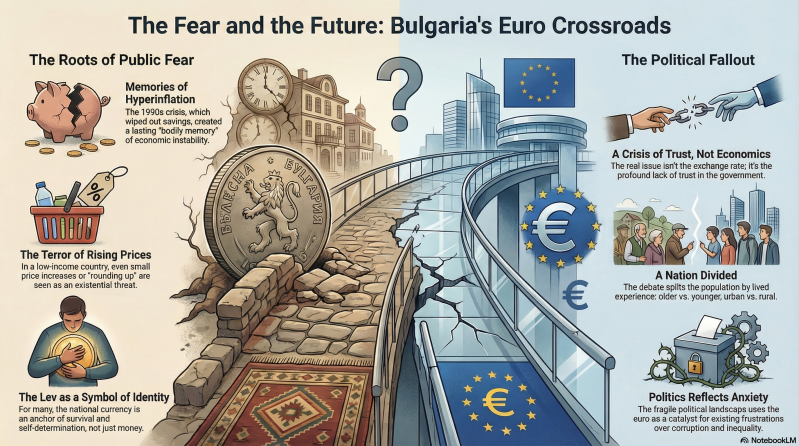
To understand the fear, you must understand memory. Not the official one, but the bodily one. The memory of the 1990s. Of hyperinflation. Of salaries that lost their value in weeks. Of savings wiped out overnight. Of parents standing in line with plastic bags and empty expressions, unsure whether the money would still be worth anything by the time they reached the counter.

In Bulgaria, economics is not theory. It lives in the spine. When people hear words like currency change, euro, transition, it does not trigger spreadsheets – it triggers survival instincts.
And it hardly helps that economists, banks, and EU institutions insist this transition is planned, controlled, safe. Fear is not about numbers. It is about experience.
Prices – the quiet terror
Walk into any grocery store. People linger longer by the shelves. They compare. They calculate in their heads. They ask the cashier.
“Will it get more expensive?”
“What does this actually cost in euros?”
It is not only the price level that worries people – it is the drift. That barely noticeable upward movement no one ever fully takes responsibility for. When 1.99 becomes 2.49. When rents are “rounded.” When wages fail to keep pace.
In countries that have already adopted the euro, officials often say: “Inflation wasn’t that big.” But for those living close to the edge, even small changes can destabilize an entire life. Bulgaria remains one of the poorest EU countries in terms of income. Many households have no buffer. For them, every increase is existential.
The lev as identity
There is also something else. Something harder to measure. The lev is not just a currency – it is proof of survival. An anchor in a history that has been anything but stable.
To replace it feels, to some, like erasing a piece of national self-determination. Not in a rhetorical sense, but an emotional one. As if saying: what you built, carried, endured – it is no longer enough.
That is why the euro debate so easily slides into questions of identity. The EU. Brussels. Control. Elites. Who decides? And for whom?
Politics as a mirror of anxiety
Bulgaria’s political landscape is already fragile. Repeated elections. Short-lived governments. Weak coalitions. Deeply eroded trust in institutions.
The euro has become a catalyst – a concentration point for all the dissatisfaction that was already there. Corruption. Inequality. The distance between those in power and ordinary citizens.
When President Rumen Radev opens the door to a referendum on the euro, it is not merely an economic position. It is an acknowledgment that trust is too thin for such a far-reaching decision to be taken without popular legitimacy.
At the same time, the government argues that Bulgaria has already committed itself, that the process is far advanced, and that stopping now would damage the country’s credibility. The result is stalemate. Polarization. Mistrust.
And once again, the word early elections begins to circulate – as if the ballot box were the only place uncertainty is allowed to breathe.
The street and everyday life
On the square, pensioners stand with handwritten signs. Not always against the euro itself, but against the fact that no one has clearly explained how their lives are supposed to work afterward. How their pensions will be recalculated. How rents will be paid. How prices will be controlled.
At the same time, there is another group – often younger, urban, internationally oriented – for whom the euro feels obvious. A step away from grey zones, cash dependence, and constant uncertainty. For them, the euro is not a threat, but a tool.
This is where the real divide lies. Not between left and right, but between lived experiences.
Europe as promise – and threat
For the EU, Bulgaria’s entry into the eurozone is a technical matter. For Bulgaria, it is existential. It is about who the country is in Europe – and on what terms.
Joining the eurozone promises more stable interest rates, easier trade, and greater investment. But it also means giving up a tool: the national currency as a shock absorber in times of crisis.
For a country still healing old wounds, it feels like stepping onto ice someone else has already tested – but you have not.
Elections that never quite decide anything
If there is yet another election, the euro will dominate the campaign. And yet the paradox remains: no election can truly resolve the issue. On paper, the decision is already made. Still, uncertainty persists, because the real question is not should we – but do we trust those telling us that we should?
That is Bulgaria’s true challenge. Not the exchange rate. Not the technical conversion. But trust.
A quiet scene, a decisive moment
It is late. An elderly man counts his banknotes at his kitchen table. He knows the numbers will change, but the value in his mind remains the same. He is not against the future. He is simply afraid of being forgotten in it.
Outside, the city moves on. Sofia has seen empires rise and fall, currencies change, systems collapse. It will still be standing after the euro arrives.
But how people feel about what is coming – that is being decided now. In conversations. In explanations. In the respect shown toward fear.
Because sometimes it is not change itself that frightens people most.
It is the feeling that no one really listened when it arrived.

By Chris...
Add comment
Comments