

I often say that what happens in Bulgaria stays in Bulgaria. It’s an expression that carries both warmth and frustration. It captures a reality many recognize: ideas are born, initiatives are launched, resources are abundant—yet the breakthrough never quite arrives. Not because quality is lacking, but because the path from potential to position is rarely mapped out.
But it’s important to state this clearly from the outset: it doesn’t have to be that way. The routes exist. They are simply longer than most expect—and they require something that cannot be improvised: time, planning, strategy, and perseverance.

A Diagnosis That Stings—Because It’s True
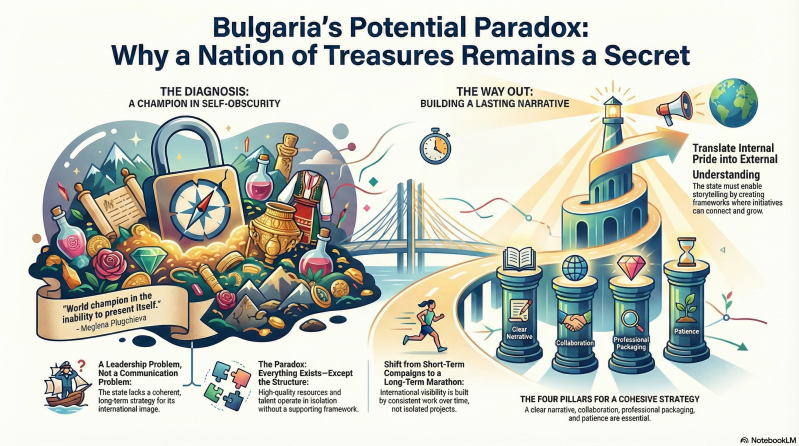
When Meglena Plugchieva, a veteran diplomat and former Deputy Prime Minister, says that Bulgaria is “world champion in the inability to present itself,” she articulates a truth long evident to anyone moving between Bulgaria and the outside world.
In the podcast Bulgaria’s Wonders, she describes a country that is a treasure chest of natural resources, biodiversity, and health tourism—yet lacks the ability to present these assets to the world with dignity. Bulgaria has primeval forests, mountains, sea, cultural heritage, and mineral-rich thermal springs of world-class quality—second only to Iceland in Europe—yet internationally the country often remains indistinct.
This is not a communications problem. It is a leadership problem.
Vienna as a Mirror—When the Truth Comes from Outside
Plugchieva’s example from a presentation of Bulgarian spa tourism in Vienna is revealing. The reaction from regional political representatives was not envy or criticism, but astonishment: “It’s insane that you are world champions in failing to present yourselves.”
Such a remark is hard to dismiss precisely because it comes from professional observers who can see the value more clearly than the country itself. The world sees the potential. Bulgaria fails to convey it.
The State as an Absent Storyteller
When Plugchieva says the state is indebted in this respect, she is not talking about money. She is talking about responsibility. About the absence of a coherent, long-term strategy for how Bulgaria should be understood internationally.
In many countries, national positioning is a professional craft where diplomacy, culture, business, and tourism move in the same direction. In Bulgaria, this has too often been reduced to short-lived projects, one-off campaigns, and fragmented initiatives. The outcome is predictable: no continuity, no recognition, no clear narrative.
The Paradox: Everything Exists—Except the Structure
Paradoxically, Bulgaria does not suffer from a lack of resources, ideas, or competence. On the contrary. There are local entrepreneurs, cultural actors, regional initiatives, and international collaborations of high quality. But they often operate in isolation, without a framework that can carry them forward.
This is where my expression becomes true: what happens in Bulgaria stays in Bulgaria. Not because people lack ambition, but because the system is not designed for long-term accumulation.
From Coincidence to Direction
Much still happens ad hoc. An event here. A presentation there. A project that starts strong but loses momentum when results don’t appear immediately. Strategy is replaced by reaction. Vision is cut short by impatience.
But international visibility is not a sprint. It is a marathon. Countries that succeed understand a simple truth: visibility is the result of consistent work over time, not isolated initiatives.
This is where frustration often arises: “We did something good—why didn’t anything happen?”
The answer is uncomfortable but simple: because good initiatives without continuity do not accumulate value.
Self-Image as a Brake
Perhaps the greatest obstacle is not external, but internal—how the country sees itself. Bulgaria carries a form of collective self-blindness: it knows what it has, but hesitates to assert its value internationally. This creates a defensive posture—waiting for recognition rather than articulating it.
A country that does not put words to its own value leaves the narrative to others.
And in that vacuum, the image is filled with stereotypes, simplifications, or silence.
When Individuals Do the State’s Work
At the same time, something interesting is happening outside official structures. Individuals—entrepreneurs, creatives, international newcomers—are beginning to tell Bulgaria’s story through their lives and projects. They present the country as it truly is: complex, beautiful, contradictory, and full of opportunity.
These stories are often more credible than official campaigns. The problem is that they are rarely gathered, amplified, or scaled. They become islands of success instead of parts of a whole.
The Way Out—Longer, But Clear
Reaching the world requires no magic. It requires structure. The paths forward run through:
-
A clear narrative—what does Bulgaria want to be known for?
-
Long-term collaboration between state, regions, and civil society
-
Professional packaging of what already exists
-
Patience to stay the course when results are slow
And perhaps most importantly: acceptance that credibility is built layer by layer.
Patience as a Competitive Advantage
In a world obsessed with speed, patience becomes a competitive advantage. Countries that work methodically build something that lasts. Bulgaria has every prerequisite to do just that—but only if it lets go of the illusion of shortcuts.
Strategy is not grand rhetoric. It is everyday, sometimes tedious work. Repetition. Adjustment. Follow-up. And the courage to continue even when applause is absent.
From Internal Pride to External Understanding
Internal pride is a strength. But it must be translated into something the outside world can understand. That requires a shift in perspective: seeing the country through others’ eyes. What is unique? What is relevant? What is comprehensible?
Here the state has a decisive role—not to control the story, but to enable it. To create frameworks where initiatives can grow and connect.
A Crossroads—Not a Verdict
Meglena Plugchieva’s words are uncomfortable precisely because they point to a long-standing failure. But they are also hopeful. The moment a problem is acknowledged, the possibility of change opens.
What happens in Bulgaria can reach the world.
But only if we stop believing it will happen by itself.
Final Words
“What happens in Bulgaria stays in Bulgaria” does not have to be an endpoint. It can be a starting point. A reminder of where the country stands—and of what it takes to move forward.
Bulgaria does not need to become something else than what it already is.
It only needs to start telling its story—consistently, long-term, and with confidence.
The roads are there.
But they require direction.
And direction requires strategy.

By Chris...
Add comment
Comments