

When a destination lacks a manual
Bulgaria says it is investing in tourism. In the visitor economy. In international guests, investments, digital nomads, conferences, sports tourism, and cultural travel. The words are there – in strategy documents, political speeches, and official presentations. The ambition is often clearly stated: the country wants to be open, welcoming, and accessible.
But reality tells a different story.
For anyone who actually tries to move through the country without local insider knowledge, a paradox quickly emerges. Bulgaria is open – yet at the same time closed. Not formally, not legally, not socially. But functionally.
It is a country you can enter, but not always navigate. A country you can arrive in, but not easily move through. A country where you are often met with warmth in personal encounters, yet left alone when it comes to systems.
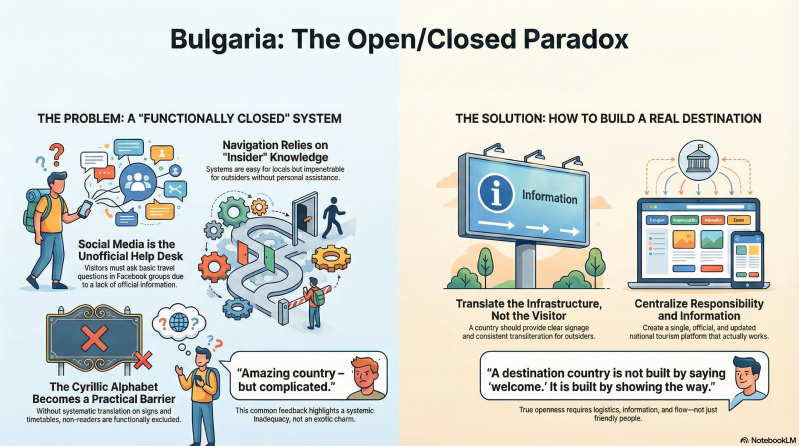
And this becomes most visible in the clearest symptom of all: the constant, repetitive questions on social media.

When Facebook becomes the country’s information desk
In international forums, Facebook groups, and comment threads, the same questions appear again and again – day after day, year after year:
How do I take the bus?
Where do I buy tickets?
Does this route exist?
Is this the right stop?
These are not niche questions. They are not special cases. They are basic questions about fundamental orientation.
When the same questions keep being asked, it means only one thing: the system does not learn. Information is not accumulated, not institutionalized. It remains trapped in temporary answers, personal explanations, and fragmented experiences.
Social media has effectively become Bulgaria’s improvised help desk for visitors – a substitute for something that should be obvious: clear, accessible, and up-to-date information on how to move through the country.
And this is where the problem becomes structural – not cultural, not personal, not linguistic. Structural.
“It’s easy” – if you already know how
Almost every local answer starts the same way:
“It’s easy, you just do this…”
It’s an honest response. But also a revealing one.
What is easy for insiders is often impenetrable for outsiders. A functioning destination country does not rely on insider knowledge. It relies on translating systems, not on visitors guessing their way through them.
Here lies the core contradiction:
Everyone inside the country knows how it works. No one outside does.
That is the definition of an open/closed country.
The alphabet as a barrier – not culturally, but practically
For many visitors, the Cyrillic alphabet is as inaccessible as Balinese. Not culturally – but practically.
When you cannot read the letters:
-
you cannot tell whether you are at the right bus stop
-
you cannot understand where the bus is going
-
you cannot interpret signs, timetables, or destinations
-
you cannot even know whether the information applies to you
There is no “partial understanding.” Either you can read it – or you cannot.
And when the alphabet cannot be decoded and no parallel guidance exists, the result is not confusion. It is exclusion.
This is not a criticism of Cyrillic as an alphabet. It is a criticism of the lack of systematic translation. Many countries use non-Latin scripts and still function perfectly as destinations.
The difference is simple:
They translate the infrastructure – not the visitor.
Bali – and why the comparison is uncomfortable
It is difficult not to draw parallels with early visits to Bali.
There, the language was completely foreign. Signs were unreadable. Transport systems were informal. But there was a crucial difference: expectations.
You knew you were far from Europe. You accepted that systems were not built for international navigation. That was part of the deal.
But Bulgaria is not Bali in the 1990s.
Bulgaria is an EU country that wants to compete with Greece, Croatia, Italy, and Portugal for the same visitors.
Yet travelers end up in the same situation:
-
you have to ask
-
you have to guess
-
you need local contacts
-
you rely on social media to move around
This is not charming. It is not exotic. It is systemic inadequacy.
Tourism is not nature – it is design
A fundamental misunderstanding often shapes discussions about tourism: the idea that beautiful places are enough.
They are not.
Tourism is not landscape. It is logistics, information, and flow. It is the art of guiding people through a country without requiring them to know the language, the codes, or the right people.
A destination country should make it possible to:
-
plan a trip without local assistance
-
use public transport without uncertainty
-
understand how regions connect
-
venture beyond the most famous spots
-
feel safe within systems, not only in personal encounters
When this fails, the same consequences always follow:
-
Tourism becomes concentrated in a few hubs
-
Smaller regions remain invisible
-
Visitors stay for shorter periods
-
Recommendations come with caveats
“Amazing country – but complicated.”
That is not a competitive advantage.
The real problem: responsibility diluted into fragments
Information about Bulgaria exists – but it is scattered, unofficial, inconsistent, and often outdated.
-
One municipality does it one way
-
Another does it differently
-
Private actors fill some gaps
-
Social media patches the rest
The result is a patchwork where no one owns the whole journey. No single entity takes responsibility for the visitor’s movement through the country.
And here lies the core criticism:
A destination country cannot be built on improvisation.
Improvisation works internally. Not externally.
When a country requires an interpreter
In practice, Bulgaria often requires an interpreter – not linguistically, but systemically.
You need someone who:
-
explains how buses “actually” work
-
tells you which signs to ignore
-
knows what information is outdated
-
understands the unwritten rules
When a country requires this kind of translation, it automatically becomes more closed than it needs to be. Not out of hostility – but out of habit.
The uncomfortable question: does Bulgaria really want to be open?
The question must be asked, even if it is uncomfortable:
Does Bulgaria truly want to be a destination country –
or does it simply want tourism revenue without assuming tourism responsibility?
Because responsibility means:
-
transparency
-
standardization
-
clear systems
-
less dependence on informal solutions
-
fewer “everyone knows how” assumptions
An insider system may feel comfortable for those inside it. But it is costly for the country.
What a real destination country actually does
This is not about slogans. It is about foundations:
-
A national tourism platform that works – operational, not cosmetic
-
Standardized information across all regions
-
Public transport that can be understood without language
-
Consistent transliteration
-
Clear signage designed for outsiders
-
Digital information that is owned, updated, and maintained
These are not luxuries. They are minimum requirements.
Final words: Bulgaria is better than its own manual
The most frustrating part of all this is that Bulgaria deserves better.
The country is rich – in nature, culture, history, and people. But it is often poor at showing the way through itself.
As long as the same questions keep circulating on social media, the message is clear: the manual is missing.
And without a manual, Bulgaria remains an open/closed country –
extraordinary for insiders, confusing for everyone else.
A real destination country is not built by saying “welcome.”
It is built by showing the way.

By Chris...
Add comment
Comments