

On the American Civil War, the birth of the rule of law, and history’s convenient blind spots
In today’s political debate, one statement is repeated more and more often: that Europe should be grateful to the United States for having saved the continent from Hitler. On the surface, this sounds reasonable. The United States undeniably played a decisive role in the defeat of Nazi Germany during the Second World War. But when history is reduced to a one-sided moral debt, a serious problem arises. Because history does not run in only one direction.
Without Europe’s support – and perhaps even more importantly, Europe’s restraint – during the American Civil War, it is entirely possible that the United States’ rule of law would never have survived. And without that rule of law, there would have been no laws, statutes, or institutions for the United States to claim it is defending today – whether in NATO, in global politics, or in its own national narrative.
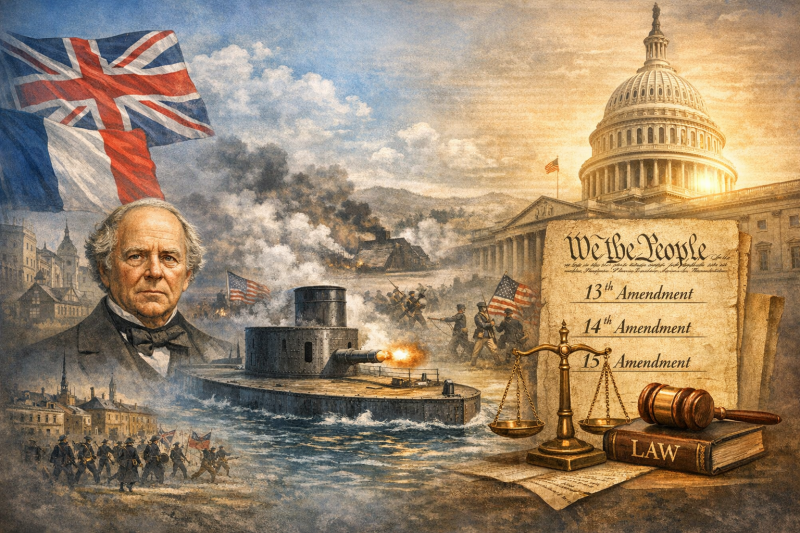
A young nation on the brink of collapse
When the American Civil War broke out, the United States was still a fragile political experiment. The Constitution existed on paper, but its real authority was far from secure. Individual states largely viewed themselves as sovereign entities. Slavery was legally protected. Federal power was weak and contested.
The Civil War was therefore not merely a conflict between North and South, or freedom versus slavery. At its core, it was a far more fundamental question:
Would the United States become a unified constitutional state – or fragment into rival nations without a shared legal order?
The answer was anything but obvious.
Europe’s role – what is rarely mentioned
Europe did not send large armies to fight on American soil. Yet Europe’s role was decisive.
France and Britain stood at a strategic crossroads. The Confederate states were economically important. Cotton was vital to European industry. Official recognition of the Confederacy was entirely possible – and would likely have changed the course of the war.
But it never happened.
That United Kingdom refrained from recognizing the Confederacy was a deliberate political decision, in which the issue of slavery played a major role. That France provided diplomatic and material support to the Union helped keep the North afloat at its most vulnerable moments.
This was not idealism. It was realpolitik. But the consequence was that the Union gained time, legitimacy, and strategic breathing space.
Sweden, iron, and the Monitor
Here is an often overlooked but symbolically powerful example.
USS Monitor – one of the most iconic warships of the Civil War – would never have existed without European expertise.
Behind its revolutionary design stood the Swedish engineer John Ericsson. His innovation, the rotating gun turret, transformed not only the war itself but naval warfare worldwide. The ship was built using high-quality Swedish iron, at a time when the United States lacked comparable metallurgical precision.
The Monitor was not just a vessel. It was proof that America’s industrial and military breakthrough rested on European knowledge and resources.
What was really at stake?
Had the Union lost the war, or had Europe chosen to recognize the Confederacy, the consequences would have been profound:
-
The United States would have fragmented permanently
-
The Constitution would have lost its authority
-
Federal law would have become regional and optional
-
Slavery would have continued as an institution
It is against this background that the laws enacted after the war must be understood.
The laws that shaped the modern rule of law
Following the Union victory came a legal revolution – not through force of arms, but through constitutional law.
Thirteenth Amendment
Abolished slavery. For the first time, all human beings were defined as legal persons rather than property.
Fourteenth Amendment
One of the most influential legal texts in modern history. Citizenship was defined at the national level. Equal protection under the law was established. Due process became a federal responsibility.
Fifteenth Amendment
Protected voting rights from racial discrimination, laying the foundation for democratic legitimacy.
These amendments could never have been enacted without a Union victory. And a Union victory would have been far less likely without Europe’s position.
Global consequences
The American constitutional model later became norm-forming far beyond its borders:
-
The Universal Declaration of Human Rights
-
Post-1945 European rule-of-law systems
-
International treaty law
-
Modern concepts of citizenship and civil rights
All of this rests on a core assumption: that the state is bound by law, not the other way around.
It is therefore ironic that this historical context is often forgotten when today’s political rhetoric turns history into a one-sided ledger of gratitude.
NATO and selective historical memory
When the United States today questions NATO and demands gratitude from Europe, one crucial dimension disappears:
-
NATO is not charity
-
NATO is a mutual security arrangement
-
The United States has benefited enormously from its global position
But more importantly:
America’s role as a global guardian of the rule of law was not self-created. It was made possible by European decisions at a decisive historical moment.
Conclusion: history is cooperation, not accounting
To say that the United States saved Europe is partly true.
To say that Europe helped save the foundations of America’s constitutional state is also true.
History is not a balance sheet of moral debts. It is a web of mutual dependence.
Without Europe’s actions during the American Civil War, the United States’ constitutional system might never have survived.
And without that system, there would have been no laws to defend – nationally or globally.
That is worth remembering the next time history is used as a political weapon.

By Chris...
Add comment
Comments