

On the education lottery, eroded security – and politicians who never risk falling
It is starting to sound like a joke. A bad one.
Get an education, the state said. Take out loans, the state said. Invest in your future, the state said.
So we did. And what did we get?
Lifelong debt. Precarious jobs.
And now – a welfare system being dismantled just when people need it the most.
Leif Östling’s famous question still echoes:
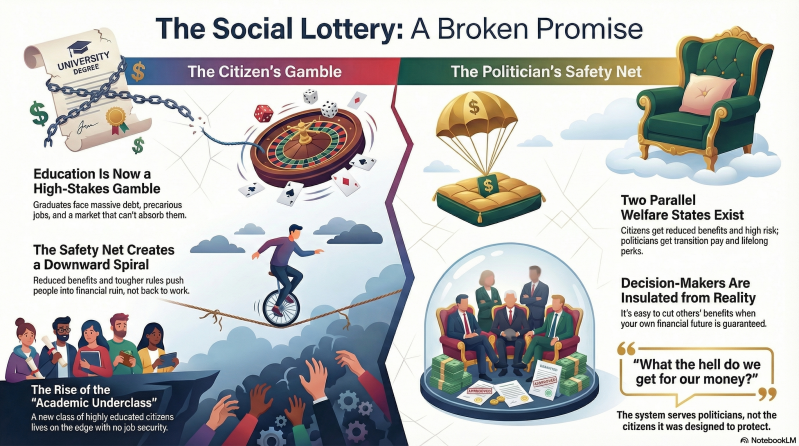
“What the hell do we get for our money?”
Today it feels more uncomfortable than ever. Because the answer no longer looks like security, opportunity, and a social contract. It looks like a system where risk has been pushed downward – and protection upward.

Education – from promise to lottery
There was a time when education was a path to stability.
Not wealth, but independence.
Today, education has become a gamble.
Thousands of people leave universities and colleges with:
• academic degrees
• student debt worth hundreds of thousands
• and a labor market that shrugs its shoulders
They did everything right according to the manual.
Yet there they stand – overqualified, underemployed, or completely shut out.
Here the paradox becomes brutal:
the unemployed today increasingly consist of highly educated people with heavy debt.
Not those who ignored their opportunities.
But those who followed the system’s instructions to the letter.
Education is still marketed as the solution to unemployment.
In reality, it has increasingly become a ticket to a game where the odds are unclear and the stakes enormous.
A safety net that no longer keeps you safe
When people finally fall, they no longer meet a real safety net.
They meet reduced benefits, tougher requirements, and shorter time limits in systems that are still called “security”.
The effect is rarely spoken out loud, but always the same:
people are pushed straight into financial ruin.
When benefits no longer cover rent, bills, and loans, something inevitable happens:
• payments are delayed
• debts accumulate
• credit records are ruined
• doors close
This is no longer a temporary setback in life.
It becomes a downward spiral.
What was once meant to be a bridge back to working life has, for many, become a trap that makes every step back harder.
The new normal: moving backwards in life
For more and more young people, the future now looks like this:
You graduate.
You don’t get a job.
The benefits are not enough.
You can’t afford your rent.
So you do something that should never be part of a modern welfare society:
you give up your first apartment.
you move back home.
not because you want to – but because the system forces you to.
A generation educated for independence is pushed back into dependence.
It is a collective step backwards.
And yet it is still called “responsible policy”.
The academic underclass
Sweden – and much of Europe – is creating something entirely new:
an academic underclass.
People with higher education living on the edge.
Doing everything right – yet never getting a foothold.
Not only lacking jobs, but also lacking the right to real protection when jobs disappear.
It is a historical paradox:
Never before have we had so many educated citizens.
Never before have so many of them been so insecure.
And at the same time:
politicians’ salaries keep rising.
bureaucracies keep expanding.
investigations keep piling up.
The system works – but not for those it was meant to serve.
The state as a gambling house
The rhetoric remains the same:
“Education leads to work.”
But reality looks more like a casino than a labor market.
The difference?
In a casino you know the odds are small.
In the education system you are told that success is almost guaranteed.
Except here the stake is not fifty euros on a lottery ticket.
It is years of life.
Years of study.
Years of debt.
And when you lose, the same state says:
You should have chosen better.
You should have planned more carefully.
As if individuals designed the system.
As if it were the unemployed person’s fault that the labor market no longer works.
Two parallel welfare states
While security is stripped away from ordinary citizens, politics lives in another reality.
Ordinary people face:
• reduced benefits
• tougher conditions
• shorter deadlines
• greater personal risk
Politicians face:
• transition payments
• advisers
• networks
• and in some cases lifelong benefits
Two welfare states, existing side by side in the same country.
And here arises the question more and more people ask – rightly:
Why should politicians receive lifelong compensation after their political careers end?
The old arguments no longer hold
Three classic defenses are usually presented:
1. To attract competent people into politics.
But politics has instead become a career path in itself. When the security after office is greater than the security of voters, something is fundamentally wrong.
2. To protect politicians from financial pressure.
But protection does not have to mean lifelong income. Reasonable transition support is enough. Otherwise, we create a political class living in a completely different economic reality from the citizens.
3. Because politicians sacrifice their private careers.
Yes, politics is demanding. But so are healthcare, education, construction, and social care. The difference is that they receive no lifelong security when their bodies or minds give out.
What incentives does this really create?
When decision-makers enjoy stronger safety nets than the people they govern, three dangerous effects emerge:
First:
Decisions become cheaper for those who make them. It is easier to cut others’ benefits when your own security is guaranteed for life.
Second:
Politics attracts the wrong people. Not civic leaders – but system players. Those who see politics as a career ladder rather than a public mission.
Third:
Distance from reality grows. Anyone who never risks eviction, debt collection, or financial collapse will struggle to understand the consequences of their decisions.
From social contract to social lottery
Once there was a social contract:
You contribute – society provides security.
You educate yourself – society provides opportunity.
Today it looks more like a social lottery:
You bet everything.
Maybe you win.
Maybe you lose.
But the debt is yours either way.
This is not a modern welfare state.
It is a high-risk project for entire generations.
When responsibility shifts from state to individual
In the past we said:
“Society should give people the tools they need.”
Today the message has quietly changed to:
“If you fail, it’s your own fault.”
No job?
You chose the wrong education.
Too much debt?
You should have thought twice before borrowing.
But how can individuals carry responsibility for a system that markets education as the solution to everything – while the labor market can no longer absorb the educated?
Individuals did not build this system.
Politics did.
Expensive politicians – cheap security
We live in a country where decision-makers speak about “adaptation” and “responsibility”.
Yet those same decision-makers enjoy protection systems ordinary people can only dream of.
Golden parachutes.
Special pensions.
Advisers.
Secure career paths.
Meanwhile, citizens are expected to:
• take loans
• take risks
• change careers
• stay flexible
• and now also bear the consequences when security is removed
Here one sentence should matter deeply:
I expect more from the vote I give to a politician. Much more.
Not more slogans.
Not better campaign videos.
But a system that actually holds when life does not.
A more reasonable alternative
Most people have no problem with politicians receiving transition support.
The problem is the level and the duration.
A fair system would follow the same principles as for everyone else:
• time-limited support
• clear requirements for active transition
• no lifelong income at taxpayers’ expense
Politics should be a public service, not a pension scheme.
Final words: the question that can no longer be avoided
So we return to where we began.
To the question that hurts because it is so simple:
What the hell do we get for our money?
Do we get:
• safer lives?
• more stable futures?
• a system that keeps its promises?
Or do we get:
• expensive politicians
• more educated unemployed
• a growing mountain of debt
• and a society where responsibility always flows downward?
When safety systems are cut so deeply that people risk debt records, eviction, and social collapse – that is no longer reform.
That is abdication of responsibility.
And when politicians are simultaneously protected by systems that would never be accepted for ordinary citizens – that is no longer democracy in balance.
That is class division disguised as welfare.
So the question remains, stronger than ever:
What is the real value of my vote – if it no longer buys security, fairness, and a functioning social contract?

By Chris...
Add comment
Comments